

Working in call centers involves constant exposure to noise. Dozens of simultaneous phone conversations create an impossible-to-ignore cacophony of sounds. The noise level often exceeds 75 decibels, approaching the limit set by occupational health and safety regulations. Polyurethane panels provide an effective solution to this problem.
Studies conducted in office environments have shown clear effects of prolonged noise exposure. Constant noise raises the level of cortisol in employees’ bodies. The body reacts to acoustic stress similarly to other threats. Call center operators spend up to eight hours a day in such an environment.
Noise reduction using sound-absorbing materials changes the quality of the workspace. Silence allows better concentration during client calls. Auditory fatigue decreases, and efficiency increases. Properly selected acoustic panels can reduce reverberation by 50 percent.
Main sources of noise in telephone customer service centers
The call center environment is characterized by a particularly high intensity of various sounds. The architecture of open office space promotes the spread of sound waves. Each workstation becomes a source of disturbance for neighboring spots. The lack of natural acoustic barriers intensifies the problem.
Most telephone centers are located in large-volume halls. Hard surfaces on walls and ceilings reflect sound in an unplanned manner. Concrete, glass, and metal act as natural acoustic mirrors. Sound energy circulates around the room for a long time.
Simultaneous conversations of many employees overlapping between workstations
The simultaneous conduct of dozens of phone calls generates the highest noise intensity. Each consultant must raise their voice to be heard clearly. The client on the other end also hears other operators’ conversations. The situation worsens during peak line usage.
The human voice reaches frequencies between 250 and 4000 Hz. This range easily penetrates office space. The average conversation level is about 60 decibels. In call centers, the sum of all voices can exceed 75-80 decibels.
The vocal masking effect causes operators to unconsciously raise their tone. Everyone speaks louder to overcome surrounding noise. The noise spiral grows throughout the workday. Evening shifts tend to be especially loud due to staff fatigue.
A study conducted in 2024 showed dramatic effects of this phenomenon. As many as 89 percent of contact center employees stated that noise reduces their efficiency rates. Additionally, 85 percent waste time repeating information to clients. Communication becomes ineffective, and frustration increases.
Echo in large open office spaces
Large rooms without acoustic partitions create conditions for echo formation. Sound bounces off parallel walls like a ping-pong ball. Reverberation time in untreated spaces can reach 2-3 seconds. Speech becomes unintelligible under such conditions.
High ceilings increase the volume of the room, which extends the reverberation time. Acoustic waves travel vertically between the floor and ceiling. Sound energy lingers in the space for a long time. Each word overlaps the previous one, creating an unintelligible mix.
The resonance phenomenon intensifies in room corners. These points become acoustic traps. Sound accumulates, creating localized noise amplification. Employees sitting near corners suffer the most.
Sounds of keyboards and computer equipment during intense work
The clicking of mechanical keys generates a characteristic background noise. Each operator makes thousands of keystrokes during a shift. The sum of sounds from dozens of workstations creates a continuous hum. The human ear perceives these high frequencies as irritating.
Office equipment adds its own symphony of disturbances. Printers, scanners, and landline phones emit sound signals. Computer cooling fans run continuously. A single device may seem quiet, but the combined effect is significant.
Acoustic stress arises not only from volume but also from the nature of sounds. Irregular, unpredictable noises are more tiring than constant noise. Keyboard clicking is among the most distracting stimuli in the office. The brain cannot get used to it.
Noise from ventilation and air conditioning systems
HVAC installations are a source of continuous low-frequency noise. Fans operate all day without interruption. Ventilation ducts transmit sound between different areas of the building. The rumble can reach 45-55 decibels.
Low frequencies below 250 Hz are particularly difficult to dampen. They penetrate walls and partitions much more easily than high sounds. Vibrations travel through the building structure. Employees experience them as an unpleasant feeling of discomfort.
Old air conditioning systems can be very noisy. Damaged bearings and leaky connections exacerbate the problem. Periodic compressor switching on and off creates additional disturbances. The monotonous hum reduces concentration ability throughout the day.
Sound damping mechanism by polyurethane panels
Polyurethane is one of the most effective sound-absorbing materials. Its cellular structure is designed to convert acoustic energy into heat. This process occurs at the molecular level inside the material. Sound waves lose energy as they pass through foam pores.
The absorption efficiency depends on many material parameters. Foam density, cell size, and panel thickness are crucial factors. A properly selected material can absorb over 80 percent of incident sound. ABM Insulation offers acoustic foams in various configurations.
Open-cell structure absorbing acoustic waves
Open-cell polyurethane foam has a unique internal geometry. Each cell is a dodecahedron shape called a dodecahedron. Walls between cells contain microscopic holes. Air can freely flow through the entire structure.
When a sound wave enters the material, air molecules begin to vibrate. Flow through tight pores generates molecular friction. Kinetic energy is converted into a small amount of heat. This process is called acoustic energy dissipation.
Optimal airflow through the material is key to effectiveness. Foam that is too dense reflects sound instead of absorbing it. Too open a structure does not generate enough friction. Manufacturers balance these parameters for maximum absorption.
Acoustic absorbing foam from ABM Insulation uses advanced production technology. The cell structure has been optimized for human speech frequencies. Panel thickness ranges from 10 to 50 mm. Thicker variants more effectively dampen low frequencies.
Reverberation time reduction improving speech intelligibility
Reverberation time determines how long sound persists in a room. In untreated offices, it can be 2-3 seconds. Installing acoustic panels reduces this time to below 0.8 seconds. The difference is immediately noticeable.
A shorter reverberation means clearer speech. Words do not overlap chaotically. Customers understand the operator better after phone calls. Employees can use a lower voice tone, which reduces overall noise.
Acoustic standards for offices recommend reverberation times below 0.6 seconds. Call centers should aim for even better parameters due to the nature of their work. Installing sound-absorbing materials on 30-40 percent of the surface area is usually sufficient. Strategic placement of panels yields better results than random coverage.
Effectiveness in the range of average human voice frequencies
Human speech focuses on the range of 250-4000 Hz. Polyurethane panels achieve maximum absorption precisely in this band. The absorption coefficient can exceed 0.9 at 1000 Hz frequency. A value of 1.0 would indicate total sound absorption.
Lower frequencies require thicker layers of material. A 20 mm foam effectively dampens sounds above 500 Hz. The 50 mm variants handle frequencies starting from 250 Hz. Thickness selection should consider dominant noise sources.
The profiled surface of the panels increases absorption efficiency. Pyramid or wave shapes enlarge the contact surface with air. Sound reflects multiple times between protrusions before penetrating the material. Each reflection absorbs part of the energy.
Material flexibility minimizing sound reflections
Soft materials do not create hard surfaces that reflect sound. The acoustic wave bends the foam structure upon impact. Mechanical energy transforms into material deformation. Polyurethane’s flexibility enables this process.
Rigid acoustic panels work differently than soft foams. They combine mass with damping, creating a barrier to sound. Foam softness causes it to absorb waves rather than block them. Both mechanisms are used in comprehensive solutions.
Installing foam on hard surfaces yields the best results. Concrete or gypsum provide sound-reflecting substrates. The foam layer captures waves before they reach the wall. The synergy effect increases the overall system effectiveness.
Tip: Before installing panels, perform a simple acoustic test. Clapping your hands reveals spots with particularly strong echoes. The first panels should be installed exactly in those places.
Reducing Auditory Stress in Telephone Operators
Prolonged exposure to noise triggers a stress response in the body. The sympathetic nervous system remains in a heightened state of readiness. The adrenal glands release excessive amounts of cortisol, the stress hormone. The body operates in a constant alarm mode.
Neurological studies show specific mechanisms of this phenomenon. Chronic noise increases heart rate and blood pressure. Sleep disturbances worsen despite fatigue. The immune system weakens under constant stress. Employees fall ill more often and use sick leave more frequently.
A quiet environment produces opposite physiological effects. The body shifts into regeneration and rest mode. The brain activates the neural network responsible for creative thinking. Productivity naturally increases without external pressure.
Reducing Acoustic Fatigue After a Full Workday
The human ear lacks a mechanism to close like eyelids. It continuously receives and processes all incoming sounds. The brain must filter relevant signals from background noise. This process requires enormous mental energy resources.
Acoustic fatigue manifests similarly to general exhaustion. Difficulty concentrating on individual tasks appears. Reactions slow down, and the number of errors increases. In the evening, employees experience severe headaches and drowsiness.
Reducing noise by 10 decibels cuts nervous system strain in half. Such a difference is enough to notice an improvement in well-being. Operators finish their shift with more energy. Recovery after work proceeds faster.
Basic symptoms of auditory fatigue:
- Difficulty understanding speech despite normal hearing function
- Increasing irritability and low tolerance for sound stimuli
- A desire to escape into silence after work
- A feeling of fullness or ringing in the ears
Chronic auditory fatigue leads to more serious health problems. Constant acoustic stress weakens the immune system and increases susceptibility to infections. Sleep disturbances worsen despite feeling exhausted after work. Employees struggle to recover even during weekends and vacations. Family life suffers when the operator needs silence upon returning home. Partners and children do not understand the irritability and withdrawal of their loved one. Noise reduction at the workplace improves the quality of life for the entire employee’s family. Energy regained thanks to a calmer environment allows for active leisure time.
Improving Concentration During Long Client Calls
Every phone conversation requires the operator’s full attention. They need to understand the client’s problem, find a solution, and record details. Background noise complicates all these processes. The employee must repeatedly ask for information to be repeated.
Handling one client in a noisy environment takes significantly longer. Average call time increases by 15-25 percent. Queues lengthen, and customer satisfaction declines. The company loses reputation and revenue.
A quiet office space allows for focus on the conversation. The operator hears every nuance in the client’s voice. They can detect emotions and respond appropriately. Service quality improves, and clients feel valued.
Research has shown a specific impact of silence on cognitive functions. Working in a calm environment enhances the ability to learn and remember. Operators absorb procedures and products more quickly. Training yields better results in quiet rooms.
Reducing cortisol levels through a quiet environment
Cortisol is the primary stress response hormone in the human body. Elevated levels have a range of negative health consequences. It disrupts sleep, weakens memory, and lowers immunity. Prolonged high cortisol leads to professional burnout.
Noise in the workplace constantly raises this hormone’s concentration. The body reacts to every loud sound as a potential threat. A state of chronic stress persists throughout the shift. In the evening, cortisol levels remain high, preventing relaxation.
The introduction of acoustic panels radically changes the situation. Studies have shown a significant decrease in cortisol in quiet work environments. Employees feel calmer and more relaxed. Team atmosphere naturally improves.
The physiological effects of silence also include slowing heart rate and lowering blood pressure. Muscles relax, and breathing becomes deeper. The body shifts into rest and recovery mode. In the long term, this translates into better overall health for the entire team.
Tip: It is worth monitoring sick leave before and after installing acoustic panels. Numerical data document real health benefits for employees.
Strategic placement of panels in call center design
The effectiveness of acoustic materials largely depends on their placement. Random panel placement yields limited results. Professional acoustic analysis identifies key points in the room. The first panels should be placed where problems are greatest.
Optimal surface coverage is 30-50 percent for a typical call center. Higher panel density does not always mean better acoustics. Distribution within the space is more important. Combining different types of sound-absorbing materials increases effectiveness.
| Room Element | Recommended Coverage | Material Type | Main Acoustic Effect |
|---|---|---|---|
| Ceiling | 40-60% | Absorbing Panels | Reverberation Reduction |
| Partitions Between Workstations | 70-80% | Foam Partitions | Horizontal Insulation |
| Main Walls | 20-30% | Decorative Panels | Echo Control |
| Corners | 100% | Bass Absorbers | Resonance Elimination |
Acoustic measurements after installation confirm the effectiveness of the applied solution. A specialist uses a sound level meter to assess the reverberation time at various points in the room. The standard for open space offices recommends a value below 0.6 seconds. Call centers should achieve even better parameters around 0.4 to 0.5 seconds. Potential problematic areas require additional panels in strategic locations. Regular inspections every six months check whether the materials maintain their properties.
Phased installation allows for observing effects and adjusting plans. The first stage covers areas with the highest noise levels. The team evaluates changes over two weeks before the next installation. Gradual implementation minimizes operational disruptions and allows budget optimization. Employees can provide feedback and suggestions during the process. Their experiences help select the best solutions for other zones. A participatory approach increases acceptance of changes and satisfaction with the final result.
Installation on partition walls between workstations
Low partitions between desks form the first line of defense against noise. Partitions 120-150 cm high significantly reduce voice transmission. Covering them with acoustic foam increases effectiveness by an additional 30 percent. Each operator gains their own acoustic zone.
The material used on partitions should be at least 20 mm thick. Thinner layers do not provide sufficient absorption. Pyramid or wave-shaped foam performs better than flat foam. The additional surface area absorbs more sound energy.
The arrangement of partitions requires a thoughtful strategy. Too dense construction creates a claustrophobic feeling. Too sparse does not fulfill the acoustic function. The optimal solution considers people flow and work ergonomics.
Materials for partition walls:
- Self-adhesive ABM Insulation acoustic foam 20-30 mm thick
- Textile panels filled with mineral fiber
- High-density wood wool boards
The colors and patterns of partitions can support identification of different departments or teams. Light shades of foam brighten the space and improve employee well-being. Darker colors absorb light and may cause gloominess. Neutral grays or beiges are a universal choice fitting most interiors. The manufacturer ABM Insulation offers foams in a dozen colors tailored to customer needs. The modular design of partitions enables easy rearrangement of workstation layouts. Changing work organization does not require purchasing new acoustic materials. Partitions can be moved or added according to current team requirements. Flexibility in arrangement ensures that the investment serves for years despite operational changes.
Application on suspended ceilings above desks
The ceiling is the largest uninterrupted surface in the room. Covering it with sound-absorbing material brings dramatic acoustic improvement. Ceiling panels absorb sound before it reflects downward. The effect is immediately noticeable throughout the space.
Suspended ceiling systems facilitate mounting acoustic panels. Standard frames can be filled with foam or mineral fiber. The lightness of polyurethane means that the supporting structure does not require reinforcement. Installation proceeds quickly without disrupting work.
The placement of panels on the ceiling should take into account light sources. LED lamps can be integrated with the acoustic system. Some cassettes are replaced by panels, others by lighting fixtures. Combining lighting and acoustic functionality saves space.
The density of placement depends on the ceiling height. Low rooms below 2.8 meters require greater coverage. High halls above 3.5 meters allow for sparser placement. At least 40 percent of the surface should always be covered.
Decorative panels dividing space into smaller zones
The office aesthetic matters for employee well-being. Acoustic panels can be an attractive design element. Various colors, shapes, and patterns are available. Designer solutions combine functionality with appearance.
Freestanding acoustic screens divide a large room into more intimate zones. They create a sense of privacy without building permanent walls. The mobility of such partitions allows for flexible arrangement. The layout can be modified according to changing needs.
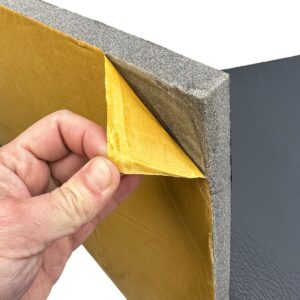
ABM Insulation acoustic foam is available in a self-adhesive version. Installation does not require drilling or specialized tools. Simply clean the surface and stick the panel on. Removal is also hassle-free during relocations.
The color scheme of panels can support the identification of functional zones. Green panels indicate quiet work areas. Blue ones designate team meeting areas. The color system facilitates orientation within the space.
Acoustic corner insulation eliminating resonance points
Room corners are natural traps for low frequencies. Sound waves accumulate at these points, creating unpleasant reverberation. Standard flat panels handle this problem poorly. Special corner absorbers are necessary.
Triangular corner fillings often extend from floor to ceiling. Their large volume absorbs bass waves more effectively than thin panels. Installing them in the four corners of a room can reduce low-frequency reverberation by 60 percent.
The absorber material should be dense and thicker than standard panels. The minimum effective wall thickness is 50 mm. The manufacturer ABM Insulation offers foams with appropriate parameters. Installation requires solid anchors or supporting frames.
The effect of using corner absorbers is especially noticeable in cubic rooms. Square or rectangular halls generate stronger resonances. Irregularly shaped rooms are naturally acoustically more favorable.
Tip: A clap test in the corner before and after absorber installation reveals the difference. The sound should be short and dull, without characteristic ringing.
Polyurethane acoustic foams and panels at ABM Insulation store
Soundproofing a call center requires selecting high-quality acoustic materials. ABM Insulation Store specializes in professional sound-absorbing solutions. The assortment includes foams absorbing sound with various parameters and thicknesses. Every product has passed quality tests confirming sound absorption effectiveness.
The company supplies acoustic materials to customers throughout Poland. Experience from over 40,000 projects guarantees proven product quality. All foams are available immediately from stock. Fast shipping ensures installation can begin within a few days.
Acoustic foams absorbing noise in various configurations
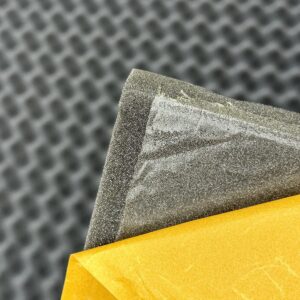
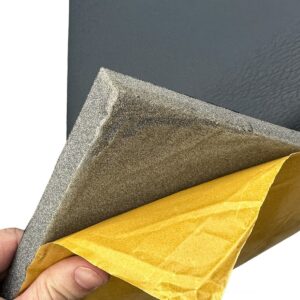
Acoustic foams available in the ABM Insulation store effectively reduce reverberation in office spaces. The open-cell structure absorbs sound waves within the frequency range of the human voice. Panel thickness ranges from 10 to 50 millimeters. Thinner variants are suitable for partitions between workstations. Thicker models are mounted on main walls and ceilings.
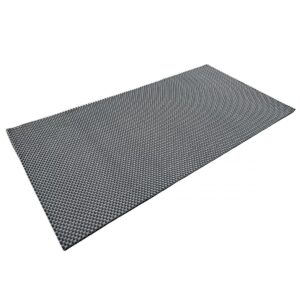
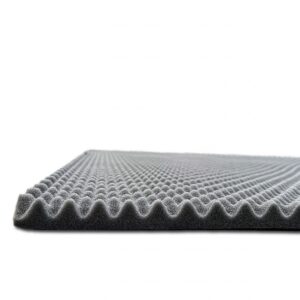
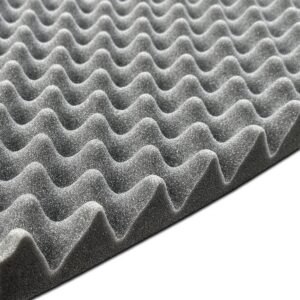
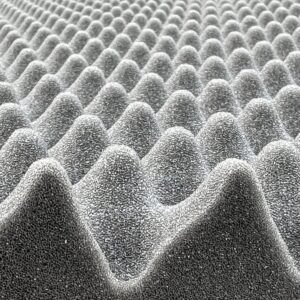
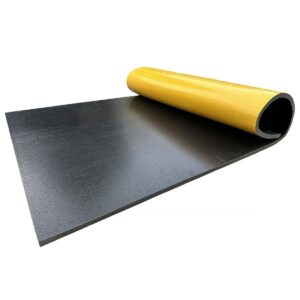
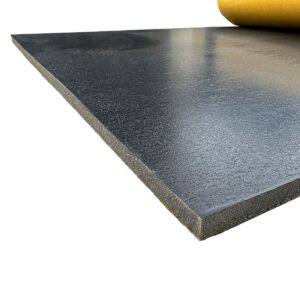
The foam surface is available in flat or profiled versions. Pyramid shapes increase absorption efficiency by 20 percent. Colors include grays, blacks, beiges, and vibrant shades. Each foam has a self-adhesive layer to facilitate installation. The flame-retardant structure meets fire safety standards.
Available surface profiling types:
- Pyramids with varying protrusion heights
- Waves enhancing interior aesthetics
- Flat surface for universal applications
Comprehensive acoustic solutions for office spaces
ABM Insulation specializes in materials for soundproofing various types of rooms. Besides acoustic foams, the assortment includes butyl mats. Products ABM Professional and ABM Xtreme are used for vibration insulation. Rubber foam eliminates sounds penetrating through building structures.
Each material is designed for a specific acoustic application. Combining different types of insulation yields the best results. Store specialists advise on selecting the optimal product configuration. Many years of experience translate into accurate recommendations for customers.
Technical support and professional advice
The ABM Insulation team provides free consultations before purchase. Customers receive assistance calculating the required amount of material. Advisors answer questions regarding installation and maintenance. A five-year warranty confirms the high quality of offered products.
Orders can be placed via the website or by phone. Fulfillment occurs within 24 to 48 hours after confirmation. The company cooperates with professional installation teams throughout the country. Comprehensive service includes delivery, advice, and after-sales support.
Contact ABM Insulation to get a personalized quote for acoustic materials. The advisory team will help select the optimal solution for your call center. Order products today and improve your employees’ work comfort.
Benefits for work efficiency and team health
Investing in acoustics brings tangible financial benefits to the organization. Higher employee productivity directly translates into revenue. Serving more customers simultaneously increases efficiency. The cost of installing panels pays off within a few months.
Team health is a value harder to measure but equally important. Fewer sick leaves reduce replacement costs. Employee loyalty grows in a comfortable environment. Recruitment becomes easier when the company has a good reputation.
Compliance with occupational health and safety standards is every employer’s obligation. Exceeding permissible noise limits can result in penalties. Prevention is cheaper than later legal consequences. Proper acoustics protect against inspection issues.
Productivity increase measured by the number of handled calls
A study conducted in American contact centers showed specific figures. Reducing noise by 10 decibels increases the number of handled calls by 12 percent. Operators spend less time on explanations and repetitions. Conversations are shorter but more effective.
Service quality rises alongside the number of calls. Customer satisfaction measured in surveys improves by 18 percent. Fewer complaints and requests for escalation to supervisors. Positive reviews on social media increase.
Teams working in quieter conditions demonstrate higher creativity. They handle non-standard customer problems better. Proactive problem-solving replaces reactive actions. The company builds a competitive advantage based on service quality.
Measurable productivity improvement indicators:
- Average call handling time reduced by 15-20 percent
- Number of served customers increased by 12-18 percent
- Customer satisfaction improved by 15-20 NPS points
- First-contact resolution rate increased by 10 percent
The efficiency increase directly impacts the entire organization’s financial results. A call center handling 15 percent more calls generates proportionally higher revenue. Operating costs remain at a similar level, and profit margin grows. Investment in acoustic panels pays off on average within four to six months. CFOs appreciate the quick return on investment with long-term benefits. Higher customer satisfaction rates lead to increased loyalty and repeat purchases. Customers satisfied with service are less likely to cancel company services. The lifetime value of a single customer rises thanks to better communication. The company’s market competitiveness improves without the need to lower prices.
Reduction of Sick Leave Caused by Stress
Burnout affects about 60 percent of call center employees. Staff turnover averages 30-45 percent annually, reaching as high as 60 percent in some sectors. Noise is one of the main factors contributing to this phenomenon. Chronic stress leads to somatic illnesses.
Improving acoustic conditions reduces sick leave by 20-30 percent. Employees suffer less from headaches and sleep disorders. The immune system functions better in a quieter environment. Fewer colds and infections occur during the fall-winter season.
Mental health also benefits from noise reduction. Anxiety and depression levels decrease among operators. Team relationships improve when people are less stressed. Conflicts occur less frequently in a calm atmosphere.
In the long term, the company saves on costs related to turnover. Training a new employee costs an average of 3-4 months’ salary (€750-€1,000). Retaining an experienced team translates into better service quality. Investing in acoustic comfort pays off multiple times.
Compliance with Workplace Noise Exposure Standards
Polish occupational health and safety regulations set clear limits on noise exposure. The maximum allowable level for an eight-hour workday is 85 decibels. For pregnant women, the limit is significantly lower at 65 decibels. Exceeding these standards requires corrective actions.
The National Labor Inspectorate monitors compliance with regulations. Penalties for violations can be financially severe. Employers must provide hearing protection above 80 decibels. Noise zone signage becomes mandatory.
Acoustic measurements should be conducted regularly. A certified specialist performs tests using a sound level meter. Documentation must be stored and available during inspections. Preventive measures protect against legal issues.
Employer obligations when standards are exceeded:
- Limiting working time in noisy environments
- Providing employees with effective hearing protectors
- Marking and restricting access to excessive noise zones
- Regular audiometric testing of employees
- Implementing a noise reduction program at the source
Proper office acoustics are part of human resource management strategy. Employers investing in noise reduction build a reputation as responsible employers. Job candidates pay attention to environmental conditions offered by the company. A comfortable office becomes a recruitment advantage in a competitive market. Employees have the right to report excessive noise to the occupational health and safety inspector. Ignoring complaints may result in inspections by external supervisory bodies. A proactive approach to acoustics prevents conflicts and builds team trust. Investing in sound-absorbing panels protects employee health while minimizing legal risks.
Long-Term Durability of Panels in Heavily Used Rooms
Polyurethane foam is characterized by high resistance to environmental factors. It does not degrade due to moisture or temperature fluctuations. The material retains its acoustic properties for many years of use. The investment is long-term.
Resistance to dirt makes it easier to keep the office clean. Dust does not penetrate deeply into the foam structure. Regular vacuuming is enough to maintain aesthetics. The material’s flame retardancy increases fire safety.
The manufacturer ABM Insulation provides a five-year warranty on its products. The materials have passed quality tests confirming the declared parameters. Over 40,000 applications worldwide confirm reliability. Customers appreciate the combination of quality and durability.
Panel maintenance is minimal and inexpensive. They do not require special treatments or impregnation. Mechanical damage is rare due to the material’s flexibility. Any replacement of individual elements is simple and cheap.
Tip: When choosing panels, pay attention to flame retardancy certificates. Fire reaction class B-s2, d0 is suitable for public utility buildings.
FAQ: Frequently Asked Questions
How quickly can effects be noticed after installing polyurethane panels in a call center?
The change in acoustic quality is noticeable immediately after panel installation. The first differences can be heard during the mounting of subsequent elements. Reverberation gradually decreases, and conversations become clearer. Operators notice improved concentration on the very first day. Background noise drops by an average of 8 to 12 decibels.
The full effects reveal themselves after a week of regular work. The team gets used to the new sound environment. The average length of phone calls shortens by 15 percent. Customers stop complaining about background noise. Operator fatigue noticeably decreases by the end of the shift. Sick leave may decrease after a month of use.
Long-term benefits accumulate over the first three months. Team productivity steadily increases. Employee turnover decreases as comfort improves. The investment pays off on average after four months of work.
Do acoustic panels require specialized maintenance and how should they be cleaned?
Polyurethane foam does not require complicated care or special treatments. Regular vacuuming with a soft brush is sufficient to keep it clean. Dust does not penetrate deeply into the material structure. A vacuum cleaner with a gentle nozzle removes surface contaminants. Cleaning every two weeks maintains the panels’ aesthetic appearance.
Maintenance procedures include:
- Vacuuming with a soft brush every 10 to 14 days
- Airing the room to reduce dust
- Avoiding moisture and direct sunlight
- Checking fastenings every six months
Deeper cleaning is performed once or twice a year. A light disinfectant spray removes bacteria without damaging the material. The product should be tested on a small area before use. The manufacturer ABM Insulation recommends mild agents without aggressive chemicals. The foam retains acoustic properties for many years with minimal maintenance.
What thickness of polyurethane panels should be chosen for effective noise reduction?
The thickness of the material determines the range of absorbed sound frequencies. 20-millimeter panels effectively dampen high and mid tones. The human voice ranges from 250 to 4000 Hz. Such panels are sufficient for most office applications. The price is proportional to the material thickness.
Variants from 30 to 50 millimeters also absorb low frequencies. The rumble of ventilation systems requires thicker layers. Acoustic corners should be at least 50 millimeters thick. Ceiling installations often use 30-millimeter panels. Partition walls between workstations are well filled with foam from 20 to 30 millimeters.
Thickness selection according to application:
- Desk partitions: 20 to 30 mm
- Ceiling panels: 25 to 40 mm
- Main walls: 30 to 50 mm
- Corner absorbers: 50 mm and above
Combining different thicknesses in one room yields the best results. The combination absorbs a wide range of acoustic frequencies. An acoustic consultant will help select the optimal configuration for a specific space.
Does installing acoustic panels require renovation or structural intervention in the building?
Installing polyurethane foam does not damage the building structure nor require construction work. Self-adhesive panel versions are mounted directly on a clean surface. Acrylic glue holds firmly for years of use. Removal usually occurs without wall damage in most cases. This solution is ideal for rented offices.
Mechanical mounting uses lightweight aluminum or plastic frames. A click-in system installed into a suspended ceiling can be set up in minutes. There is no need to drill holes in concrete or drywall. The flexibility of the solution allows later space reorganization. Freestanding partitions require no wall attachment.
The work can be done in the evening or on weekends without disrupting company operations. Installing 100 square meters of panels takes one working day for two people. Operational downtime is minimal or zero. Employees return to a soundproofed office the next morning.
What percentage of the room surface should be covered with acoustic panels?
The standard coverage for call centers is 40 to 50 percent of the total wall and ceiling surface area. More material does not always mean better acoustics. Panel distribution matters more than quantity. Strategic placement yields better results than chaotic clustering.
Recommended coverage by element:
- Ceiling above workstations: 45 percent
- Walls between desks: 70 percent
- Perimeter walls: 25 percent
- Room corners: 100 percent
A professional acoustic analysis indicates optimal panel installation locations. Measuring reverberation time before and after installation documents effectiveness. The target time should be 0.4 to 0.6 seconds for call center rooms. Sometimes, 30 percent coverage with intelligent placement is sufficient. Excess material can create an overly muffled environment, which also tires hearing. Balancing absorption with natural acoustics is key for work comfort.
Summary
Noise reduction in call centers benefits all parties involved. Employees enjoy better health and less stress. Customers receive more efficient and pleasant service. The company increases productivity and saves on costs related to turnover.
Polyurethane panels provide an effective and economical solution to acoustic problems. Their cellular structure absorbs sound within the frequency range of the human voice. Strategic placement of sound-absorbing materials completely changes the office atmosphere. The investment pays off within a few months thanks to improved efficiency.
Compliance with occupational health and safety standards protects the employer from legal consequences. Attention to acoustic comfort builds a positive company image. Recruitment becomes easier when the workplace has a good reputation. The long-term durability of the materials guarantees benefits for many years of use.
Sources:
- https://www.sciencedirect.com/science/article/pii/S1876610215029100
- https://acoustics.ippt.pan.pl/index.php/aa/article/view/2141
- https://bibliotekanauki.pl/articles/178030
- https://pmc.ncbi.nlm.nih.gov/articles/PMC10650689/
- https://www.pip.gov.pl/dla-pracodawcow/porady-prawne/halas?tmpl=pdf%3Ftmpl%3Dpdf
