

Effective soundproofing of a car is a key element of driving comfort. Noise from outside, vibrations of the metal, and booming can significantly reduce the quality of travel. Butyl mats are one of the most effective solutions for acoustic insulation in the automotive industry.
The technical parameters of soundproofing material determine its damping properties. The thickness and density of the butyl mat directly affect its ability to absorb sound and reduce vibrations. Each of these parameters plays a different role in the process of acoustic insulation of the vehicle.
The choice of the appropriate material specification requires an understanding of noise damping mechanisms. A mat that is too thin will not provide sufficient acoustic protection. At the same time, excessive thickness may complicate installation and increase the weight of the vehicle. Understanding the relationship between technical parameters and soundproofing effectiveness allows for informed selection of insulation materials.
Basic technical parameters of butyl mats affecting soundproofing
The effectiveness of soundproofing material is defined by specific technical values. The mechanical loss factor, surface weight, and operating temperature range are fundamental indicators for assessing the quality of the mat. Manufacturers provide this data in product specifications, enabling comparison of different solutions.
Materials available on the market differ in parameters depending on their intended use. Mats for basic applications have different characteristics than premium class products. Knowledge of these differences allows for optimal selection of insulation to meet specific user needs.
The importance of the mechanical loss factor MLF in noise reduction
The MLF factor (Mechanical Loss Factor) defines a material’s ability to convert vibration energy into heat. The higher this parameter’s value, the more effectively the mat dampens body panel vibrations. Materials with a low MLF factor allow most acoustic energy to pass through without absorption.
Professional butyl mats achieve MLF values ranging from 0.31 to 0.54. In comparison, basic products have a coefficient of about 0.2. ABM Professional Butyl Mat exhibits an MLF damping factor of 0.38, ensuring effective vibration absorption.
A high MLF factor translates into a real reduction in noise measured in decibels. Materials with an MLF above 0.3 can reduce sound levels by 3 to 5 dB. Such a difference is clearly felt by passengers in the vehicle.
The surface weight of the mat and its effectiveness in sound absorption
The density of the material, expressed as mass per square meter, directly affects acoustic insulation. Butyl mats available on the market have a surface weight ranging from 2.1 to 4.8 kg/m². Products with higher density block low-frequency sounds more effectively.
Characteristic density ranges for butyl mats:
- Light mats with a thickness of 1.5 mm achieve a density of about 2.1 kg/m²
- Standard products at 2 mm feature a mass of 3.3 to 3.4 kg/m²
- Thicker mats at 2.5 mm reach a density of 3.4 to 3.9 kg/m²
- The heaviest products at 3 mm have a surface weight of up to 4.8 kg/m²
An increase in density by 1 kg/m² can improve insulation by about 2 decibels. However, it is important to maintain a balance between effectiveness and the total mass of the vehicle. Excessive load negatively affects fuel consumption and driving dynamics.
The optimal range for most automotive applications is between 3.0 and 4.0 kg/m². This density provides effective soundproofing without significantly increasing the weight of the car. Materials with a density below 2.5 kg/m² are only suitable for less demanding locations.
Operating temperature range and its impact on acoustic properties
Thermal conditions in the vehicle vary significantly depending on the season. In summer, temperatures under the hood can exceed 100°C, while in winter, some body elements reach negative values. Butyl mats must maintain flexibility and damping properties over a wide temperature range.
Professional materials function effectively in the range from minus 40°C to plus 170°C. Basic products have a limited range from minus 30°C to plus 70°C. Exceeding these limits results in loss of flexibility or excessive softening of the material.
Thermal stability affects the durability of acoustic insulation. Low-quality materials lose their damping properties after several cycles of heating and cooling. ABM Insulation butyl mats retain their parameters throughout the entire lifespan of the vehicle.
The relationship between butyl layer thickness and decibel reduction level
Mats thickness is a key parameter affecting soundproofing effectiveness. Materials available on the market range from 1.3 to 5 mm in thickness. Each additional layer of butyl improves acoustic energy absorption, but also impacts the flexibility of the material.
The relationship between thickness and noise reduction is not linear. Doubling the thickness does not mean doubling effectiveness. There is an optimal point beyond which further increases in thickness yield minimal acoustic benefits.
Comparison of effectiveness for mats ranging from 1.8 mm to 5 mm thick
Research shows differences in damping efficiency for various material thicknesses. A mat measuring 1.8 mm is considered a basic standard in automotive applications. Its MLF coefficient is approximately 0.31, providing noise reduction at levels between 2 to 3 dB.
Increasing thickness to 2 mm improves acoustic parameters by about 0.5 dB. This size is regarded as an optimal compromise between effectiveness and weight. The material maintains good flexibility and does not hinder installation in hard-to-reach places.
Mats with a thickness of 2.5 mm exhibit significantly better damping of low frequencies. Noise reduction increases to up to 4 dB in the range from 50 to 200 Hz. Increased surface mass more effectively blocks rumbling generated by the engine and exhaust system.
Premium products with a thickness of 3 mm achieve an MLF rating of 0.54. Noise attenuation across the entire frequency range improves by 5 to 6 dB compared to standard mats. This material is effective in professional audio installations and in soundproofing commercial vehicles.
Thicker mats of 4 to 5 mm are used in specific locations. Their installation requires more space, which limits their application to flat surfaces. Acoustic effectiveness increases slightly compared to 3 mm products.
Optimal thickness for different areas of the vehicle body
Each part of the vehicle requires a different approach to acoustic insulation. The floor and center tunnel are exposed to noise from the engine and exhaust system. A thickness of 2.5 to 3 mm provides the best damping in this area.
Recommended mat thicknesses for individual body elements:
- Doors and side panels: 1.8 to 2 mm due to limited space and the need to maintain lightness
- Engine hood: 2.5 to 3 mm for effective blocking of high temperatures and mechanical noise
- Car roof: 2 to 2.5 mm as a compromise between wind noise reduction and weight
- Trunk lid: 1.8 to 2 mm for sufficient insulation without overloading the hinges
- Wheel arches: 3 to 4 mm due to strong vibrations and noise from the surface
The use of different thicknesses depending on location optimizes the final result. This approach allows for maximum effectiveness with controlled increases in vehicle weight. Professional installations use between two and four different thicknesses of material.
The impact of thickness on flexibility and ease of material installation
Thinner mats are characterized by better flexibility and adapt more easily to complex shapes. The 1.8 mm material can be installed in technical openings of doors and on rounded surfaces. It does not require heating or special tools for shaping.
A mat with a thickness of 2 mm retains high flexibility with improved acoustic properties. It can be stretched and adjusted without the risk of cracking. Installation in most areas of the vehicle proceeds without difficulty.
Products thicker than 2.5 to 3 mm require more attention during installation. The stiffer material adheres less effectively to small recesses. Heating the surface may be necessary before application on strongly curved elements.
Mats above 3 mm are recommended only for flat or slightly curved areas. Installation on complex shapes may lead to inaccurate adhesion and air bubbles forming. Such areas require the use of thinner products.
Scientific studies on the relationship between thickness and sound wave damping
The Society of Automotive Engineers (SAE) conducted studies on the effectiveness of butyl mats. The results show a noise reduction coefficient (NRC) ranging from 0.65 to 0.75. These values confirm the high efficiency of butyl materials in blocking sounds and absorbing vibrations.
An analysis of the impact of thickness on damping showed the greatest improvement in the range from 1.8 to 2.5 mm. Each additional millimeter of material increased reduction by about 1 dB. Above 3 mm, the increase in effectiveness clearly decreased, reaching only 0.3 dB per millimeter.
Frequency studies showed differences in damping characteristics. Thicker mats effectively blocked low frequencies from 50 to 300 Hz. High sounds above 1000 Hz were equally well dampened by materials of varying thickness. Density and the MLF coefficient played a key role there.
Tip: For optimal soundproofing of a standard passenger car, use a 2 mm mat on the doors and ceiling, and 2.5 to 3 mm on the floor and in the trunk. This combination will provide effective insulation with a moderate increase in vehicle weight.
The Role of Material Density in Blocking Low and High Frequency Sounds
The density of butyl mats determines their mass relative to volume. This parameter critically affects the ability to block acoustic waves of various frequencies. Higher density materials offer greater resistance to sound propagation.
The physics of acoustics indicates a direct relationship between the mass of a barrier and the insulation of airborne sounds. Increasing density by 50% improves low frequency damping by about 3 dB. This effect is particularly noticeable in the range from 50 to 250 Hz, where rumbling and engine noise are generated.
Characteristics of Mats with Different Densities
The market offers butyl mats in a wide range of densities. Basic products with a mass of 2.1 kg/m² represent an economical solution for less demanding applications. They effectively dampen medium and high frequency sounds but have limited effectiveness against rumbling.
| Mat Density | Thickness | Application | Noise Reduction |
|---|---|---|---|
| 2.1 kg/m² | 1.5 mm | Doors, trunk lid | 2-3 dB |
| 3.3-3.4 kg/m² | 2 mm | Universal applications | 3-4 dB |
| 3.9 kg/m² | 2.5 mm | Floor, center tunnel | 4-5 dB |
| 4.8 kg/m² | 3 mm | Professional installations | 5-6 dB |
Mats with a density of 3.3 kg/m² represent the standard for most automotive applications. They provide balanced acoustic properties across the entire frequency spectrum. This material is used by professional workshops specializing in vehicle soundproofing.
Premium products achieve a density of 4.8 kg/m² with a thickness of 3 mm. This specification guarantees the highest damping effectiveness available on the market. It is used in luxury vehicles and high-end car audio installations.
The impact of density on vibration and panel vibration reduction
Body panel vibrations are the main source of noise inside the vehicle. Acoustic waves from outside and the engine excite panel vibrations, which transform into audible sound. The mass of the butyl mat dampens these resonances by increasing surface inertia.
Higher density materials absorb mechanical vibration energy more effectively. A mat weighing 4.8 kg/m² reduces vibration amplitude by about 60% compared to uninsulated metal. Lighter products at 2.1 kg/m² achieve a reduction of 35 to 40%.
The effectiveness of vibration damping also depends on the degree of surface coverage. Even a dense mat applied only to 50% of the panel will not provide optimal results. The best effects are achieved with coverage of 70 to 90% of the area prone to resonance.
Tip: When soundproofing doors, use a mat with a minimum density of 3.3 kg/m² on the inner side of the outer panel. Cover at least 70% of the surface, focusing on the largest flat areas most susceptible to vibrations.
The composite structure of butyl mats and its significance for acoustic insulation
The effectiveness of soundproofing material stems from its layered construction. Butyl mats consist of several elements serving different acoustic functions. Each layer contributes to the final noise damping effect.
A typical structure includes a layer of butyl rubber, aluminum foil, and a self-adhesive mounting layer. The thickness of each element affects the acoustic characteristics of the entire composite. Manufacturers optimize proportions to achieve the best properties while controlling weight.
The function of the aluminum foil layer in reflecting sound waves
Aluminum foil serves as the outer layer of the butyl mat. Its thickness ranges from 50 to 150 micrometers depending on product class. This layer performs several important functions beyond just acoustic insulation.
Aluminum reflects high-frequency sound waves, preventing them from penetrating through the material. This effect is particularly noticeable for sounds above 2000 Hz. Thicker foil, ranging from 100 to 150 micrometers, provides better acoustic barrier than thinner variants.
Additionally, the aluminum layer provides thermal insulation. It reflects thermal radiation from the engine and road surface. This function protects the vehicle’s interior from excessive heating in summer.
Energy Absorption Mechanism of Butyl Rubber Layer
Butyl rubber forms the core of the mat and is the main element responsible for vibration damping. This material is characterized by a high internal damping coefficient. The mechanical energy of vibrations is converted into heat within the polymer structure.
This process is known as viscous damping. The rubber molecules move relative to each other during vibrations, generating internal friction. The thicker the butyl layer, the more energy can be dissipated.
Acoustic Energy Absorption Mechanisms in Butyl Mat:
- Internal friction in the polymer structure converts mechanical energy into heat
- The mass inertia of the butyl layer counteracts body panel vibrations
- Elastic deformations of the material absorb a wide spectrum of frequencies
- The composite structure creates a barrier for acoustic waves traveling through the air
Pure butyl without asphalt retains flexibility over a wide temperature range. Low-quality materials containing asphalt become stiff in cold weather and excessively soften in heat. This leads to a deterioration of damping properties and a risk of mat detachment.
Cooperation of Butyl Mats with Acoustic Foams
A comprehensive soundproofing solution for vehicles requires the use of several types of materials. Butyl mats dampen vibrations and block low frequencies. Supplementing insulation with acoustic foams improves effectiveness in the mid and high tones range.
The foam applied on the butyl mat absorbs acoustic waves traveling through space. The cellular structure of the material converts sound energy into heat. A two-layer system achieves noise reduction of 8 to 12 dB, while the mat alone provides 4 to 6 dB.
The optimal thickness for acoustic foam is 5 to 10 mm for most applications. Thinner layers do not provide sufficient absorption, while thicker ones increase mass without proportional improvement in effect. Rubber foam additionally provides thermal insulation and moisture protection.
Tip: First apply the butyl mat to a clean, degreased sheet metal, pressing it down with a roller or hand. After 24 hours, stick the acoustic foam onto it, keeping joints between sheets without gaps for maximum insulation effectiveness.
Butyl Mats at ABM Insulation Store
ABM Insulation Store specializes in the production and distribution of sounding materials of the highest quality. The company has been operating in the market since 2010, gaining trust from customers in Poland and many European countries. The assortment includes professional insulation solutions designed for soundproofing vehicles, machines, and buildings.
Butyl mats available in the offer feature various technical parameters. This allows for the material to be tailored to specific acoustic requirements. Each product undergoes quality control and has certificates confirming its insulation effectiveness.
ABM Professional Series for Universal Applications
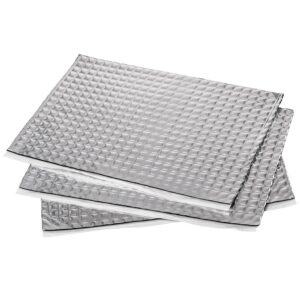
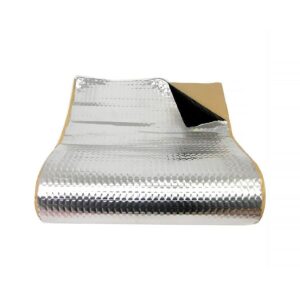
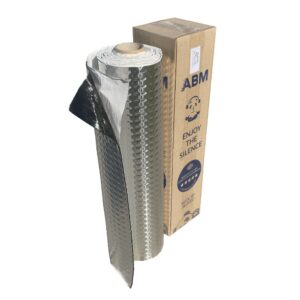
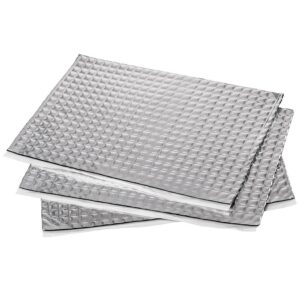
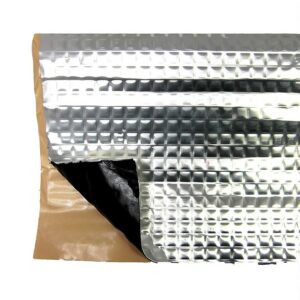
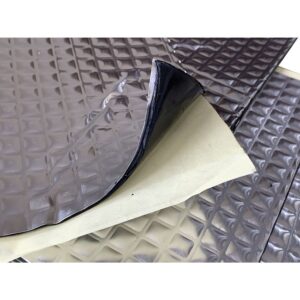
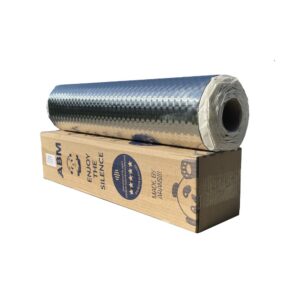
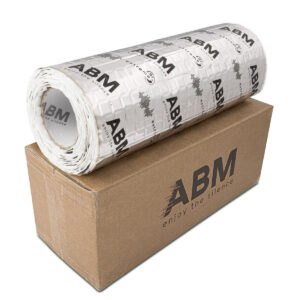
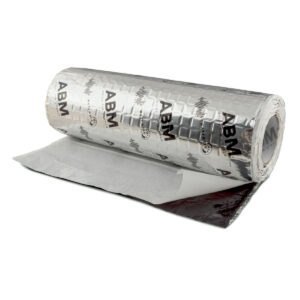
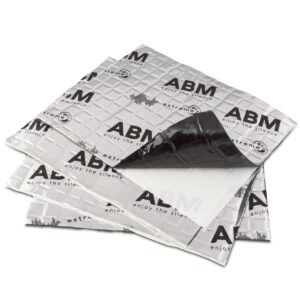
ABM Professional Butyl Mats provide a solution for demanding acoustic applications. The products are available in various thicknesses from 1.5 to 3 mm, allowing for optimization of insulation for specific areas of the bodywork. The MLF damping coefficient of 0.38 ensures effective vibration absorption and noise reduction.
Technical Parameters of the Professional Series:
- Operating temperature range from minus 50°C to plus 150°C guarantees stability throughout the year
- Material density from 2.1 to 4.8 kg/m² depending on the thickness of the butyl layer
- Aluminum foil layer with a thickness of 100 micrometers provides additional thermal insulation
- Self-adhesive structure facilitates installation and ensures durable adhesion to metal
The materials in the Professional series are effective in soundproofing doors, floors, ceilings, and trunks. Pure butyl without asphalt maintains flexibility and damping properties regardless of weather conditions. The products can be combined with acoustic foams for comprehensive insulation.
ABM Xtreme Series for Extreme Conditions
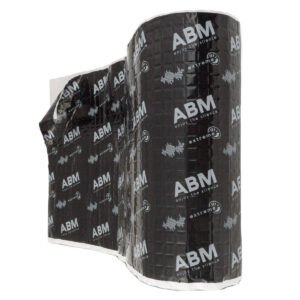
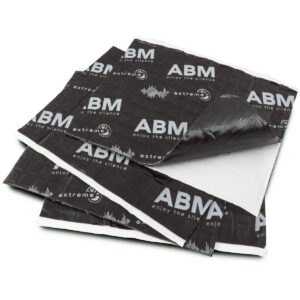
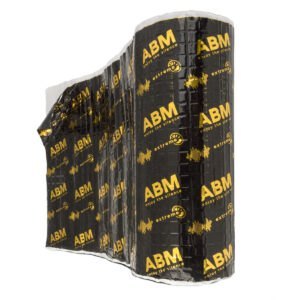
ABM Xtreme Butyl Mats are designed for the most demanding acoustic applications. This series features a reinforced structure and increased thickness of the damping layer. The materials maintain their parameters in extreme temperatures from minus 55°C to plus 170°C.
Xtreme products utilize advanced manufacturing technology for maximum effectiveness. The damping coefficient exceeds standard mat values, providing top-level vibration reduction. This series is used in professional car audio installations and soundproofing commercial vehicles.



Experience and Technical Support from ABM Insulation
The Company ABM Insulation provides comprehensive consulting when selecting insulation materials. A team of specialists assists in choosing the optimal thickness and density of mats for specific vehicles. Fast order fulfillment within 24 hours enables efficient soundproofing work.
The manufacturer guarantees the highest quality of materials and their acoustic effectiveness. All products have safety certificates and are environmentally friendly. Delivery covers all of Poland and countries in the European Union, ensuring access to professional insulation solutions.
Contact the customer service department of ABM Insulation for detailed consultation and assistance in selecting the appropriate butyl mats. Order products through the online store and see for yourself the effectiveness of professional acoustic insulation.
Practical performance indicators of soundproofing depending on mat parameters
Assessing the effectiveness of insulation materials requires analysis of actual acoustic measurements. Noise reduction measured in decibels serves as an objective indicator of soundproofing efficiency. The technical parameters of the mat translate into specific values that improve acoustic comfort.
Professional measurements are conducted with a sound level meter before and after applying the materials. The difference in readings shows the actual effectiveness of the solution applied. These values depend on the thickness of the mat, density, coverage area, and location within the vehicle.
Noise reduction measurements in decibels for mats with different specifications
Laboratory studies and field tests provide data on the effectiveness of individual products. A basic 1.8 mm mat with a density of 2.1 kg/m² reduces noise by 2 to 3 dB. This effect is barely noticeable to most users.
Standard products 2 mm with a density of 3.3 kg/m² achieve a reduction of 3 to 4 dB. This difference is already noticeable, especially when driving on the highway. Wind noise and tire noise become significantly quieter.
Professional mats 2.5 mm with a mass of 3.9 kg/m² provide attenuation at a level of 4 to 5 dB. Such soundproofing significantly improves acoustic comfort. Conversations in the cabin become easier, and fatigue during long trips decreases.
Premium products 3 mm with a density of 4.8 kg/m² achieve a reduction of 5 to 6 dB. When applied across the entire floor, doors, and ceiling, an improvement of 8 to 10 dB is possible. Comprehensive soundproofing can reduce interior noise by over 50%.
The impact of surface coverage degree on final acoustic effect
The effectiveness of insulation depends not only on material quality but also on the application area. Covering 30% of door surfaces provides a reduction of only 1 to 1.5 dB. Increasing it to 50% improves the result to 2.5 dB.
Recommended coverage levels for optimal results:
- A minimum of 70% coverage on flat panel surfaces eliminates resonances and significantly reduces vibrations
- 80 to 90% coverage provides the best effect-to-material ratio
- Total coverage at 100% improves results only marginally compared to 90%
- Focusing on the largest flat areas yields better results than evenly spreading a thin layer
The strategic placement of mats is more important than percentage coverage. Identifying areas prone to vibrations allows for effective use of material. The central parts of large panels resonate most strongly, so application there brings the greatest benefits.
Leaving small gaps between sheets does not significantly worsen the effect. More important is good adhesion of the material to the sheet metal. Air bubbles under the mat eliminate contact and drastically reduce damping effectiveness.
Recommendations for Selecting Thickness and Density for Specific User Needs
The choice of appropriate mat parameters depends on expectations and budget. For basic comfort improvement in an older vehicle, a 2 mm mat with a density of 3.3 kg/m² is sufficient. Application on the doors and floor will bring a noticeable difference at moderate costs.
Enthusiasts seeking a significant acoustic improvement should choose a 2.5 mm product with a weight of 3.9 kg/m². Expanding the application to the roof and trunk lid will provide comprehensive insulation. Such a system reduces noise by 6 to 8 dB, significantly enhancing driving comfort.
Professional installations and preparing the vehicle for car audio competitions require the use of premium class mats with a thickness of 3 mm and a density of 4.8 kg/m². Covering the maximum surface area of the body in combination with acoustic foams can achieve noise reduction exceeding 10 dB. The result approaches the insulation level of luxury premium class vehicles.
Tip: Start soundproofing from the front doors by applying a 2 mm mat to their inner panels. The effect will be immediately noticeable, and if it meets expectations, continue on the floor using thicker material of 2.5 to 3 mm for better damping of low frequencies from the engine.
FAQ: Frequently Asked Questions
What thickness of butyl mat is best for soundproofing a car?
A universal thickness of 2 mm is an optimal solution for most automotive applications. Material of this specification combines effective damping with low weight and good flexibility. It provides noise reduction at a level of 3 to 4 dB while maintaining ease of installation.
For areas exposed to particularly strong vibrations, such as the floor or trunk, a thickness of 2.5 to 3 mm is recommended. Thinner mats at 1.5 mm are sufficient for soundproofing the hood and trunk lid. The choice of thickness should be adapted to the specific location on the body and the expected level of acoustic insulation.
How many decibels can be reduced using butyl mats?
Comprehensive soundproofing using butyl mats can reduce noise by 3 to 4 dB, which translates to over 50% reduction in perceived sound. Professional installations covering doors, floors, wheel arches, trunks, and roofs achieve significant improvement in acoustic comfort.
A system combining butyl mats with acoustic foams can reduce noise by as much as 10 to 15 decibels. Such insulation significantly affects driving comfort and driver concentration. Each reduction of 3 dB means a halving of the acoustic energy reaching the interior of the vehicle.
Can different thicknesses of mats be used in different parts of the vehicle?
The use of differing thicknesses depending on location represents a professional approach to soundproofing. Each part of the body has different acoustic requirements and spatial limitations. Doors and trunk lids work well with mats ranging from 1.5 to 2 mm due to internal reinforcements.
The floor and the central tunnel require thicker mats of 2.5 to 3 mm for effective engine noise blocking. The roof can be soundproofed with material of 2 to 2.5 mm as a compromise between efficiency and weight. Wheel arches need 2.5 mm mats to dampen strong vibrations generated by the wheels and suspension. This varied approach optimizes the result while controlling the overall increase in vehicle weight.
What MLF factor should a good quality butyl mat have?
The MLF factor (Mechanical Loss Factor) above 0.3 characterizes professional soundproofing materials. This value indicates the mat’s ability to convert vibration energy into heat. Standard products achieve an MLF of around 0.31, while premium mats can exceed 0.5.
The higher the factor, the more effectively the material dampens body panel vibrations. One should look for a compromise between high MLF and material weight. A mat with a factor of 0.38 provides effective vibration absorption at moderate density, making it suitable for most automotive applications.
Is a thicker mat always better than a thinner one?
Increasing thickness improves damping, but the relationship is not linear. The greatest improvement in efficiency is observed in the range of 1.8 to 2.5 mm. Each additional millimeter increases reduction by about 1 dB. Above 3 mm, the effectiveness gain decreases, reaching only 0.3 dB per millimeter.
Thicker mats are characterized by greater stiffness, making installation on curved surfaces more difficult. Increased weight also affects fuel consumption and vehicle dynamics. For many applications, a 2 mm mat provides a better effectiveness-to-weight ratio than thicker products.
How does mat thickness affect installation difficulty?
Thinner mats of 1.8 to 2 mm are highly flexible and easily conform to complex shapes. They can be installed in technical openings of doors without heating or special tools. There are no issues with improper adhesion or air bubbles forming.
Thicker products of 2.5 to 3 mm require more attention during application. Stiffer material adheres less effectively to small nooks and sharply curved elements. Heating the surface before installation on complex shapes may be necessary. Mats over 3 mm are recommended only for flat or slightly curved areas of the bodywork.
Summary
The effectiveness of car soundproofing depends on the conscious selection of butyl mat parameters. The thickness of the material from 1.8 to 3 mm and a density ranging from 2.1 to 4.8 kg/m² directly translate into noise reduction levels. Increasing thickness by each millimeter improves damping by about 1 dB, while higher density particularly effectively blocks low frequencies.
The MLF factor serves as an objective indicator of soundproofing material quality. Products with values from 0.3 to 0.5 provide professional acoustic insulation. The composite structure combining a butyl layer with aluminum foil creates an effective barrier against vibrations and sound waves. Using appropriate thickness in specific locations on the bodywork optimizes results while controlling increases in vehicle weight.
Comprehensive soundproofing requires covering at least 70% of surfaces susceptible to resonance. The combination of butyl mats with acoustic foams allows for noise reduction exceeding 10 dB. This approach transforms driving comfort, eliminating fatigue during long journeys and facilitating communication among passengers. Investing in high-quality insulation materials pays off through a noticeably improved silence within the cabin.
Sources:
- https://en.wikipedia.org/wiki/Soundproofing
- https://en.wikipedia.org/wiki/Mechanical_loss_factor
- https://pl.wikipedia.org/wiki/Izolacja_akustyczna
- https://www.sae.org/publications/technical-papers/content/2003-01-1620/
- https://www.sciencedirect.com/science/article/pii/S0003682X18302458
- https://resonixsoundsolutions.com/blogs/resources/what-is-the-best-sound-deadening-material-independent-testing-data
