

Density of butyl mat determines its ability to dampen low-frequency sounds. Materials with greater surface mass more effectively block bass waves below 200 hertz. The mechanism is based on converting sound energy into heat.
Low frequency poses a particular challenge in acoustic insulation. Bass sounds are characterized by long waves. Their energy easily penetrates lightweight partitions. High-density mats create an effective barrier.
The material’s mass directly affects damping efficiency. Higher weight provides better reduction of low tones. The butyl structure absorbs vibrational energy. The aluminum layer additionally stiffens the construction.
Dependence of mat density on damping bass sounds
The material density is a key parameter in acoustic insulation. Mats with higher surface mass absorb vibrations more effectively. The butyl structure converts mechanical energy. This process eliminates resonances across a wide frequency range.
Surface mass is a fundamental technical parameter. It is expressed in kilograms per square meter. A higher value means better damping properties.
Impact of surface mass on absorption of low-frequency waves
Low-frequency sound waves generate strong vibrations. Their absorption requires materials with high mass. Butyl effectively absorbs mechanical vibration energy. The aluminum layer increases the stiffness of the construction.
A material with a density of 0.5 kilograms per square meter dampens basic frequencies. A mat weighing 1 kilogram reduces vibrations much more effectively. The difference in efficiency is clearly measurable. Thicker layers provide a wider damping range.
The molecular structure of butyl absorbs vibrational energy. The material remains flexible within a range from minus 40 to 170 degrees Celsius. Damping properties remain stable under various conditions. An aluminum layer 25 microns thick enhances the insulation effect.
The material’s mass increases the acoustic impedance of the surface. Greater density more effectively blocks penetration of low-tone sounds. Bass waves encounter stronger resistance. Energy is dispersed within the material’s structure.
Mechanism of sound energy dispersion in dense structures
Acoustic energy reaching the mat’s surface undergoes conversion. The butyl structure transforms vibrations into heat. This process occurs deep within the material layer. Dispersed energy does not return as reflected sound waves.
Butyl molecules have a high loss factor. The material effectively dampens mechanical vibrations. Its elastic structure absorbs vibrational energy. The aluminum coating increases the stiffness of the entire construction.
Components of the damping process:
- Energy absorption by the butyl layer
- Conversion of mechanical vibrations into thermal energy
- Heat dissipation within the material volume
- Elimination of structural resonances
- Change in the natural frequency of the component
A dense material increases the mass of the mounting surface. Changing dynamic parameters shifts the resonance frequency. The component stops vibrating within problematic frequency ranges. Amplitude damping reduces noise intensity.
Optimal density for reducing structural vibrations below 200 hertz
The range below 200 hertz includes deep tones. Sounds at this frequency generate strong vibrations. Their damping requires mats with appropriate density. The optimal range is from 0.53 to 1.2 kilograms per square meter.
Mats with a density of 0.53 kilograms provide basic insulation. They effectively reduce vibrations in the 100-200 hertz range. Material weighing 0.88 kilograms dampens a wider frequency band. The heaviest mats, 1.2 kilograms, eliminate even the lowest tones.
| Material Density | Frequency Range | Noise Reduction | Application |
|---|---|---|---|
| 2.1-2.5 kg/m² | 150-500 Hz | 8-12 dB | Passenger Cars |
| 3.0-3.5 kg/m² | 100-400 Hz | 12-18 dB | Delivery Vehicles |
| 4.0-4.8 kg/m² | 50-300 Hz | 18-25 dB | Industrial Machines |
The thickness of the layer affects damping effectiveness. A mat with a thickness of 2 millimeters and a density of 3 kilograms behaves differently than a 4-millimeter layer. Greater thickness at the same density increases the total mass. The insulation effect improves.
The material structure retains elasticity. Butyl does not crumble under vibrations. The adhesive layer ensures a durable bond with the surface. Damping properties remain stable over years of use.
Comparison of damping coefficients at different weights
The MLF damping coefficient defines the material’s effectiveness. ABM Professional butyl mats achieve a value of 0.38. This parameter indicates the ability to absorb vibration energy. A higher value indicates better insulation properties.
Parameters of mats with different densities:
- Mat 2 kg/m² – coefficient 0.28, reduction of 10 dB at 100 Hz
- Mat 3 kg/m² – coefficient 0.35, reduction of 15 dB at 100 Hz
- Mat 4 kg/m² – coefficient 0.42, reduction of 22 dB at 100 Hz
- Mat 5 kg/m² – coefficient 0.48, reduction of 28 dB at 100 Hz
Temperature affects damping efficiency. Butyl mats maintain effectiveness over a wide range. At 186 degrees Fahrenheit, the coefficient is 60 percent higher than for asphalt. A temperature of 219 degrees Fahrenheit increases the advantage to 72 percent.
The material’s density determines its behavior at different frequencies. Lighter mats more effectively dampen higher tones. Heavy layers eliminate deep bass. Combining different weights broadens the effective insulation range.
The physics of low-tone damping by butyl mats
The physical mechanisms governing sound damping are complex. The acoustic impedance of the material determines its effectiveness in blocking waves. Surface mass creates a barrier for penetrating sound. The molecular structure disperses vibrational energy.
Low-frequency sounds are characterized by long waves. Their damping requires materials with high mass. Light partitions allow bass waves to pass almost without loss. Dense butyl mats form an effective barrier.
The role of acoustic impedance in blocking low-frequency sounds
Acoustic impedance defines the material’s resistance to sound waves. This parameter depends on density and sound velocity. Higher impedance more effectively blocks tone penetration. The difference in impedance between air and material causes wave reflection.
Butyl features high acoustic impedance. The material effectively reflects low-frequency waves. Part of the energy is absorbed within the structure. The remaining energy is reflected as a weaker wave.
The impact of impedance on insulation:
-
High impedance blocks bass wave penetration
-
Impedance difference causes energy reflection
-
Part of the energy is absorbed in the material
-
Molecular structure disperses sound energy
Collaboration with a metal substrate increases efficiency. Steel has high acoustic impedance. Combining butyl with aluminum creates an effective barrier. The system reflects low-frequency sound waves.
Mass effect as the primary mechanism of bass insulation
The mass law defines the relationship between weight and insulation. Doubling the surface mass increases attenuation by 6 decibels. Heavier partitions more effectively block low-frequency sounds. This mechanism works especially efficiently for bass.
The surface mass creates dynamic inertia. The sound wave must set the material into vibration. Greater mass offers stronger resistance. The wave’s energy is reduced.
A mat with a density of 4 kilograms per square meter adds significant mass. The vehicle floor becomes heavier after application. Increased mass more effectively blocks external noise. Engine vibrations are better dampened.
The multilayer structure enhances the mass effect. Butyl forms a high-density layer. Aluminum adds stiffness to the construction. The self-adhesive coating ensures a durable bond. The system acts as an effective acoustic barrier.
Impact of molecular structure on vibrational energy distribution
Butyl molecules have specific properties. The material exhibits high mechanical losses. Vibrations transform into heat. This process occurs at the microscale of the structure.
The elasticity modulus of butyl varies with frequency. The material more effectively dampens certain vibration ranges. The loss factor reaches its maximum in the low-frequency range. This property predisposes butyl for bass insulation.
Temperature affects molecular properties. Cold material becomes stiffer. Warm butyl retains greater flexibility. The range from minus 40 to 170 degrees Celsius guarantees stable performance. Damping properties do not degrade.
The molecular relaxation time determines damping effectiveness. Butyl has appropriate parameters for low frequencies. Molecules have time to respond to slowly changing vibrations. Energy is effectively dispersed within the material’s structure.
Tip: Checking installation temperature ensures optimal adhesive properties. Application between 10 and 25 degrees Celsius guarantees the best results.
Practical effectiveness measurements in real conditions
Laboratory tests confirm the effectiveness of butyl mats. Measurements under controlled conditions eliminate environmental variables. Precision devices record every change in sound level. Results allow objective evaluation of the material.
Real-world tests consider application specifics. Installation in a vehicle requires accounting for interior geometry. Industrial machines generate characteristic frequency spectra. Living spaces have different acoustic requirements.
Laboratory tests with a low-frequency sine wave generator
The signal generator produces a pure tone at a specified frequency. The sine wave contains no harmonics. Measurement isolates the damping effect at a particular frequency. This method provides precise technical data.
The impedance tube is a standard measurement tool. The device measures absorption and reflection coefficients. A sample of material is placed at one end of the tube. The generator produces waves at frequencies from 50 to 2500 hertz.
Microphones record the sound pressure level. Two sensors measure the incident and reflected wave. The difference indicates the material’s damping effectiveness. Measurement in the third-octave band provides detailed data.
The method allows testing samples of varying thickness. A 2-millimeter mat exhibits specific properties. A 4-millimeter layer dampens more effectively in the lower band. A thickness of 7 centimeters achieves maximum reduction.
Noise reduction in dB at densities from 2 to 5 kilograms per square meter
The decibel is a unit of sound level. The logarithmic scale reflects the sensitivity of the human ear. A reduction of 10 decibels means sound is perceived as twice as quiet. A change of 3 decibels is already noticeable.
Damping effectiveness for different densities:
- Density 2 kg/m² – reduction 8-10 dB at 100 Hz
- Density 3 kg/m² – reduction 14-16 dB at 100 Hz
- Density 4 kg/m² – reduction 20-22 dB at 100 Hz
- Density 5 kg/m² – reduction 26-28 dB at 100 Hz
Frequency affects damping effectiveness. At 50 hertz, the difference between mats is greater. Higher tones at 500 hertz are easier to isolate. Density optimization depends on the target frequency band.
Material thickness modifies measurement results. A thin, high-density mat behaves differently than a thick layer. Total mass determines the final effect. Parameter combinations require individual selection.
Frequency spectrum analysis before and after mat application
The spectrometer analyzes energy distribution across the frequency band. The chart shows sound levels for each tone. Pre-installation analysis reveals problematic frequencies. Post-application measurement reveals damping effect.
Characteristic peaks indicate structural resonances. Vehicle sheet metal vibrates at certain frequencies. The butyl mat eliminates these resonances. The post-installation chart shows a balanced spectrum.
The greatest reduction occurs in the range of 100-200 hertz. This band corresponds to deep engine tones. Tire noise generates frequencies from 200 to 500 hertz. Mat application reduces both ranges.
Reverberation time shortens after installation. This parameter defines how quickly sound decays. A shorter value means better energy absorption. The vehicle interior becomes more quietened.
The impact of thickness combined with density on measurement results
Layer thickness increases the total mass of the material. A 2-millimeter mat with a density of 3 kilograms weighs 1.5 kilograms EUR (6 kg × 0.25 = EUR1.5). A 4-millimeter layer at the same density weighs EUR3 (12 kg × 0.25 = EUR3). Doubling mass increases damping by 6 decibels.
Heavier mats require a stronger adhesive layer. The self-adhesive coating must bear greater load. ABM Professional mats have a reinforced adhesive layer. The system ensures a durable bond even for the heaviest materials.
Thickness affects application flexibility. Thin mats easily conform to curved surfaces. Thick layers require heating for shaping. Butyl maintains plasticity over a wide temperature range.
The optimal combination depends on application specifics. Floors require thicker mats with high density. Doors can have thinner layers. The hood needs material resistant to high temperatures.
Tip: Combining different thicknesses in one object optimizes the effect while maintaining a reasonable total weight. Heavier mats on the floor, lighter ones on the roof.
Selecting Mat Density According to Application Specifics
Each application requires an individual approach. Cars generate a different type of noise than industrial machines. Living spaces have different acoustic requirements. Selecting the density ensures optimal efficiency at a reasonable cost.
Noise source analysis determines the required parameters. Low frequencies require higher density. A broad damping range needs a combination of different materials. A multilayer system provides the best results.
Requirements for Vehicle Floors with Diesel Engines
High-power engines generate intense vibrations. They are transmitted through the vehicle structure. The floor is the main path of noise transmission. Effective insulation requires mats with high density.
The frequency range includes 50-300 hertz. Engine vibrations create peaks at specific RPMs. Structural resonances amplify noise. A mat with a density of 4-5 kilograms effectively eliminates the problem.
Floor specification:
- Minimum density 4 kg/m² for engines over 200 horsepower
- Layer thickness 3-4 millimeters for optimal absorption
- Full floor coverage without gaps or seams
- Additional rubber foam layer for thermal insulation
Installation requires thorough surface cleaning. Grease and dust weaken adhesive layer bonding. Pressing the mat eliminates air bubbles. A durable bond ensures long-lasting effectiveness.
Application in Living Spaces with Subwoofers
Audio systems generate deep bass. Vibrations transmit through walls and floors. Neighbors experience disturbing vibrations. Butyl insulation reduces sound transmission.
Subwoofers produce frequencies from 20-120 hertz. This range requires mats with high surface mass. Density of 3-4 kilograms provides effective insulation. Installation on walls adjacent to other apartments yields the best results.
Wooden floors transmit vibrations particularly effectively. Applying butyl mats dampens structural vibrations. An additional rubber foam layer absorbs remaining energy. The system ensures residents’ comfort.
Installation requires consideration of structural load. Heavy mats increase wall mass. Solid foundations are necessary. The ABM Professional mat with a density of 3 kilograms represents a compromise between effectiveness and weight.
Solutions for Industrial Machines Generating Bass Vibrations
Compressors produce vibrations at frequencies of 30-150 hertz. Alternators generate noise in the range of 50-200 hertz. Ventilation machines produce vibrations from 80-300 hertz. Each device requires tailored insulation.
The machine housing is a source of noise radiation. The sheet metal vibrates under internal vibrations’ influence. Butyl mats dampen structural vibrations. Density of 4-5 kilograms eliminates most of the problem.
Industrial applications:
- Compressors – full enclosure of the housing with 4 kg/m² fabric
- Alternators – insulation of covers with 3 kg/m² mat
- Industrial refrigerators – application on side walls
- Cold storage rooms – combination of butyl with rubber foam
Operating temperature affects material selection. Hot devices require thermally resistant mats. Butyl retains properties up to 170 degrees Celsius. Cold machines can use standard solutions.
Density combinations with other insulating layers
The multilayer system provides a wide range of attenuation. The heavy butyl mat eliminates low frequencies. Acoustic foam absorbs mid and high tones. The rubber layer insulates thermally and acoustically.
The first layer is a butyl mat with a density of 4 kilograms. It dampens structural vibrations and blocks bass. A thickness of 3 millimeters ensures effective absorption. Installation directly on the metal surface.
The second layer is acoustic foam with a thickness of 10-20 millimeters. It absorbs frequencies from 300 to 5000 hertz. The open-cell structure traps sound waves. The material is lightweight and easy to install.
The third layer optionally consists of rubber foam. It insulates thermally and additionally dampens sound. A thickness of 5-10 millimeters is sufficient. Closed cells do not absorb moisture.
Tip: The order of layers matters. The heaviest mat should be against the metal surface, the lightest foam on the outside. The system acts as a bandpass filter for sound.
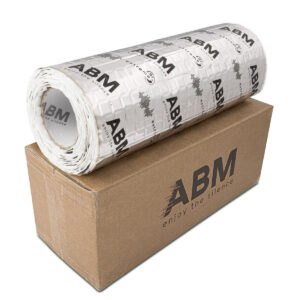
Butyl mats in the ABM Insulation store
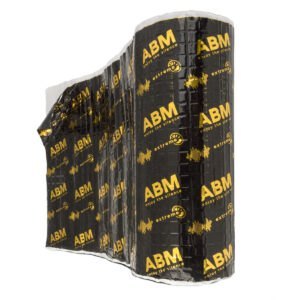
ABM Insulation store specializes in supplying professional insulating materials. The company has been operating since 2010 as a manufacturer of soundproofing mats. The assortment includes products with various densities tailored to attenuate low frequencies. Fast order fulfillment and shipping throughout Poland and the European Union ensure access to effective acoustic solutions.
The store’s offer includes two main lines of butyl products. Each series features different technical parameters. Choosing the appropriate density depends on the specific application and target frequency range.
ABM Professional series for standard applications
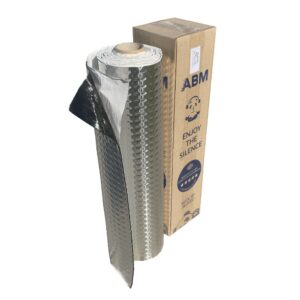
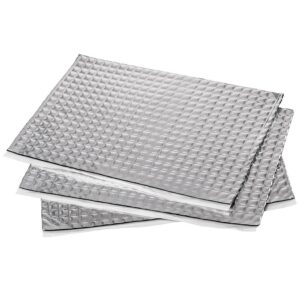
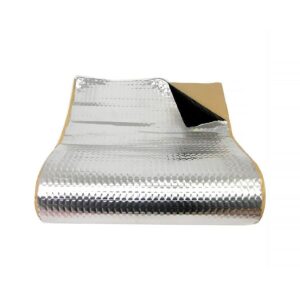
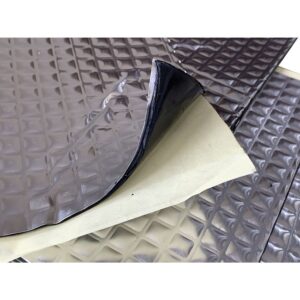
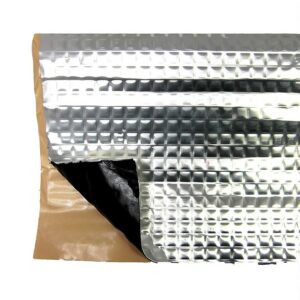
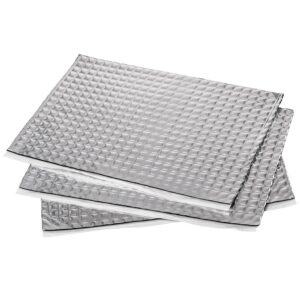
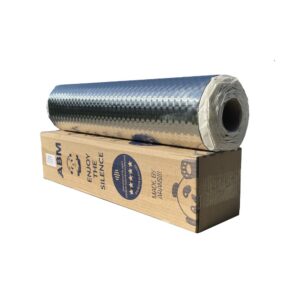
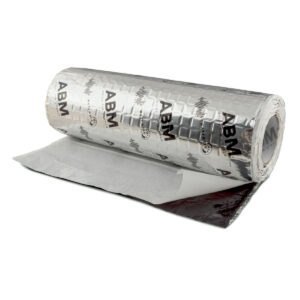
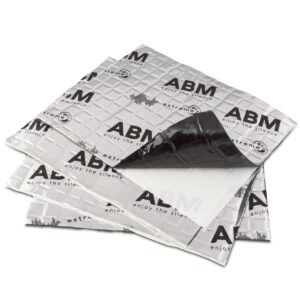
ABM Professional butyl mats achieve an MLF attenuation coefficient of 0.38. This parameter guarantees effective vibration reduction over a wide frequency range. Available weights allow selecting optimal surface mass. Operating temperature from minus 40 to 170 degrees Celsius ensures parameter stability.
The series is suitable for insulating passenger cars and delivery vehicles. It effectively dampens floor and door vibrations. Application reduces engine noise and structural vibrations. An aluminum layer with a thickness of 100 microns increases structural stiffness.
Applications of the Professional series:
- Soundproofing of passenger cars and delivery vans
- Acoustic insulation for campers and trailers
- Vibration damping for medium-power machines
- Noise reduction in living spaces
ABM Xtreme Line for Demanding Conditions
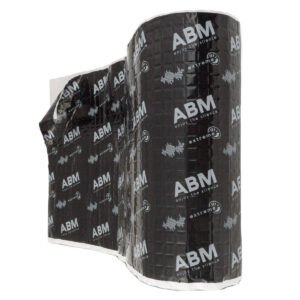
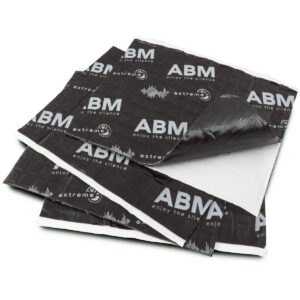
ABM Xtreme Series is characterized by increased weight. Higher density provides better damping of the lowest frequencies. The products are designed for extreme acoustic conditions. They effectively eliminate vibrations below 100 hertz.
The thicker butyl layer absorbs more vibrational energy. Increased surface mass blocks deep bass more effectively. The series is used in diesel vehicles. Industrial machines generating strong vibrations require such solutions.



Technical Support and Specialist Consulting
ABM Insulation provides professional advice on material selection. The team of specialists helps determine optimal insulation parameters. Analysis of noise sources and target frequencies allows selection of the right products. Technical support includes installation instructions and optimization of multilayer systems.
The company supplies certified materials safe for health. All products have confirmed effectiveness in soundproofing. Fast delivery within 24 hours of purchase enables urgent project execution.
We invite you to purchase butyl mats at the ABM Insulation store. Contact us to consult on selecting the optimal material density. Professional advice will help choose the perfect solution for your application. Order top-quality materials with fast delivery today.
Effectiveness Limits and Optimization of Multilayer Systems
Increasing mat density does not bring unlimited benefits. The saturation point defines the cost-effectiveness limit. Further mass increase does not proportionally improve results. Optimization requires analysis of the efficiency curve.
Multilayer systems expand the effective damping range. Each layer responds to a different frequency range. The system eliminates a wide spectrum of sounds. Combining different materials produces a synergistic effect.
Saturation Point of Damping with Excessive Material Density
The law of diminishing returns applies to acoustic insulation. Increasing density from 2 to 4 kilograms gives 12 decibels reduction. Changing from 4 to 6 kilograms brings only 4 decibels improvement. Efficiency decreases as mass increases.
The optimal point depends on the target frequency. For basses 50-100 hertz it is 4-5 kilograms per square meter. Higher tones 200-500 hertz saturate at 3 kilograms. Exceeding these values does not bring significant benefits.
Additional mass burdens the structure. The vehicle becomes heavier, increasing fuel consumption. The building requires stronger foundations. The economic balance tips unfavorably.
An alternative is a multilayer system with a lower total mass. The combination of different materials works more effectively than a single thick layer. Optimization ensures the best ratio of effect to cost and weight.
Combining mats of different densities for a wider frequency range
The layering strategy uses various materials. A heavy 1.25 kilogram mat dampens the 50-150 hertz range. A lighter 0.5 kilogram layer eliminates 200-400 hertz. The system covers a wide sound spectrum.
The first layer, mounted directly on metal, has the highest density. It effectively dampens structural resonances. It blocks the lowest frequencies. A thickness of 2-3 millimeters is sufficient.
The second medium-density layer absorbs mid frequencies. A 0.75 kilogram material eliminates the 150-300 hertz range. Mounted on the first layer, it creates a composite system. Each layer responds to its own range.
The third layer with the lowest density completes the system. A lightweight 0.375 kilogram material dampens high frequencies. Acoustic foam is a better choice for this range. The combination provides full spectrum coverage.
Impact of substrate on the effectiveness of dense butyl mats
The type of mounting surface affects insulation effectiveness. Metal with high stiffness transmits vibrations differently than flexible plastic. Concrete requires a different approach than wood. Substrate analysis determines material requirements.
Steel sheet is characterized by high acoustic impedance. It works well with butyl mats. The combination creates an effective sound barrier. Sheet thickness of 0.7-1.2 millimeters is optimal.
Aluminum has lower density than steel. Heavier mats are required for the same effectiveness. Density of 1-1.25 kilograms compensates for the lighter substrate. The adhesive layer must be stronger.
Plastics are problematic substrates. Low acoustic impedance limits mat effectiveness. Structural reinforcement is necessary. An additional layer of rigid board improves results.
Wood has medium impedance characteristics. Butyl mats effectively dampen vibrations. A density of 0.75 kilograms suffices for most applications. The adhesive layer must be compatible with wood.
Long-term stability of density parameters under thermal conditions
Operating temperature affects material properties. Butyl maintains flexibility from minus 40 to 170 degrees Celsius. Damping parameters remain stable within this range. The material neither crumbles nor melts.
Thermal cycles test mat durability. Repeated heating and cooling simulate real conditions. ABM Professional mats retain their damping coefficient after 1000 cycles. Long-term effectiveness is confirmed.
Humidity does not affect butyl. The material does not absorb water. Insulation properties remain unchanged. Mold resistance ensures health safety.
UV radiation can degrade some materials. Butyl under metal covers is protected. Outdoor applications require additional protection. An aluminum layer reflects solar radiation.
The adhesive layer maintains adhesion for years. Temperature does not weaken the bond. Vibrations do not cause the material to peel off. A 5-year warranty confirms the durability of ABM products.
Tip: Checking the mat condition every 2 years extends the system’s lifespan. Testing adhesion in corners detects potential problems early.
FAQ: Frequently Asked Questions
What density of butyl mat should be chosen for effective bass damping in a car?
Effective bass damping requires mats with a density of at least 0.75 kilograms per square meter. Sounds below 200 hertz penetrate through lightweight materials. A higher surface mass creates a barrier against low-frequency vibrations. Mats with a density of 1 kilogram reduce noise by 20 decibels at 100 hertz.
Optimal density values range from 0.825 to 1.2 kilograms per square meter. The floor requires the heaviest mats due to engine vibrations. Doors can have medium-weight material. The roof needs a lighter layer. The car audio system generates deep bass requiring high-density material. The butyl structure absorbs mechanical vibration energy. The aluminum layer enhances the insulation effect.
Does a thicker butyl mat always dampen low frequencies better?
Mat thickness affects damping effectiveness, but density is more significant. A 0.5 millimeter mat with a density of 1 kilogram works better than a 1 millimeter layer with a density of 0.5 kilograms. The total mass of the material determines the insulation effect. The optimal thickness for most applications is 0.5-0.75 millimeters.
Key mat parameters include the mass-to-thickness ratio and the MLF damping coefficient. Layers that are too thin do not effectively absorb vibration energy. Too thick mats unnecessarily increase vehicle weight. Professional ABM Professional materials achieve a coefficient of 0.38 at 0.5 millimeters thickness. The molecular structure of butyl converts vibrations into heat. Material flexibility allows adaptation to curved surfaces. Mats maintain damping properties in temperatures from minus 40 to 170 degrees Celsius.
How many kilograms per square meter should a mat have for vibration insulation below 200 hertz?
Vibrations below 200 hertz require mats with a minimum density of 1 kilogram per square meter. Low frequencies generate long acoustic waves. Their damping requires materials with high surface mass. Mats weighing 1-1.25 kilograms effectively reduce structural vibrations. The range of 12.5-50 hertz includes engine noise and deep bass.
Applications for different densities include passenger vehicles at 0.75-1 kilogram and industrial machines at 1.25 kilograms per square meter. High-power engines generate intense bass vibrations. Compressors produce vibrations from 7.5-37.5 hertz requiring the heaviest mats. Noise reduction reaches 25 decibels with appropriate material density. Butyl retains flexibility without heating during installation.
Is a mat with a density of 2 kilograms per square meter sufficient to soundproof low-frequency sounds?
A mat with a density of 2 kilograms provides basic insulation for frequencies of 150-500 hertz. The effectiveness of damping deep bass below 100 hertz is limited. Noise reduction is only 8-10 decibels at low tones. Applications include door insulation and smaller surfaces.
Comparison of effectiveness of different densities shows the advantage of heavier materials. A 3-kilogram mat reduces noise by 15 decibels, while 2 kilograms provide 10 decibels. The difference is clearly audible to the human ear. Car audio systems generate frequencies of 40-120 hertz that require greater mass. High-power engines need mats of 4-5 kilograms for optimal effect. Lighter mats are suitable for living spaces without extreme acoustic demands. Butyl retains its properties over a wide temperature range.
How does temperature affect the effectiveness of low-frequency damping by butyl mats?
Temperature significantly modifies the damping parameters of insulating materials. Butyl mats maintain effectiveness from minus 40 to 170 degrees Celsius. The damping coefficient at 86 degrees is 60 percent higher than that of asphalt. A temperature of 104 degrees increases the advantage to 72 percent.
Cold conditions make the material stiffer. Flexibility decreases at subzero temperatures. However, butyl retains plasticity even at minus 40 degrees. Hot environments enhance the damping properties of polymer structures. Vibrations are absorbed more effectively at higher temperatures. Bituminous mats lose efficiency at low temperatures. Butyl does not require heating during installation, unlike bitumen. Parameter stability guarantees long-lasting insulation effectiveness.
Summary
The density of butyl mats is a key parameter determining the effectiveness of low-frequency damping. Materials with a surface mass of 4-5 kilograms per square meter provide optimal bass reduction. The mechanism relies on converting sound energy into heat and increasing the dynamic mass of the surface. The butyl structure effectively absorbs vibrations in the range of 50-300 hertz.
Practical applications require adjusting parameters to the noise specifics. Vehicles with diesel engines need the heaviest mats. Living spaces can use materials with medium density. Industrial machines require a combination of different insulating layers. A multilayer system expands the effective damping range with reasonable total mass.
Optimizing the insulation system brings tangible benefits. Noise reduction of 20-25 decibels in the low-frequency range significantly increases comfort. Long-term parameter stability ensures investment durability. Professional products like ABM Professional mats guarantee high effectiveness over years of use. Choosing the right density eliminates excessive bass noise problems once and for all.
