

Passive construction represents a breakthrough in energy-efficient housing solutions. Passive houses consume 90 percent less energy than traditional buildings. Rubber foams play a fundamental role in achieving such spectacular results.
Insulation materials with a closed-cell structure eliminate heat loss. Modern mechanical ventilation systems require airtightness below 0.6 ACH50. Rubber insulation meets the strictest passive building standards.
The physical properties of the foams make heating systems work more efficiently. Cooling systems consume less electricity. Buildings achieve thermal comfort with minimal primary energy demand.
Thermal insulation of installations in zero-energy homes
Heating and cooling systems are key elements of passive house infrastructure. Pipelines carrying media must maintain temperature parameters without losses. Thermal insulation of pipelines prevents unnecessary heat or cold dissipation.
The closed-cell structure of rubber foams blocks temperature penetration. The material features a low thermal conductivity coefficient. Insulation thickness is adjusted to pipe diameter and operating temperature.
Protection of heating pipes against heat loss in heat recovery ventilators
Heat recovery ventilators recover up to 95 percent of heat from exhaust air. Pipes connecting the exchanger to the installation require effective insulation. Rubber foams protect pipelines from losing recovered energy.
The temperature in the heat recovery system ranges from 15 to 60 degrees Celsius. Lack of insulation causes losses reaching 30 percent of recovered heat. Closed-cell materials eliminate water vapor condensation on pipe surfaces.
ABM Insulation produces foams dedicated to ventilation installations. The material maintains stable parameters throughout its service life. The flexible structure allows installation on joints and bends of pipelines.
Insulation of cooling pipes minimizing electricity consumption
Cooling installations in passive houses operate seasonally. Pipes carrying refrigerant have temperatures from minus 10 to 5 degrees Celsius. Heat penetration from the environment reduces system efficiency by 25 percent.
Rubber foams with aluminum foil reflect thermal radiation. The insulation layer reduces energy consumption by compressors. Cooling systems achieve parameters under lower load.
The moisture-resistant material prevents pipe corrosion. The closed-cell structure does not absorb water from the environment. Installations remain airtight for decades of use.
Airtight connections eliminating thermal bridges in systems
Thermal bridges occur at installation passages through walls. Leaks reduce building insulation effectiveness by 15 percent. Rubber foam fills gaps around pipelines and ducts.
Flexible material adapts to irregular surfaces. Joints remain sealed despite thermal movements of the structure. The system maintains integrity without additional protections.
Advantages of sealed connections:
- Elimination of heat loss through installation openings
- Protection against infiltration of outside air
- Stabilization of temperature inside building partitions
- Prevention of water vapor condensation in passages
Application of foams at passage points requires thorough surface cleaning before installation. Rubber adhesive ensures a durable bond between the material, wall, and pipeline. Installation temperature should be between 5 and 25 degrees Celsius. The material is pressed firmly for at least 30 seconds to achieve optimal adhesion. Sealing tapes close the joints between insulation sheets. Complete sealing of installation passages raises the building’s energy class by one level.
Thermal conductivity coefficient below 0.04 W/mK
The lambda parameter defines thermal insulation efficiency. Rubber foams achieve a coefficient from 0.033 to 0.038 W/mK. Values remain stable at temperatures from minus 40 to plus 105 degrees.
The low thermal conductivity coefficient allows reducing insulation thickness. Installations take up less space while maintaining performance parameters. The building gains more usable area.
Traditional materials require layers that are 50 percent thicker. Rubber foams achieve better results with less weight. Transport and installation become simpler and faster.
| Parameter | Rubber Foam | Mineral Wool | Styrofoam |
|---|---|---|---|
| Lambda (W/mK) | 0.033-0.038 | 0.035-0.040 | 0.036-0.042 |
| Moisture Resistance | Very High | Low | Medium |
| Operating Temperature (°C) | -50 to +110 | -40 to +250 | -50 to +70 |
| Flexibility | High | Low | Very Low |
| Durability (years) | 50+ | 25-30 | 30-40 |
Material density directly affects insulation parameters and mechanical strength. Foams with a density of 60-80 kg/m³ are suitable for insulating ventilation ducts. Variants with a density above 100 kg/m³ withstand loads in heated floors. Laboratory tests confirm the stability of the lambda coefficient for 50 years of use. Certificates of compliance with European standards guarantee product quality and safety. The insulation meets the requirements of passive houses without the need for additional protective layers.
Air sealing of passive construction using rubber foams
The airtightness of building partitions determines energy efficiency. The standard for passive houses requires airtightness below 0.6 ACH50. Blower Door Test verifies the quality of seals in the building.
Uncontrolled air exchange causes energy losses. Infiltration of cold air in winter increases energy consumption by 40 percent. Rubber foams eliminate leaks in the structure.
Filling gaps around window and door frames
Installation of joinery leaves gaps ranging from 5 to 20 millimeters wide. These spaces are the main source of air infiltration. Flexible rubber foam fills the gaps between the frame and the jamb.
The material expands after application and adapts to the shape of the gap. The connection remains airtight despite thermal movements of walls. Windows and doors retain their airtightness parameters for years.
ABM Insulation supplies self-adhesive foams for joinery sealing. Installation does not require specialized equipment. The adhesive layer ensures a durable bond with the surface.
Preventing air infiltration through drywall joints
Partition walls made of drywall create numerous joints. Joints between panels allow air to pass into interstitial spaces. Foams fill gaps and eliminate airflow.
Areas requiring sealing:
- Connections of panels with structural walls
- Joints between ceilings and vertical partitions
- Passages of electrical installations through panels
- Mounting holes for outlets and switches
- Spaces around electrical distribution boards
Sealing joints reduces sound transmission between rooms. Building acoustics improve without additional costs. Resident comfort increases due to quieter interiors.
Stabilizing internal pressure in ventilated spaces
Mechanical ventilation systems maintain positive pressure inside the building. Pressure differences range from 50 to 100 pascals. Leaks cause uncontrolled airflow.
Airtight partitions stabilize pressure distribution in rooms. The heat recovery ventilator operates at optimal efficiency. Energy consumption by fans decreases by 20 percent.
Rubber foams retain elasticity throughout the building’s lifetime. The material does not harden or crumble over years. Seals remain effective despite temperature and humidity changes.
Reduction of uncontrolled air exchange by 90 percent
Traditional buildings lose 30 to 50 percent of heat through infiltration. Passive houses reduce this rate below 5 percent. Comprehensive sealing with rubber foams achieves the best results.
Leakage tests before and after application show dramatic improvement. The n50 parameter drops from 3-5 to below 0.6 air changes per hour. The building meets the most stringent energy standards.
Heating costs decrease proportionally to improved airtightness. Energy bills are 60 percent lower compared to conventional buildings. The investment in sealing pays off within 3-5 years.
Tip: Sealing the building with rubber foams is done before Blower Door tests. Airtightness control allows detection of remaining leaks and completion of insulation. Professional material application cuts work time in half.
Acoustic insulation of partitions in energy-efficient buildings
External and internal noise reduces residents’ comfort. Acoustic standards require sound levels below 30 decibels in bedrooms. Acoustic insulation with rubber foams achieves parameters exceeding standards.
The material structure dampens sound waves over a wide frequency range. Acoustic energy absorption reaches 85 percent for sounds at frequencies of 500-4000 Hz. Rooms become quieter and more pleasant for users.
Noise reduction of mechanical ventilation fans with heat recovery
Heat recovery ventilators generate noise from 25 to 45 decibels during operation. Fans rotate at speeds up to 3000 revolutions per minute. Vibrations transmit through ventilation ducts into rooms.
Rubber foams installed around ventilation ducts absorb sounds. Noise levels in rooms drop by 15-20 decibels. Residents do not hear the operation of the ventilation system.
Acoustic insulation of ducts prevents transmission of conversations between rooms. Privacy in the home improves significantly. Each room maintains acoustic autonomy.
Reduction of sound transmission through exterior walls
Passive house walls contain multiple layers of insulation. Acoustic bridges in the structure allow sounds from outside to pass through. Rubber foams fill gaps between structural elements.
Benefits of acoustic wall insulation:
- Reduction of street noise by 25-30 decibels
- Elimination of sounds from neighboring units
- Improved sleep quality for residents
- Increase in property value by 10-15 percent
The acoustics of rooms affect residents’ mental health. Continuous noise causes stress and sleep problems. Effective sound insulation creates a peaceful oasis.
Absorption of vibrations from heat pumps and ground exchangers
Heat pumps generate vibrations during compressor operation. Vibrations transmit through foundations to the building structure. Rubber foams installed under devices isolate foundations from vibrations.
Rubber foam pads dampen mechanical oscillations. The building remains quiet despite heating system operation. Acoustic comfort does not deteriorate during winter.
Ground heat exchangers pump brine through pipelines buried in the ground. Circulation pumps generate noise from 30 to 50 decibels. Acoustic insulation of the pipes eliminates sound transmission to the building.
Tip: Installing acoustic foams under heat pumps reduces noise by half. The material absorbs vibrations before they reach the structure. Neighbors do not hear the operation of heating devices.
Flexibility of foams with thermal structural movements
Buildings undergo movements resulting from thermal expansion of materials. Temperature differences cause expansion and contraction of structural elements. Flexible insulation adapts to dimensional changes without losing properties.
Rigid insulation materials crack during thermal movements. Gaps allow air and moisture into the insulation. Rubber foams maintain integrity under variable conditions.
Damping material expansion due to seasonal changes
The temperature of structural elements ranges from minus 20 to plus 60 degrees Celsius. Concrete expands by 0.012 millimeters per meter length per degree of temperature. Annual dimensional changes reach several millimeters along a wall length.
Rubber foams operate within a range from minus 50 to plus 110 degrees Celsius. The material’s elasticity is 200 percent. The insulation stretches and contracts without structural damage.
Joints between building elements remain sealed for decades. Thermal parameters do not deteriorate despite cyclical temperature changes. The building maintains energy efficiency throughout its service life.
Compression resistance in flat heating floors
Underfloor heating systems require insulation beneath pipelines. The material must withstand loads from 500 to 1,250 kilograms per square meter. Rubber foams with density above 100 kg/m³ maintain stability under pressure.
The material’s resilience prevents pipe punctures from point loads. Furniture and equipment do not damage the heating installation. The floor remains even for years of use.
Thermal insulation directs heat upward, eliminating losses into the ground. The floor heats faster with lower energy consumption. The heating system operates more efficiently with reduced operating costs.
Adaptation to irregular foundation surfaces
Foundations rarely have perfectly even surfaces. Level differences range from 5 to 15 millimeters. Rigid insulation materials do not fill irregularities.
Flexible rubber foams conform to surface profiles. The insulation layer maintains uniform thickness without empty spaces. Thermal bridges do not form at uneven spots.
Installation techniques on irregular surfaces:
- Cleaning substrate from loose elements
- Leveling larger irregularities with mortar
- Applying foam pressed against the surface
- Eliminating air bubbles under the material
- Sealing joints with rubber tape
Self-adhesive ABM foams facilitate installation on vertical foundation walls. The material adheres without additional mechanical anchors. Work time is reduced by half compared to traditional methods.
Tip: Applying rubber foams on foundations increases the building’s airtightness. The material eliminates air flow through the joint between the foundation and the wall. Airtightness tests show an improvement in the n50 parameter by 0.1-0.2 points.
ABM Insulation Rubber Foams in the ABM Insulation Store
ABM Insulation Store provides specialized insulation solutions dedicated to passive construction. The assortment includes rubber foams with parameters meeting the most stringent energy standards. The materials maintain thermal and acoustic properties for over 50 years of use.
The manufacturer has been operating since 2010, specializing in high-quality insulation. The company supplies products throughout Poland, the European Union, and the United States. Shipping is carried out within 24 hours of placing an order.
Professional Closed-Cell Insulation Foams
Rubber foams available in the store feature a closed-cell structure. The thermal conductivity coefficient lambda ranges from 0.033 to 0.038 W/mK. The products perform effectively at temperatures from minus 50 to plus 110 degrees Celsius.
The assortment includes self-adhesive foams that facilitate installation. Material thicknesses are adapted for various construction applications. Versions with aluminum foil provide additional protection against thermal radiation.
Available thickness variants:
- Thin layers 3-6 mm for seals and gaps
- Medium thicknesses 10-13 mm for heating pipelines
- Thick insulation 19 mm for refrigeration installations
- Sheet formats from 0.25 to 1 square meter
The closed cells of the material block moisture and water vapor flow into the insulation interior. The structure eliminates condensation on refrigeration and air conditioning pipe surfaces. Resistance to biological factors prevents mold and fungus growth. The material has hygiene certificates allowing contact with drinking water installations.
The foam’s flexibility facilitates installation on elbows, tees, and installation valves. Sheets are cut with a knife without specialized tools. The self-adhesive layer reduces installation time by half compared to traditional methods. Rolls up to 10 meters long allow insulating long sections without joints. A complete system of mounting accessories ensures professional installation finishing.
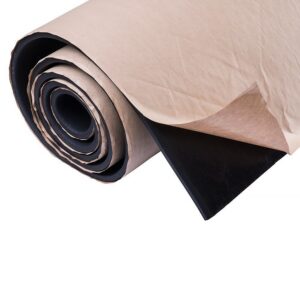
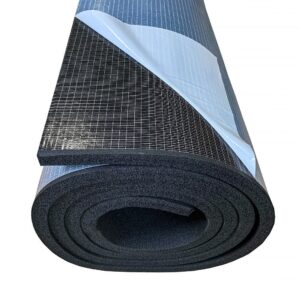
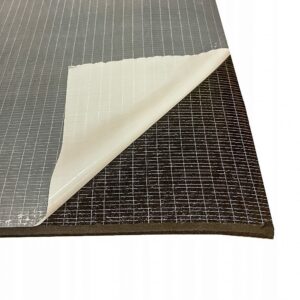
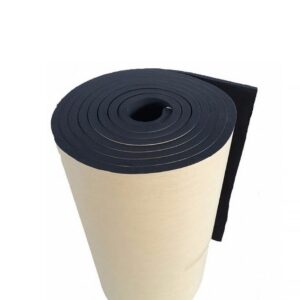
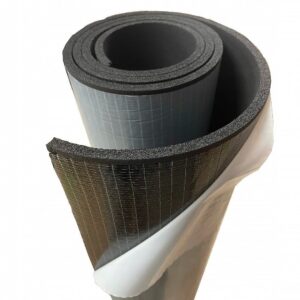
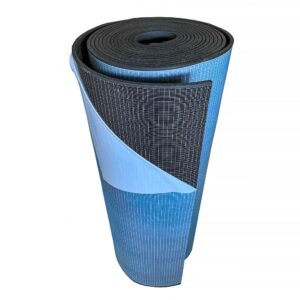
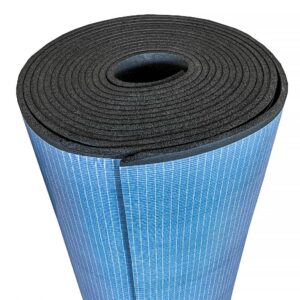
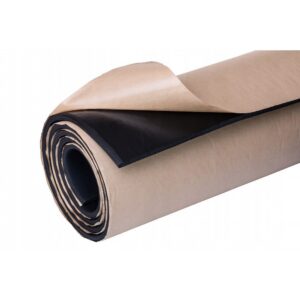
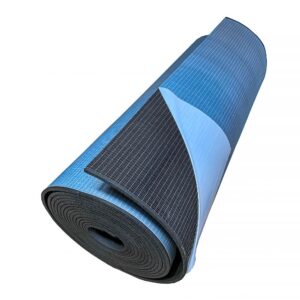
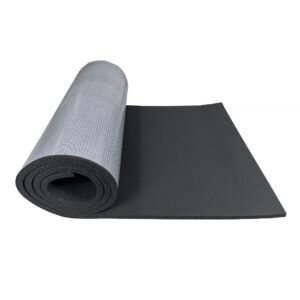
Rubber Foam. ABM Acoustic Insulation Self-adhesive, 25mm, 1m2
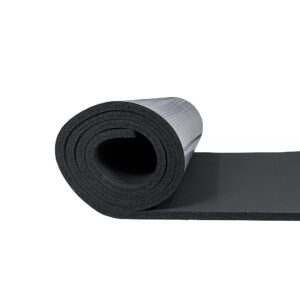
ABM Rubber Foam. Acoustic Insulation Self-adhesive, 32mm, 0.5m2
Rubber Foam. Acoustic Insulation Self-adhesive ABM, 32mm, 1m2
Applications in Energy-Efficient Building Systems
ABM rubber foams are effective in insulating heat recovery ventilation systems. The materials protect ventilation ducts from recovered heat losses. The flexible structure adapts to the shape of pipelines and collectors.
The products eliminate water vapor condensation on refrigeration pipes. Closed cells block moisture penetration into the insulation. Heat pump systems operate more quietly thanks to vibration-damping properties.
Technical Support and Specialist Consulting
ABM Insulation Team provides professional advice on material selection. Consultants help choose the optimal insulation parameters for a specific project. Technical support includes detailed installation and application instructions.
The store offers complete insulation solutions for passive construction. Customers receive tested and certified materials. Product quality is confirmed by years of cooperation with construction companies.
Contact us to get professional consultation regarding passive building insulation. Order high-quality ABM rubber foams and increase your home’s energy efficiency. Our team will help select optimal solutions for your project.
Durability of Rubber Foams in Extreme Operating Conditions
Insulation materials must maintain their parameters throughout the building’s lifespan. Passive standards assume operation exceeding 50 years. Rubber foams retain properties for five decades without degradation.
The closed-cell structure protects the material from external factors. Moisture does not penetrate inside the foam. Insulation parameters remain stable regardless of environmental conditions.
Parameter Stability after 50 Years in a Humid Microclimate
Aging tests accelerate the material’s operating process. Samples are subjected to heating and cooling cycles for 10,000 hours. The lambda coefficient changes by less than 3 percent.
Long-term studies confirm the durability of rubber foams. Materials installed 40 years ago maintain insulation parameters. Buildings retain energy efficiency without insulation replacement.
Air humidity does not affect the material’s properties. The closed-cell structure does not absorb water from the environment. Insulation works effectively in humidity conditions up to 98 percent.
Resistance to Mold and Mildew Growth in Hermetic Spaces
Cavity spaces in walls can promote microorganism growth. Fungi and molds destroy building materials and threaten health. Rubber foams contain biocidal agents preventing biological growth.
The material holds hygiene certificates for the food industry. User safety remains a priority for manufacturers. Insulation does not emit harmful substances throughout its service life.
Microbiological studies confirm no fungal growth on foam surfaces. The material remains sterile despite humid conditions. Buildings maintain a healthy microclimate without biological threats.
Maintaining Flexibility at Temperatures from Minus 50 to Plus 110 Degrees
Extreme weather conditions do not affect mechanical properties. Foams remain flexible in frost below minus 40 degrees. The material does not harden or crumble at low temperatures.
High operating temperatures do not cause structural degradation. Hot water pipelines reach temperatures up to 95 degrees. Insulation maintains parameters without thermal deformation.
UV resistance protects the material from sunlight. Foams with an aluminum layer reflect light without aging. Insulation on external pipes works for decades.
Tip: Choosing rubber foams guarantees trouble-free insulation operation. The material requires no maintenance or replacement for half a century. The investment pays off multiple times through energy savings.
FAQ: Frequently Asked Questions
What thickness of rubber insulation should be used on pipes in a passive house?
The insulation thickness depends on the diameter of the pipelines and the temperature of the medium. Heating pipes with a diameter up to 22 millimeters require a 19-millimeter layer. Pipes over 35 millimeters in diameter need 32 millimeters of insulation thickness. Refrigeration pipelines require thicker layers due to the risk of condensation.
Recommended insulation thicknesses:
- Heating pipes 15-22 mm: layer 13-19 mm
- Heating pipes 28-42 mm: layer 25-32 mm
- Refrigeration pipes: layer 50 percent thicker
- External pipelines: additionally 10-15 mm
Operating temperature affects the choice of material thickness. High-temperature systems above 70 degrees require thicker protection. ABM Insulation produces foams with thicknesses from 6 to 50 millimeters. Parameter selection ensures maximum energy efficiency of the installation.
How to properly install rubber foam on installations?
The surface is cleaned and degreased thoroughly before installation. Self-adhesive foams are applied directly after removing the protective film. Materials without adhesive are installed using special rubber glues. Glue is applied thinly on both joining surfaces.
The glue drying time ranges from one to three minutes. Surfaces are joined after solvent evaporation. Installation is performed using a butt joint method without overlaps. Gaps between pieces are sealed with rubber tape. The material is pressed firmly against the substrate for 30 seconds.
Steps for professional installation:
- Cleaning surfaces from dirt and rust
- Applying glue evenly
- Waiting for solvent evaporation
- Pressing material firmly onto the pipe
- Sealing joints with dedicated tape
How does rubber foam differ from mineral wool in passive applications?
Rubber foams have a closed-cell structure. Mineral wool has an open structure that allows water vapor to pass through. Rubber’s flexibility facilitates installation in difficult areas. Wool requires more installation space due to its rigidity.
The lambda coefficient of foam is 0.033-0.038 W/mK. Mineral wool achieves values of 0.035-0.040 W/mK. Rubber’s moisture resistance is significantly higher. Wool absorbs water and loses insulating properties. Foams maintain parameters in humid environments.
The fire resistance of mineral wool reaches class A1. Rubber belongs to flammable material classes. Wool’s operating temperature reaches 600-1000 degrees Celsius. Foams work effectively up to 110 degrees Celsius. Rubber durability exceeds 50 years of operation. Mineral wool requires replacement after 25-30 years.
How many years does rubber foam retain its properties in passive buildings?
The material maintains its insulation parameters for at least 50 years. The closed-cell structure prevents mechanical degradation. Long-term studies confirm the stability of the lambda coefficient. Parameter changes do not exceed 3 percent after five decades.
Resistance to weather conditions protects the material from aging. UV radiation requires additional protection with an aluminum coating. EPDM foams degrade more slowly than standard NBR/PVC. Flexibility remains unchanged within the operating temperature range. Humidity does not affect insulation properties throughout the entire service life.
Can rubber foam be used to insulate both heating and cooling installations?
The material works universally in both hot and cold systems. The operating temperature range spans from minus 50 to plus 110 degrees Celsius. Insulating refrigeration pipes prevents condensation of water vapor. The closed-cell structure blocks moisture diffusion.
Heating installations retain the medium’s temperature without losses. Cooling systems operate more efficiently with lower energy consumption. The foam eliminates dew formation on cold pipes. Corrosion protection extends the lifespan of pipelines.
Multifunctional applications:
- Central heating and hot water pipes
- Air conditioning refrigerant lines
- Heat recovery ventilation installations
- Air and ground source heat pump pipelines
- Underfloor heating and cooling systems
The material’s flexibility allows installation on elbows and joints. One insulation protects various types of installations. Versatility reduces material costs and simplifies construction logistics.
Summary
Rubber foams are the foundation of energy efficiency in passive buildings. A thermal conductivity coefficient below 0.04 W/mK eliminates heat loss. Airtightness reaches levels required by the most stringent standards.
The use of elastomeric materials covers all key building systems. Insulating heating and cooling installations increases efficiency by 30 percent. Sealing building partitions reduces air infiltration by 90 percent. Acoustic properties create a comfortable living environment.
Durability exceeding 50 years without parameter degradation guarantees stable operating costs. Buildings maintain energy efficiency throughout their service life. Investing in quality rubber insulation pays off through low energy bills. Thermal and acoustic comfort for residents remains at the highest level for decades.
Sources:
- https://www.sciencedirect.com/science/article/abs/pii/S2352710224024148
- https://www.sciencedirect.com/science/article/pii/S2590123024009897
- https://pb.edu.pl/oficyna-wydawnicza/wp-content/uploads/sites/4/2022/11/Sustainable_buildings_8.pdf
- https://www.passivhaustrust.org.uk/UserFiles/File/Technical%20Papers/2017%20Passivhaus%20Insulation_Good%20Practice%20Guide_Rev_0.1.pdf
- https://www.sciencedirect.com/science/article/pii/S1359836822005777
