
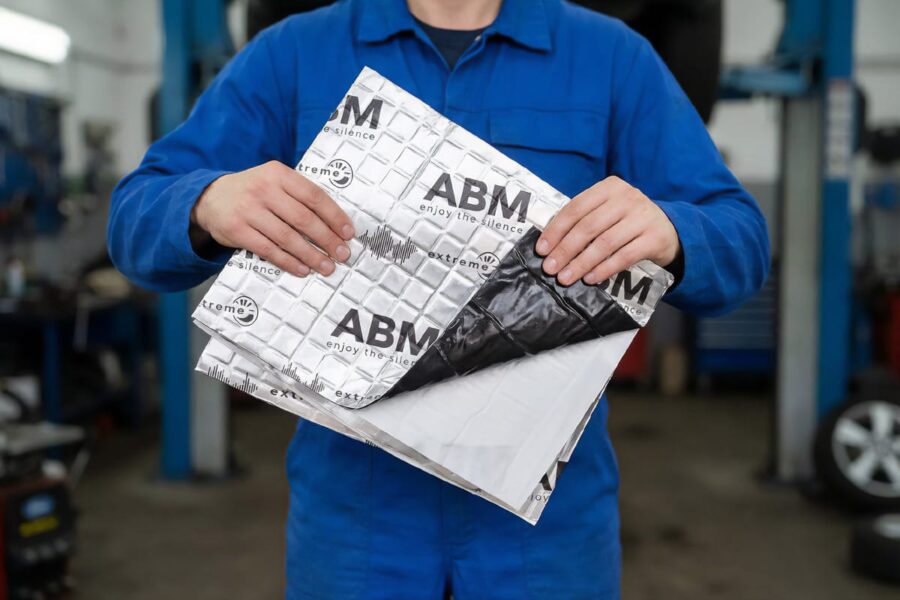
Aluminum layer in butyl mats is a key element providing effective acoustic and thermal insulation. This metal stands out due to its exceptional physical properties, which make it excellent at reflecting both sound waves and thermal radiation. The thickness of the aluminum layer in professional butyl mats is typically 100 microns, ensuring an optimal balance between insulation effectiveness and material flexibility.
The mechanism of action of the aluminum layer is based on the natural properties of this metal. The smooth surface of aluminum has a reflectivity of up to 95 percent for infrared waves. At the same time, its low thermal emissivity means that the material absorbs minimal amounts of thermal energy. The crystalline structure of aluminum allows free electrons in the metal to effectively scatter both electromagnetic and acoustic waves.
The combination of dense butyl mass with the aluminum layer creates an insulation system with unique parameters. Butyl provides damping of vibrations and resonance through its high material density. Aluminum serves as a barrier reflecting radiation and sound waves. This construction allows for effective insulation across a wide range of frequencies and operating temperatures.
Physical properties of aluminum responsible for radiation reflection
Aluminum is among the metals with the highest coefficients of reflection for electromagnetic radiation. These properties directly result from the atomic structure and surface characteristics of this element. The metal features free electrons that effectively interact with incoming electromagnetic waves.
The aluminum surface acts as a natural mirror for various types of radiation. The high electrical conductivity of the metal translates into its ability to reflect light and heat waves. Conductive electrons in aluminum quickly respond to the oscillating electromagnetic field of incoming radiation. This reaction causes the emission of reflected waves at the same frequency as the incoming waves.
The crystalline structure of aluminum also affects the reflective properties of the material. The regular arrangement of atoms in the crystal lattice promotes uniform wave reflection. The absence of discontinuities in the structure minimizes energy dissipation as heat. As a result, most incoming radiation is reflected rather than absorbed.
High reflectivity of aluminum surface reaching 95 percent
The aluminum layer in butyl mats features an exceptionally high reflection coefficient. For infrared radiation, aluminum’s reflectivity reaches values from 92 to 95 percent. Visible light reflects off the aluminum surface in the range of 88 to 92 percent. Even ultraviolet radiation is reflected at rates exceeding 85 percent.
Reflection parameters for radiation by aluminum:
- Infrared range: reflectivity of 92-95 percent at wavelengths above 1 micrometer
- Visible light: reflectivity of 88-92 percent in the spectrum of 400-700 nanometers
- UV radiation: reflectivity above 85 percent for wavelengths shorter than 400 nanometers
- Minimal wavelength dependence: stable properties across a wide spectrum
- Surface impact: smooth finish increases reflectivity
Aluminum stands out for its stability in reflective properties across different spectral ranges. Unlike silver or gold, aluminum’s reflectivity remains high regardless of the wavelength. The minimum reflectivity value still exceeds 85 percent throughout the analyzed range. This feature makes aluminum an ideal material for thermal insulation applications.
The thickness of the aluminum layer at 100 microns in ABM butyl mats ensures full optical functionality. Such thickness guarantees opacity to light and thermal radiation. Thin layers of aluminum below 10 nanometers exhibit partial transparency. A layer of 100 microns creates a solid barrier against all types of electromagnetic radiation.
Low thermal emissivity of aluminum metal
Thermal emissivity defines a material’s ability to radiate thermal energy. Aluminum has an exceptionally low emissivity ranging from 0.02 to 0.10. Highly polished aluminum surfaces achieve emissivities below 0.05. This means that the material absorbs and emits minimal amounts of thermal radiation.
The low emissivity of aluminum is directly related to its high reflectivity. According to Kirchhoff’s law, absorption and emission of radiation are equal. If aluminum reflects 95 percent of radiation, it only absorbs 5 percent. The same principle applies to thermal emission by the material.
The oxidized surface of aluminum exhibits higher emissivity than pure metal. An aluminum oxide layer can raise the emissivity to values of 0.6 or higher. In butyl mats, aluminum with a smooth surface free from oxidation is used. Minimizing oxidation ensures low thermal emissivity is maintained throughout the product’s lifespan.
The surface temperature of aluminum affects its emissive properties. Within the operating temperature range of butyl mats from minus 40 to 170 degrees Celsius, the emissivity remains stable. Aluminum does not significantly change its reflective properties within this temperature range. The thermal stability of the material guarantees effective insulation regardless of usage conditions.
Crystal structure of aluminum and its impact on wave reflection
Aluminum crystallizes in a regular body-centered cubic crystal lattice. The metal atoms are arranged in a way that ensures maximum packing density. This structure is characterized by the presence of free electrons moving between metal ions. Conductive electrons are a key element responsible for reflecting electromagnetic waves.
The falling electromagnetic radiation causes electrons to oscillate. The oscillating electrons emit their own electromagnetic waves at the same frequency. These waves destructively interfere with the incoming waves inside the metal. As a result, the radiation does not penetrate deep into the material but is reflected from the surface.
Atomic-level reflection mechanism:
- The incoming electromagnetic waves interact with free electrons in the metal
- Electrons begin to oscillate at the frequency of the incoming wave
- Oscillating electrons generate secondary electromagnetic radiation
- Secondary waves overlap with incoming waves causing reflection
- The electrical conductivity of aluminum is about 37.7 million siemens per meter
- The penetration depth of electromagnetic waves is only a few dozen nanometers
The regular crystal structure minimizes energy dissipation in the form of heat. Crystal lattice defects could cause absorption of part of the energy from the incoming radiation. High-purity aluminum is characterized by a minimal number of structural defects. The purity of the metal used in butyl mats usually exceeds 99 percent.
Tip: When installing butyl mats, avoid crumpling the aluminum layer, as deformation can locally reduce radiation reflection efficiency by 5-10 percent.
Construction of a butyl mat with a 100-micron aluminum layer
Butyl mat is a composite insulation material combining the properties of two different substances. It consists of a dense butyl mass with high vibration damping parameters. The outer layer is made of aluminum foil with precisely defined thickness. The combination of these materials creates an insulation system that operates simultaneously at both acoustic and thermal levels.
The total thickness of the butyl mat offered by ABM Insulation ranges from 1.3 to 4 millimeters. The aluminum layer is a constant element with a thickness of 100 microns, or 0.1 millimeters. The remaining part of the thickness consists of butyl mass along with an adhesive layer. These proportions ensure an optimal combination of mechanical damping and radiation reflection.
The technology for bonding butyl to aluminum requires a precise manufacturing process. The aluminum layer must adhere evenly to the surface of the butyl. Lack of adhesion could lead to delamination of the material during use. The manufacturer of ABM Professional and ABM Xtreme mats employs a laminating process that ensures durable bonding of layers.
| Parameter | Value | Impact on insulation |
|---|---|---|
| Thickness of aluminum layer | 100 microns | Full reflection of radiation and acoustic waves |
| Thickness of butyl mass | 1.2-3.9 mm | Damping of vibrations and absorption of mechanical energy |
| Density of butyl | approximately 1200 kg/m³ | Effectiveness in blocking low-frequency noise |
| Operating temperature | -40 to 170°C | Retention of properties in extreme conditions |
| Material flexibility | High ductility | Ease of installation on curved surfaces |
Dense Butyl Mass as the Basis for Insulation Material
Butyl is a synthetic rubber produced from the copolymerization of isobutylene and isoprene. This material is characterized by an exceptionally high density of about 1200 kilograms per cubic meter. The high density directly translates to effective sound and vibration damping. The mass of the material acts as a barrier to the propagation of acoustic waves within the structure.
The viscoelastic properties of butyl ensure effective absorption of mechanical energy. The material deforms under the influence of vibrations, converting kinetic energy into heat. The damping coefficient of butyl reaches values significantly higher than those of traditional insulation materials. This effect is particularly noticeable in the low-frequency range from 50 to 500 hertz.
Characteristics of Butyl Mass in ABM Mats:
- Material density: 1200 kg/m³ providing high surface mass
- Viscoelasticity involves effective transformation of vibration energy into heat
- Temperature resistance: stable properties in the range from minus 40 to 170 degrees Celsius
- No asphalt: elimination of crack risk at low temperatures
- Chemical resistance: no degradation under the influence of operating fluids
- Flexibility: ability to install on surfaces with complex shapes
The butyl layer in ABM Professional and ABM Xtreme mats contains no asphalt or harmful fillers. Pure butyl retains flexibility over a wide temperature range. Materials containing asphalt lose plasticity at low temperatures and may crack. The absence of asphalt also provides resistance to oils and organic solvents.
The thickness of the butyl layer has a direct impact on damping effectiveness. A mat with a thickness of 2 millimeters provides noise reduction of 2-6 decibels in the mid-frequency range. A thickness of 4 millimeters increases damping to 5-10 decibels. Increasing thickness also improves effectiveness in the low-frequency range below 200 hertz.
Real Aluminum vs. Metallized Foils in Mats
The insulation materials market offers products with various types of metallic layers. It is important to distinguish between real aluminum and metallized foils created through vacuum sputtering. The difference between these materials is fundamental to insulation effectiveness. Metallized polyester films contain an aluminum layer only a few dozen nanometers thick.
Butyl mats from ABM Insulation utilize real aluminum foil that is 100 microns thick. This thickness ensures full reflective properties characteristic of aluminum metal. Metallized foil with a thickness of 50 nanometers has significantly poorer insulation parameters. A thin layer of metal may allow some infrared radiation to pass through the polymer substrate.
Differences in Insulation Effectiveness Between Real Aluminum and Metallization:
- Real aluminum 100 micrometers reflects 95 percent of infrared radiation
- Metalized foil with a thickness of 50 nanometers reflects only 70-80 percent of radiation
- The thickness of aluminum affects optical density and the reflection coefficient
- Real aluminum also provides better mechanical properties for the layer
- Metalization can be damaged during installation and bending of the material
A layer of real aluminum with a thickness of 100 micrometers provides a solid mechanical structure. The foil reinforces the entire butyl mat, increasing its resistance to stretching. Metalized foils do not contribute significantly to the mechanical strength of the material. During installation, the mat with real aluminum is more resistant to damage.
The manufacturer ABM Insulation uses only real aluminum in its products. The thickness of the metal layer at 100 micrometers is the thickest option available on the market. Competing products often use thinner aluminum foils or metalized substitutes. This difference directly translates to the effectiveness of acoustic and thermal insulation.
Tip: Before purchasing a butyl mat, it is worth checking the specification regarding the thickness of the aluminum layer, as values below 50 micrometers may indicate metalized foil instead of real aluminum.
The mechanism of sound wave reflection by the aluminum layer
Acoustic waves are mechanical disturbances propagating through a material medium. The aluminum layer in the butyl mat interacts with sound waves based on impedance reflection. A sudden change in acoustic impedance at the air-metal boundary causes a significant portion of acoustic energy to be reflected. The remaining energy is transmitted to the material structure, where it is dampened by the butyl layer.
Acoustic impedance depends on the density of the material and the speed of sound within its structure. Aluminum has an impedance of about 17 million Rayleigh. Air has an impedance of only 400 Rayleigh. The impedance difference by four orders of magnitude causes approximately 99.9 percent reflection of acoustic wave energy striking perpendicularly.
The effectiveness of reflection also depends on sound frequency and angle of incidence. For frequencies above 500 hertz, the aluminum layer acts as an effective acoustic mirror. Lower frequencies additionally require action from the butyl mass to dampen vibrations. The combination of both mechanisms provides broadband acoustic protection.
Reflection of acoustic waves from a smooth metal surface
The aluminum surface in butyl mats is characterized by high smoothness and uniformity. Smooth surfaces promote regular reflection of acoustic waves according to the law of reflection. The angle of incidence equals the angle of reflection, just like with light. A rough surface would cause scattering of acoustic energy in various directions.
Regular reflection of waves from an aluminum surface minimizes sound penetration through the material. Acoustic energy is directed back toward the noise source. This effect is particularly significant in automotive applications for butyl mats. Noise generated by engines or tires is reflected rather than penetrating into the vehicle cabin.
The thickness of the aluminum layer of 100 microns ensures mechanical stability during vibrations. Thin films could deform under the influence of acoustic pressure. Surface deformations would reduce the effectiveness of sound wave reflection. A solid aluminum layer maintains a flat surface even at high sound levels.
The efficiency of acoustic reflection also depends on the combination of aluminum with a butyl base. A loosely laid metal film could vibrate as a membrane, emitting its own noise. A durable bonding of layers prevents undesirable resonances in the metal surface. The composite system acts as a whole, combining surface reflection with volume damping.
Damping of resonance and vibrations through the combination of butyl with aluminum
Acoustic resonance is one of the main problems in soundproofing. Thin metal panels can be excited to resonate under noise influence. The resonant frequency depends on the mass, stiffness, and dimensions of the panel. This effect causes an amplification of noise instead of its damping.
The butyl layer bonded to aluminum effectively dampens any structural resonances. The viscoelastic properties of butyl cause energy from vibrations to dissipate as heat. This mechanism is referred to as material or internal damping. The damping coefficient of the butyl-aluminum composite ranges from 0.3 to 0.5.
Damping mechanisms in the composite system:
- Viscoelastic damping: conversion of mechanical energy into heat in the butyl mass
- Increased surface mass: reduction of structural vibration amplitude
- Elimination of resonances: shifting natural frequencies beyond the audible range
- Damping vibrations: absorption of energy before it is transmitted to the supporting structure
- Broadband damping: effectiveness in the range from 50 to 5000 hertz
The thickness of the butyl layer directly affects the effectiveness of resonance damping. A mat with a thickness of 2 millimeters reduces the amplitude of resonant vibrations by about 15-20 decibels. A thickness of 4 millimeters increases damping to 20-25 decibels. This effect is particularly noticeable in the frequency range from 100 to 1000 hertz.
Aluminum also serves as an element that increases the stiffness of the composite. Higher stiffness shifts resonant frequencies toward higher values. At the same time, butyl dampens these resonances, preventing their excitation. The synergistic action of both materials provides more effective insulation than the sum of each effect separately.
The effectiveness of acoustic insulation for low frequencies
Low frequencies from 50 to 200 hertz pose a particular challenge in acoustic insulation. The wavelength in this range is from several to several dozen meters long. Traditional foam materials are ineffective at blocking such long waves. The butyl mat with an aluminum layer utilizes a different insulation mechanism based on mass and impedance.
According to the law of mass, the effectiveness of acoustic insulation increases proportionally to the logarithm of surface mass. A butyl mat with a thickness of 2 millimeters has a surface mass of about 2.4 kilograms per square meter. A thickness of 4 millimeters increases mass to 4.8 kilograms per square meter. Such mass effectively blocks low-frequency propagation.
The aluminum layer adds an additional mass of approximately 0.27 kilograms per square meter. The density of aluminum is 2700 kilograms per cubic meter at a thickness of 0.1 millimeters, contributing significantly to the total mass. The increase in surface mass improves low-frequency insulation by an additional 2-3 decibels.
The effectiveness of low-frequency insulation also depends on how the mat is installed. The material must adhere evenly to the entire insulated surface. Gaps and irregularities could create acoustic bridges that allow noise to pass through. The adhesive layer in ABM mats ensures complete adhesion without the need for additional adhesives.
The Role of Material Density in Blocking Noise
Material density is one of the most important parameters determining the effectiveness of acoustic insulation. High-density materials block the propagation of sound waves more effectively. Butyl with a density of 1200 kilograms per cubic meter is among the densest elastomers used in insulation. In comparison, polyurethane foams have a density of only 30-50 kilograms per cubic meter.
The high density of butyl is particularly utilized in damping low-frequency noise. The mass law states that transmission loss increases by 6 decibels when the surface mass is doubled. A butyl mat with a thickness of 4 millimeters provides twice as much insulation as a 2-millimeter mat. This effect is most noticeable in the frequency range below 500 hertz.
Aluminum with a density of 2700 kilograms per cubic meter further increases the surface mass of the composite. A layer of 100 microns contributes 0.27 kilograms per square meter. The total surface mass of a 4-millimeter mat with aluminum is approximately 5.1 kilograms per square meter. Such a value provides effective acoustic insulation comparable to concrete panels several centimeters thick.
Density also affects the speed of sound propagation in the material. In butyl, the speed of sound is about 1200 meters per second. In aluminum, it increases to 6400 meters per second. The difference in speed at the boundary of materials causes partial reflection of acoustic energy. This effect enhances the overall effectiveness of the composite system’s insulation.
Tip: When applying butyl mats to large surfaces, it is advisable to use material with maximum available thickness, as each additional millimeter improves low-frequency insulation by about 3-4 decibels.
Reflection of Thermal Radiation and Thermal Insulation of Aluminum
Thermal radiation is one of three mechanisms of heat exchange alongside convection and conduction. In ambient temperature ranges, most thermal energy is transferred through infrared radiation. The aluminum layer in butyl mats effectively reflects this radiation, minimizing heat flow through the material. This mechanism works both ways, preventing heat loss in winter and excessive heating in summer.
The intensity of thermal radiation increases with the fourth power of temperature according to the Stefan-Boltzmann law. Even relatively small temperature differences generate a significant stream of radiant energy. The surface of a car body heated by the sun to 70 degrees Celsius emits about 600 watts per square meter. The aluminum layer reflects 95 percent of this energy, allowing only 30 watts per square meter to pass through.
The effectiveness of thermal insulation depends on the emissivity coefficient of the surface. Low-emissivity materials emit and absorb little thermal radiation. Aluminum with an emissivity of 0.05 is about 20 times more effective than paint with an emissivity of 0.90. This difference translates into a measurable reduction in heat flow through barriers insulated with butyl mat.
Reflection of up to 95 percent of infrared radiation
Infrared radiation occupies the wavelength range from 0.7 to 1000 micrometers. Heat from the environment at temperatures ranging from minus 40 to 170 degrees Celsius is mainly emitted in the range of 3-50 micrometers. Aluminum exhibits consistently high reflectivity across this range. The reflection coefficient ranges from 92 to 95 percent regardless of the exact wavelength.
The mechanism of infrared radiation reflection by aluminum is based on interaction with free electrons. Infrared photons have too little energy to excite electrons to higher energy states. Instead, conduction electrons oscillate at the frequency of the incoming wave. Oscillating electrons emit secondary radiation that interferes with the incoming wave, causing reflection.
Parameters for thermal radiation reflection:
- Mid-infrared range 3-8 micrometers: reflection 94-95 percent
- Far-infrared range 8-50 micrometers: reflection 92-94 percent
- Stability as a function of temperature: no change in properties from minus 40 to 170 degrees Celsius
- Independence from angle of incidence: effectiveness above 90 percent for angles up to 60 degrees
- Durability of properties: no degradation after years of use
A layer of aluminum that is 100 microns thick is completely opaque to infrared radiation. The penetration depth of electromagnetic waves in aluminum is only a few dozen nanometers. Even a thin film with a thickness of 10 microns would stop all incoming radiation. A thickness of 100 microns additionally provides mechanical strength to the layer.
The effectiveness of radiation reflection in real conditions may be slightly lower than laboratory values. Surface contaminants on aluminum reduce the reflection coefficient by a few percent. Dust, oil, or moisture create a layer with higher emissivity. Regular cleaning of the aluminum surface can improve thermal insulation effectiveness.
A barrier to thermal conductivity in temperatures ranging from minus 40 to 170 degrees Celsius
Thermal conductivity represents the second mechanism for heat transfer after radiation. The thermal conductivity coefficient for aluminum is 237 watts per meter kelvin. This value is very high compared to insulators. Butyl has a conductivity coefficient of about 0.24 watts per meter kelvin. The combination of these materials creates a thermal barrier that operates on the principle of reflecting radiation.
A thin layer of aluminum with a thickness of 100 microns has negligible thermal resistance for conduction. The thermal resistance of this layer is only 0.0004 square meters kelvin per watt. The main role in limiting conductivity is played by the butyl layer. A thickness of 2 millimeters of butyl provides a thermal resistance of about 0.008 square meters kelvin per watt.
The key function of aluminum is to reflect thermal radiation. This mechanism operates independently of the material’s conductivity. The aluminum surface facing the heat source reflects 95 percent of the incident radiation. The remaining 5 percent is absorbed and transferred to the butyl layer. Butyl disperses this energy over a larger volume, minimizing temperature rise.
The operating temperature range from minus 40 to 170 degrees Celsius covers all conditions encountered in practice. In automotive applications, the temperature under the engine hood can reach 150 degrees Celsius. Ambient temperatures in arctic climates drop below minus 40 degrees. The ABM butyl mat retains flexibility and insulating properties throughout this range.
Sealing and Protection Against Energy Loss
Sealing is a crucial aspect of the performance of butyl mats in thermal insulation. Gaps and leaks in building partitions or vehicle bodies cause significant energy losses. The adhesive layer in ABM mats ensures full adhesion to surfaces. Butyl fills small irregularities, creating a tight barrier against air flow.
Air convection in gaps can transfer more heat than conduction through the material. A layer of air with a thickness of 1 centimeter at a temperature difference of 30 degrees can carry about 10 watts per square meter. Sealing gaps with butyl mat eliminates this loss mechanism. The effect is particularly noticeable in automotive applications, where eliminating gaps in doors or the trunk lid improves thermal comfort.
The aluminum layer protects butyl from thermal degradation due to solar radiation. Direct exposure to sunlight could accelerate the aging of the polymer material. Aluminum reflects both visible light and ultraviolet rays. This protection extends the lifespan of the mat to over 10 years even under harsh conditions.
The energy efficiency of thermal insulation translates into measurable savings. In a vehicle, effective insulation of the engine compartment shortens heating time in winter. Reflecting solar radiation in summer reduces air conditioning load. It is estimated that comprehensive insulation with butyl mats can reduce fuel consumption by 2-3 percent under extreme temperature conditions.
Tip: When installing butyl mats in areas exposed to direct sunlight, ensure that the aluminum layer is facing the heat source, which maximizes radiation reflection and protects the butyl from degradation.
Butyl Mats at ABM Insulation Store
ABM Insulation Store has specialized in the production and distribution of advanced insulation materials since 2010. Butyl mats with an aluminum layer are the flagship products of the company, designed for demanding acoustic and thermal applications. All materials are produced according to rigorous quality standards, ensuring effective insulation across a wide frequency range.
The company supplies insulation materials to customers throughout Poland and in the European Union and United States. Fast order fulfillment and professional technical support distinguish ABM Insulation from its competitors. Many years of experience in the insulation industry translates into ongoing collaboration with automotive services and industrial companies.
ABM Professional Series for Standard Applications
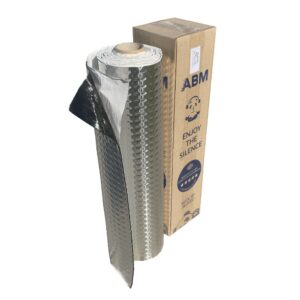
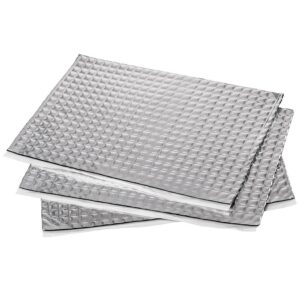
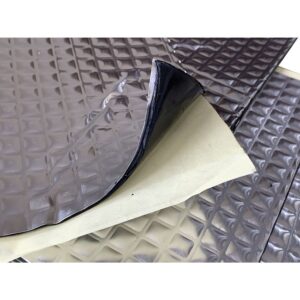
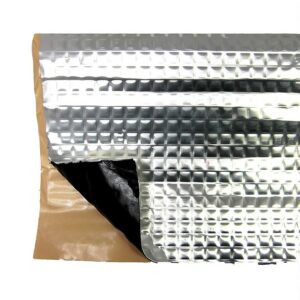
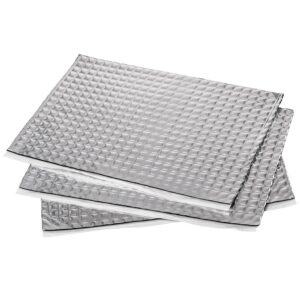
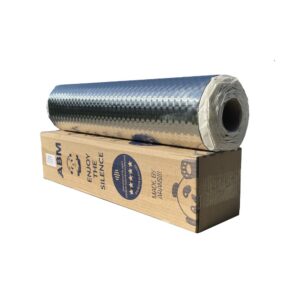
ABM Professional Butyl Mats feature high sound dampening effectiveness while maintaining optimal flexibility. The series is available in various thicknesses from 1.3 to 4 millimeters, allowing parameters to be tailored to specific needs. The 100-micron aluminum layer provides complete reflection of thermal radiation and acoustic waves.
Applications of Professional Mats include:
- Dampening sound in passenger and delivery vehicle cabins
- Insulating doors, floors, and trunk lids
- Dampening resonances in body panels
- Thermal protection of the engine compartment
The material retains its properties at temperatures ranging from minus 40 to 170 degrees Celsius. The self-adhesive layer eliminates the need for additional mounting materials. The flexible structure allows application on curved surfaces without risk of damage.
ABM Xtreme Series for Extreme Acoustic Conditions
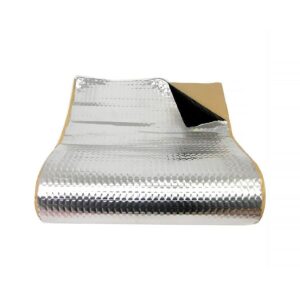
ABM Xtreme Mats have been designed for the most demanding applications requiring maximum soundproofing levels. The series provides the highest degree of acoustic insulation available from the manufacturer. Increased thickness of butyl mass guarantees effective damping of low frequencies below 200 hertz.
Xtreme materials are used in professional vehicle soundproofing projects as well as industrial machines. High surface mass ensures noise reduction of 5 to 10 decibels across a wide frequency range. The series is particularly effective in insulating commercial vehicles, campers, and motorboats.
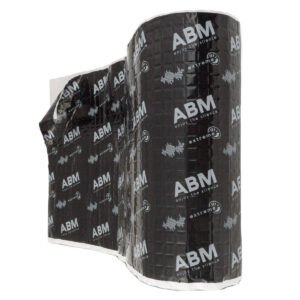
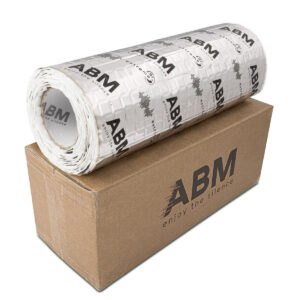

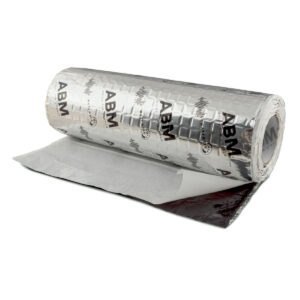
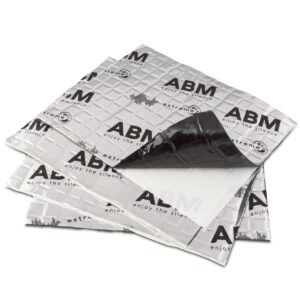

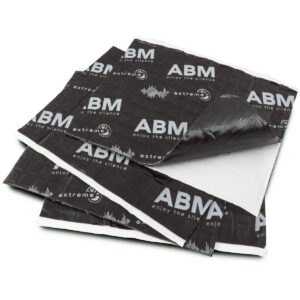
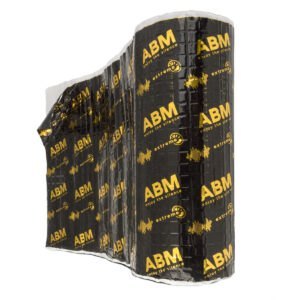

Order high-quality butyl mats directly from the manufacturer and experience the effectiveness of aluminum insulation. Contact the ABM Insulation team for a professional consultation regarding the selection of appropriate materials for your project.
Effectiveness of the aluminum layer in various operating conditions
Operating conditions for butyl mats encompass a wide range of temperatures, humidity, and mechanical loads. The aluminum layer must maintain its properties regardless of the working environment. The chemical stability of aluminum ensures resistance to most corrosive factors. The physical properties of the metal remain unchanged within a temperature range from minus 40 to 170 degrees Celsius.
In automotive applications, the butyl mat is exposed to vibrations, oils, and exhaust gases. The construction industry requires resistance to moisture and ultraviolet radiation. Industrial applications impose requirements for chemical and thermal resistance. Butyl mats from ABM Insulation have been designed with all these challenges in mind.
The long-term effectiveness of insulation depends on the preservation of properties in both layers of the material. Degradation of butyl could lead to a loss of vibration-damping properties. Corrosion of aluminum would reduce the radiation reflection coefficient. The manufacturer provides a 5-year warranty on maintaining the insulation parameters of ABM Professional and ABM Xtreme mats.
Moisture resistance and anti-corrosive action of aluminum
Aluminum exhibits natural corrosion resistance due to the formation of a protective oxide layer. An Al₂O₃ layer several nanometers thick forms spontaneously upon contact with air. Aluminum oxide is chemically inert and protects the metal from further corrosion. This process is referred to as surface passivation of aluminum.
Moisture does not cause degradation of aluminum properties in butyl mats. The metal retains full reflectivity even after prolonged exposure to water. The oxide layer may slightly increase thermal emissivity from 0.05 to about 0.10. This change does not significantly affect thermal insulation effectiveness. The radiation reflection coefficient remains above 90 percent.
Material resistance in harsh conditions:
- Relative humidity up to 100 percent: no degradation of aluminum properties
- Contact with water: formation of a protective passive oxide layer on the surface
- Chemical vapors: resistance to most acids and bases at operational concentrations
- Condensation of moisture: the aluminum layer does not corrode even with continuous condensation
- Salt action: resistance to chlorides under winter vehicle usage conditions
Butyl, as a hydrophobic material, does not absorb moisture. This property is crucial for maintaining the mass and density of the material. Hygroscopic materials could increase mass when saturated with water. Such changes would affect resonant frequencies and damping properties. Butyl maintains stable parameters regardless of ambient humidity.
The combination of aluminum and butyl creates a system resistant to moisture. The aluminum layer provides an additional barrier against the diffusion of water vapor. Butyl seals the edges, preventing moisture from penetrating the load-bearing structure. This effect is particularly important in construction applications, where moisture control is crucial.
Preservation of Insulating Properties During Temperature Changes
Thermal stability of insulating materials determines their long-term effectiveness. Aluminum retains its physical properties unchanged over a wide temperature range. The radiation reflection coefficient does not depend on the metal’s temperature. The crystal structure of aluminum remains stable up to a melting temperature of 660 degrees Celsius.
Butyl exhibits viscoelastic properties throughout its operational range from minus 40 to 170 degrees. At low temperatures, the material becomes slightly stiffer while maintaining flexibility. High temperatures increase the viscosity of butyl, improving vibration damping. The absence of asphalt in the composition prevents brittleness in frost and excessive softening in heat.
Thermal cycles of heating and cooling do not degrade the properties of the composite. The coefficients of thermal expansion for aluminum and butyl are similar. Aluminum has a coefficient of 23 micrometers per meter Kelvin. Butyl has a value of about 200 micrometers per meter Kelvin. This difference does not cause delamination during thermal cycles, as the flexibility of butyl compensates for stresses.
The adhesive layer in ABM mats maintains adhesion at extreme temperatures. The butyl rubber-based adhesive does not lose its grip in frost. High temperatures do not cause dripping or degradation of the adhesive layer. This stability ensures durability during installation for more than 10 years.
Tip: When installing butyl mats in low-temperature conditions below 10 degrees Celsius, it is recommended to gently heat the surface to 15-20 degrees, which improves adhesive grip without risking damage to the material.
FAQ: Frequently Asked Questions
How does the thickness of the aluminum layer affect insulation effectiveness in butyl mats?
The thickness of the aluminum layer is crucial for acoustic and thermal insulation effectiveness. ABM Professional butyl mats use true aluminum foil with a thickness of 100 microns, which is the thickest available layer on the market. Such thickness ensures complete reflection of thermal radiation and sound waves, achieving a reflection coefficient of 95 percent.
Thinner aluminum layers below 50 microns significantly reduce insulation effectiveness. Metallized films with a thickness of only several tens of nanometers reflect only 70-80 percent of radiation. A thickness of 100 microns also guarantees greater mechanical strength of the material during installation and resistance to damage at bends.
Does a butyl mat with an aluminum layer require heating during installation?
A butyl mat does not require heating during installation. The flexible structure of butyl allows for easy shaping of the material at room temperature. It is sufficient to keep the mat in a room with positive temperatures for two hours before application.
The efficient adhesive layer based on butyl rubber provides strong adhesion without the need for a heat gun or other heat sources. The material is flexible enough to easily adhere to curved surfaces. This distinguishes it from bituminous mats, which require heating to temperatures exceeding 100 degrees Celsius. The use of a pressure roller is sufficient to achieve full surface adhesion.
What operating temperatures can the aluminum layer in butyl mats withstand?
The aluminum layer in butyl mats retains its full insulating properties in temperature ranges from minus 40 to 170 degrees Celsius. Aluminum does not change its radiation reflection parameters regardless of thermal conditions. The metal maintains a stable crystalline structure up to a melting temperature of 660 degrees, which significantly exceeds operational conditions.
Butyl remains flexible both in extreme cold and high temperatures occurring in the engine compartment. The material does not crack at low temperatures and does not soften excessively during heat waves. The absence of asphalt in the composition prevents degradation during thermal cycles. The combination of aluminum with butyl creates a system resistant to extreme conditions for over 10 years of use.
Does aluminum in butyl mats protect against moisture and corrosion?
Aluminum naturally protects against moisture by forming a protective oxide layer a few nanometers thick. The Al₂O₃ layer forms spontaneously when exposed to air and water, passivating the surface of the metal. This process prevents further corrosion even with prolonged exposure to moisture.
Aluminum foil also acts as an effective barrier against water vapor diffusion. Moisture does not penetrate through the metal layer into the supporting structure. Butyl, as a hydrophobic material, does not absorb water, maintaining constant mass and density. The combination of both materials creates an airtight insulation system resistant to condensation and atmospheric moisture in the range of 0 to 100 percent relative humidity.
What is the difference between real aluminum and metallized foil in mats?
Real aluminum with a thickness of 100 microns provides full reflective properties for radiation and sound waves. It reflects 95 percent of infrared radiation and effectively blocks noise propagation. Metallized foils contain an aluminum layer that is only 50 nanometers thick applied by vacuum sputtering. Such a layer reflects only 70-80 percent of thermal energy.
The difference in insulation effectiveness arises from the optical density of the material. Thin metallization may allow some radiation to pass through the polymer substrate. Real aluminum foil is completely opaque to all types of electromagnetic radiation. It also provides a solid mechanical structure reinforcing the entire butyl mat.
Does the aluminum layer significantly increase the weight of the mat and complicate installation?
The aluminum layer with a thickness of 100 microns adds about 0.27 kilograms per square meter to the total mass. This is a small fraction of the total mass of the entire butyl mat, which ranges from 2.4 to 4.8 kilograms per square meter. The additional mass improves low-frequency acoustic insulation by 2-3 decibels.
Aluminum does not hinder installation; on the contrary, it increases the rigidity of the material, facilitating precise application. The foil prevents excessive stretching of the butyl during rolling. The flexibility of the composite allows for installation on curved surfaces without the risk of damage. The material can be cut with regular scissors or a knife, forming fitted elements for insulated areas.
Summary
The aluminum layer in butyl mats is a key element that ensures effective acoustic and thermal insulation. Its high reflectivity, reaching 95 percent for infrared radiation and low thermal emissivity below 0.10, makes aluminum an excellent heat reflector. The crystal structure of the metal with free electrons also provides effective reflection of sound waves. The thickness of the aluminum layer at 100 microns in ABM Insulation mats guarantees full functionality while maintaining the flexibility of the material.
The combination of a dense butyl mass with a density of 1200 kilograms per cubic meter and an aluminum layer creates a system with unique properties. Butyl dampens vibrations and structural resonances, converting mechanical energy into heat. Aluminum reflects radiation and acoustic waves, acting as a barrier to energy flow. The synergistic action of both materials ensures effectiveness that significantly exceeds the sum of their individual effects.
The effectiveness of butyl mats has been confirmed across a wide range of applications. Noise reduction of 5-10 decibels in low and mid-frequency ranges improves acoustic comfort in rooms and vehicles. Reflecting 95 percent of thermal radiation translates into measurable energy savings. Resistance to temperatures from minus 40 to 170 degrees Celsius and to moisture ensures durability of properties over years of use in the most challenging conditions.
Sources:
- https://pmc.ncbi.nlm.nih.gov/articles/PMC11841031/
- https://pubs.acs.org/doi/10.1021/acs.langmuir.4c03838
- https://yajialuminum.com/reflectivity-of-aluminum/
- https://www.sciencedirect.com/science/article/pii/S2468080X17301115
- https://pmc.ncbi.nlm.nih.gov/articles/PMC8640968/
- https://pl.wikipedia.org/wiki/Aluminium
- https://en.wikipedia.org/wiki/Aluminium
- https://en.wikipedia.org/wiki/Butyl_rubber
