
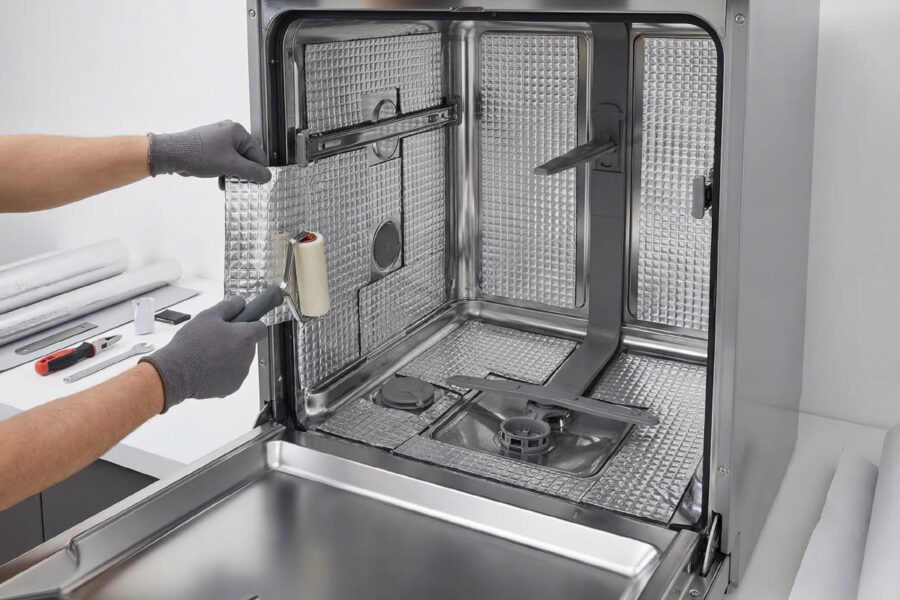
A working washing machine can generate noise up to 90 decibels during the spin cycle, which is equivalent to the noise level of street traffic. A dishwasher produces an average of 46 to 55 dB during its wash cycle, which can be very bothersome in a small apartment. Many people are looking for an effective way to reduce this problem without replacing their appliances with new ones.
One solution increasingly used in homes is a butyl sound-deadening mat, applied directly to the appliance’s casing. This material is well-known from the automotive industry, where it reduces noise and body vibrations. The question of whether it will perform just as well for household appliances is entirely valid. The answer requires understanding both the source of the noise and the mechanism of action of the material itself.
Where Does the Noise from Washing Machines and Dishwashers Come From?
Before using any insulating materials, it’s worth understanding exactly where the bothersome noise originates. Washing machines and dishwashers are appliances with moving parts, pumps, and motors that vibrate the entire casing during operation. Each component can be a separate source of unwanted sound.
Types of Vibrations in Household Appliances
The noise generated by a washing machine comes from several different sources simultaneously. The rotating drum, electric motor, and water drainage pump operate at the same time, creating a complex acoustic profile. Each of these components produces a different type of vibration that is transmitted to the metal casing.
Three basic noise-generation mechanisms can be identified:
Sources of Noise in Household Appliances
- structural vibrations of the casing caused by the motor and pump
- drum vibrations during high-speed spinning
- resonance of the casing panels, amplifying initially weak sounds
Structural vibrations are particularly important from a soundproofing perspective. They are transmitted through the casing and radiate sound outwards, regardless of the appliance’s placement. The metal casing panels act like a speaker diaphragm, amplifying even the slightest vibration.
Acoustic Frequencies Generated During Operation
During the wash cycle, a washing machine primarily operates in the low-frequency range, from 50 to 200 Hz. During the spin cycle, slightly higher frequencies dominate, which are more penetrating and harder to dampen by walls. A dishwasher primarily generates the sound of water, the operation of the pump motor, and the clatter of dishes.
Low tones, such as humming and rumbling, are the most difficult to dampen with traditional materials. It is in this range that butyl acoustic matting performs exceptionally well. The high-density material acts as an effective barrier for low-frequency waves, whereas lighter polyurethane foams have significant problems with them.
Why Thin Casing Walls Exacerbate the Problem
The casings of washing machines and dishwashers are made of thin steel sheets, typically 0.5 to 1 mm thick. Such thin metal has a very low inherent mass, causing it to easily enter into resonance under the influence of vibrations from the motor or pump. The effect is similar to striking an empty can, where the thin wall amplifies and radiates sound.
Increasing the surface mass by attaching additional material effectively reduces the tendency of sheet metal to resonate. This is the main principle behind sound-deadening mats. The heavier and more damping the layer on the sheet metal, the less acoustic energy escapes outwards.
What is a butyl mat and how soundproofing works
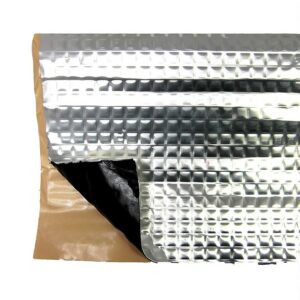
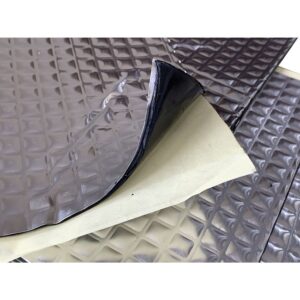
Butyl mats are insulation materials made from butyl rubber, most often reinforced with a layer of aluminum foil. Originally used for soundproofing cars, they have also found applications in industry, construction, and for soundproofing household appliances. Their effectiveness stems from the unique physical and chemical properties of butyl itself.
Construction and properties of butyl material
Butyl rubber is a polymer characterized by exceptionally high density and viscoelasticity. This combination allows the material to absorb mechanical energy very efficiently. It does not crack and maintains flexibility over a wide temperature range, from minus 40 to plus 170 degrees Celsius, making it durable in domestic conditions.
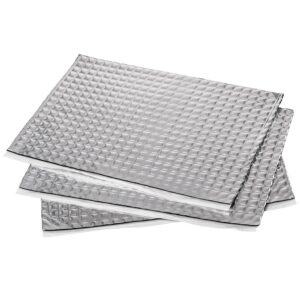
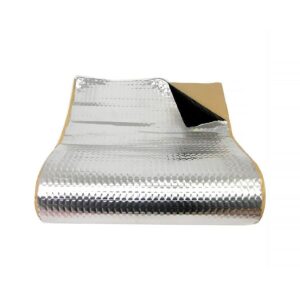
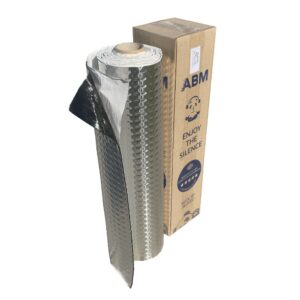
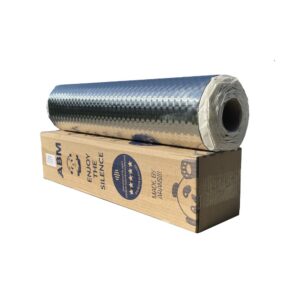
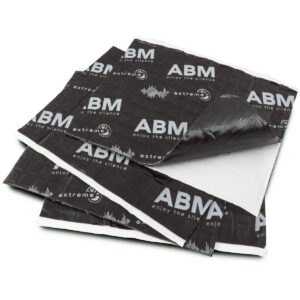
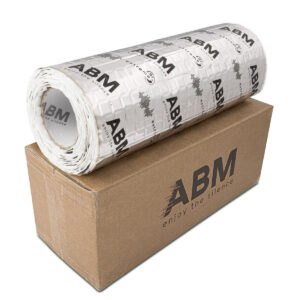
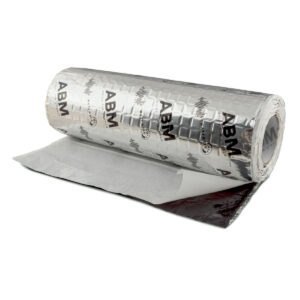
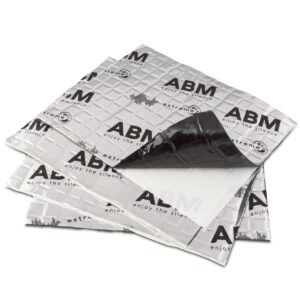
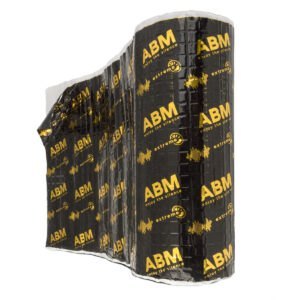
Products from ABM Insulation’s offer, such as ABM Professional butyl mats, are available in sheets and rolls with thicknesses ranging from 1.3 to 4 mm. They are equipped with a self-adhesive layer, which simplifies installation without the need for additional glue or heating the material. The aluminum layer on the surface reflects some sound waves and prevents substrate corrosion.
Properties of butyl:
- high density ensuring significant mass per unit area
- viscoelasticity that converts vibrations into heat
- resistance to moisture and mold, important in kitchen environments
- flexibility that facilitates application on irregular surfaces
- absence of toxic components, safe for domestic use
Mechanism of acoustic energy absorption
The operation of a sound-deadening butyl mat is based on the phenomenon of energy conversion. Sound waves or mechanical vibrations reaching the mat’s surface are absorbed by the elastic structure of the butyl. The acoustic energy is then converted into minimal amounts of heat and dissipates within the material instead of radiating further.
This mechanism works on two levels simultaneously. Firstly, the increased mass of the attached mat lowers the resonant frequency of the sheet metal, reducing its tendency to vibrate. Secondly, the viscoelastic butyl actively dampens vibrations, converting them into heat. The effectiveness of sound damping by butyl is 72% higher than that of asphalt materials, especially at higher temperatures.
Differences between butyl mats and other insulation materials
Various materials are available on the market for soundproofing appliances: polyurethane foams, mineral wool, bitumen mats, and butyl mats. Each has a different range of noise reduction and distinct performance characteristics. The table below clearly summarizes these differences.
| Material | Noise Reduction | Moisture Resistance | Temperature Range | Flexibility |
|---|---|---|---|---|
| Butyl mat | 25–35 dB | High | from −40 to +170°C | Very High |
| Polyurethane foam | 15–25 dB | Low | from −20 to +80°C | Medium |
| Mineral wool | 20–28 dB | Low | up to +700°C | Low |
| Bitumen mat (asphalt) | 15–25 dB | Medium | from −10 to +80°C | Low |
Butyl mat stands out for both its superior noise reduction effectiveness and its resistance to the conditions inside appliance housings. High humidity and variable temperatures are typical operating environments for washing machines or dishwashers. Materials with low moisture resistance lose their properties and peel off after a few months.
How to Properly Apply Soundproofing Butyl Mat in Appliances
Choosing the right material is only half the battle. Proper installation determines whether the soundproofing effect will be long-lasting and effective. Inaccurate adhesion, skipping surface cleaning, or insufficient coverage of the metal sheet will prevent the investment from yielding the desired results.
Preparing the Housing Surface Before Installation
The first step is to disassemble or remove the appliance’s housing to gain access to the inner metal walls. Metal surfaces require thorough cleaning to remove dust, grease, and any contaminants. Dirt and grease significantly reduce the adhesion of the mat’s adhesive layer, leading to it peeling off over time.
It is best to use a degreaser or isopropyl alcohol for cleaning and wait for the surface to dry completely. Installing on a wet or slightly damp metal sheet is a fundamental mistake. A dry and clean surface is a prerequisite for durable adhesion.
Applying the Mat and Rolling
After preparing the surface, cut pieces of the mat to fit the individual housing panels. It is advisable to cover at least 60–70% of each wall’s surface to achieve a noticeable acoustic effect. The larger the covered area, the better the noise reduction.
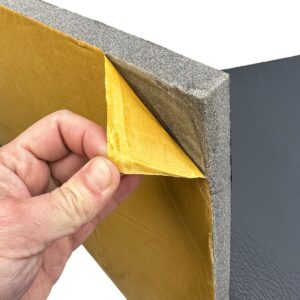
ABM Professional mat, available in sheets or rolls, allows for precise fitting to any shape. After peeling off the protective film from the adhesive layer, apply the mat to the metal sheet and press firmly. The crucial next step is to roll it with a hard rubber roller or the handle of a tool to eliminate air bubbles and ensure full contact across the entire surface.
Proper rolling directly impacts the quality of the bond and the durability of the insulation. Air bubbles under the mat weaken the vibration damping effect and can cause the material to detach. This stage requires sufficient attention.
Combining Butyl Mat with Rubber Foam
The soundproofing butyl mat itself effectively dampens structural vibrations and low frequencies. However, for a more comprehensive acoustic effect, it is recommended to combine it with insulating rubber foam. Rubber foam absorbs higher frequency sounds and acts as an additional layer for energy dissipation.
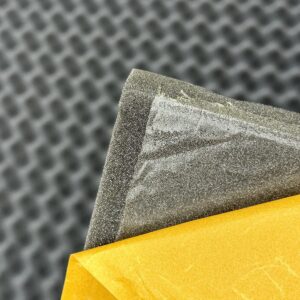
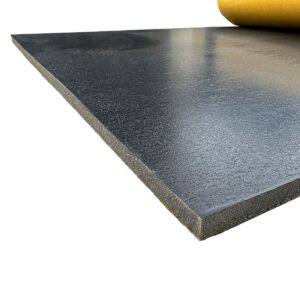
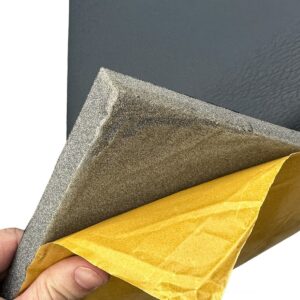
ABM Rubber Foam, available in self-adhesive versions from 3 to 19 mm thick, is applied over a pre-attached butyl mat. Its closed-cell structure ensures moisture resistance and durability in harsh environmental conditions. The combination of both materials creates a two-layer insulation system, significantly more effective than either material alone.


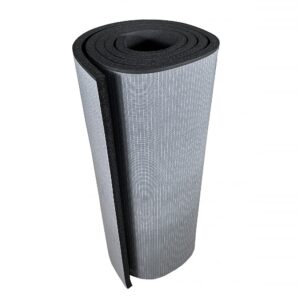
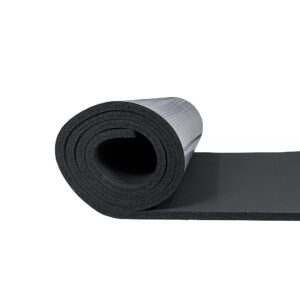
ABM Rubber Foam. Acoustic Insulation Self-adhesive, 32mm, 0.5m2
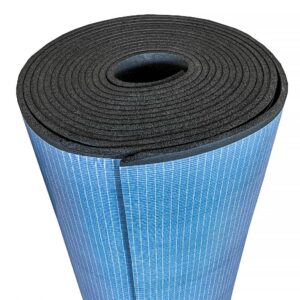
This combination is particularly effective for soundproofing side and rear panels where vibrations are strongest. It is also advisable to apply a layer of rubber foam under the appliance if it is placed on a hard floor. This reduces vibration transfer to the floor and adjacent rooms.
Common Mistakes When Soundproofing Home Appliances
Installing a butyl mat is simple, but several common mistakes can significantly reduce its effectiveness. Knowing these mistakes can help you avoid disappointment with the final result.
Mistakes to Avoid:
- Applying the mat without degreasing the metal surfaces first
- Insufficient surface coverage, below 50% of the panel
- Skipping the rolling stage, leaving air bubbles
- Using the mat on only one panel of the casing
- Installation on a wet or cold surface below 10°C (50°F)
Installation at temperatures below 10°C (50°F) weakens the adhesive layer’s grip. It is best to perform the application at room temperature. Neglecting the rear panel of the casing, through which most vibrations escape, is one of the most common errors that diminishes the overall effect of the operation.
Tip: If access to the inside of the casing is difficult, you can also apply the mat to the external surfaces of the appliance. The effect will be slightly weaker than from the inside, but still noticeable, especially when using a thicker mat of 3–4 mm.
ABM Insulation Products for Soundproofing Home Appliances
Effective soundproofing of a washing machine or dishwasher requires proven materials with confirmed acoustic properties. ABM Insulation, operating in the market since 2010, specializes in the production and distribution of insulation materials for industrial, automotive, and domestic applications. Orders are shipped within 24 hours, and delivery is fast throughout the European Union.
ABM Insulation’s product range includes butyl mats, rubber foams, and sound-absorbing acoustic foams. Each product has been developed for specific applications and frequency ranges. Choosing the right set of materials directly translates into a real soundproofing effect.
Butyl Mats and Foams for Soundproofing Home Appliance Casings
For soundproofing the casing of a washing machine or dishwasher, two products from the ABM Insulation offer are best suited. Each performs a distinct acoustic function and can be used separately or as a two-layer system.
ABM Insulation Butyl Mats:
- ABM Professional Butyl Mat – available in sheets and rolls with thicknesses from 1.3 to 4 mm, equipped with a self-adhesive layer. Made from butyl rubber with aluminum foil, it is asphalt-free and resistant to moisture and mold. It is suitable for the inner walls of household appliance casings.
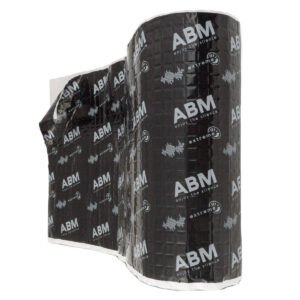
- ABM Xtreme Butyl Mat – a premium product with higher density and better vibration damping parameters. Designed for applications requiring more significant reduction of vibrations and low frequencies. The strong adhesive layer allows for permanent installation without heating.
Both mat lines are temperature-resistant in the range of minus 40 to plus 170 degrees Celsius and contain no toxic components. The ABM Xtreme product comes with a 5-year manufacturer’s warranty, confirming its durability in demanding conditions. An insulating rubber foam is applied over the butyl mat, available in self-adhesive versions with thicknesses from 3 to 19 mm. The rubber foam complements the butyl’s action by absorbing higher-frequency sounds and creating a two-layer insulation system.



Acoustic Foams for Improved Acoustic Comfort
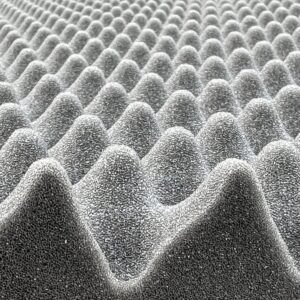
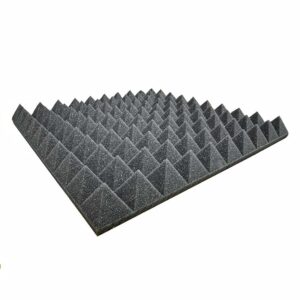
Complementing the set for quieting home appliances are sound-absorbing acoustic foams from ABM Insulation. Made from porous materials with an open-cell structure, they effectively absorb sound waves instead of reflecting them. Their application is particularly effective in reducing echo and noise in rooms where loud household appliances operate.
Variants of ABM Acoustic Foams:
-
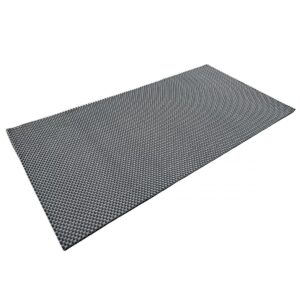
Flat polyurethane foams in thicknesses of 10, 20, and 30 mm, with a self-adhesive option
-
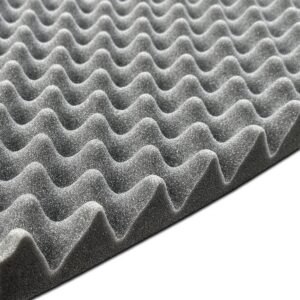
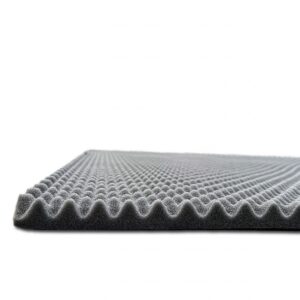
ABM WAVE profiled foams in thicknesses of 15, 20, and 40 mm, increasing the absorption surface area
-
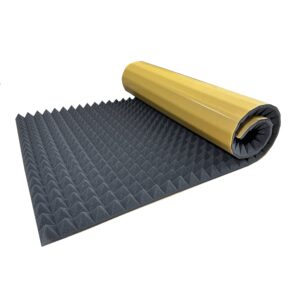
ABM PYRAMID foams with a thickness of 50 mm, used where significant reverberation reduction is required
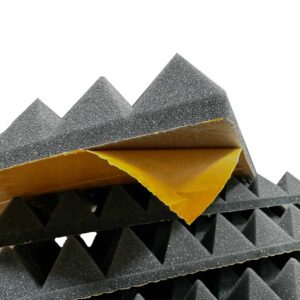
The materials are available in versions with a self-adhesive layer, simplifying installation without the need for specialized tools. ABM acoustic foams are characterized by their flame retardancy, resistance to external factors, and long-lasting sound-absorbing properties throughout their service life.
ABM Insulation customers highlight high-quality materials in reviews, efficient order processing, and expert advice when selecting appropriate products. Fast delivery within the European Union and professional pre-purchase support are features that set the company apart in the market. Before placing an order, you can consult with the ABM Insulation team regarding material selection to choose the right solution tailored to specific equipment and desired acoustic effect.
How effective is soundproofing a washing machine and dishwasher with butyl matting
The effectiveness of using acoustic butyl matting on appliance casings is real and measurable. However, it is not a method capable of completely eliminating device noise or replacing soundproofing from scratch in new models. It is important to have realistic expectations.
Real-world noise reduction effects in decibels
The application of butyl matting combined with rubber foam can reduce the noise level radiated by the casing by as much as 3–4 dB. While this may sound modest, in practice, it means a subjective perception of over 50% quieter sound, as the decibel scale is logarithmic. A 10 dB reduction subjectively corresponds to a twice as quiet sound.
A complete insulation system, consisting of butyl matting and rubber foam, can achieve noise reduction of 25–35 dB compared to bare metal. For appliance casings, the real acoustic gain after such soundproofing is several to a dozen decibels. For residents of apartment buildings or small apartments, such an improvement can be clearly noticeable.
Limitations of the method and situations where it is insufficient
Butyl soundproofing matting will not solve all noise problems with household appliances. There are several situations where insulating the casing alone will not provide sufficient improvement.
Limitations of the soundproofing method:
- when noise originates from mechanically worn components, e.g., bearings or pumps
- when the appliance is not level and vibrates as a whole unit
- when vibrations are transmitted mainly through the appliance’s legs to the floor
- when the problem is an internal resonating component casing that is inaccessible
For vibrations transmitted through the appliance’s legs, anti-vibration pads or mats placed under the appliance will be more effective. When the source of loud operation is a damaged bearing or a worn pump, the only solution is professional repair. Butyl matting works on the casing, not on the internal mechanics.
The best results are achieved by combining several methods simultaneously. Soundproofing the casing with butyl matting, anti-vibration pads under the appliance legs, and furniture enclosure are three complementary actions. Each of them eliminates a different path through which noise reaches the residents’ ears.
Tip: Before applying the mat, it is worth checking if the appliance is perfectly leveled. Incorrect washing machine setup can increase vibrations by up to 30%, and no soundproofing material can mechanically compensate for improper appliance operation.
FAQ: Frequently Asked Questions
Does a butyl mat actually reduce washing machine noise during spinning?
Yes, a butyl mat effectively reduces noise radiated by the metal casing walls of a washing machine. It works by increasing the mass of the sheet metal and absorbing vibrations that would otherwise be radiated as sound. The material converts mechanical energy into minimal heat instead of transmitting it further.
Applying the mat to the inner casing walls can reduce noise levels by several to a dozen decibels. The effect is particularly noticeable in the low-frequency range and engine hum, which are the most difficult to dampen by other methods. The best results are achieved when covering at least 60–70% of the surface area of each sheet metal panel.
Can a butyl mat be applied independently without specialized knowledge?
Installing a butyl mat on the casing of a washing machine or dishwasher is relatively simple and does not require specialized knowledge. Simply remove the appliance casing, thoroughly clean and degrease the metal surfaces, and then apply the appropriately cut sheets of the mat. A crucial step is careful rolling to eliminate air bubbles.
The entire process usually takes 1 to 2 hours, depending on the size of the appliance. It is important to perform the installation at room temperature, not lower than 10 degrees Celsius. Low temperatures reduce the adhesion of the adhesive layer, which can result in the mat peeling off after a few weeks of use.
What butyl mat thickness should be chosen for soundproofing home appliances?
For soundproofing washing machines or dishwashers, butyl mats with a thickness of 1.3 to 2.5 mm are most commonly used. Thinner versions are suitable for large flat panels where the main goal is to reduce sheet metal resonance. Thicker sheets, up to 3–4 mm, are better at dampening strong vibrations at high spin speeds.
When choosing the thickness, consider the space inside the casing. A mat that is too thick may hinder the reassembly of panels or restrict airflow around components. An optimal solution is a mat with a thickness of 2 mm, which provides a good balance between effectiveness and ease of installation.
Is a butyl mat alone sufficient, or are additional materials needed?
A butyl mat alone is very effective at dampening vibrations and low frequencies. However, the full acoustic effect is only achieved when it is combined with insulating rubber foam, applied as a second layer. The foam absorbs higher and mid-frequency sounds, which the butyl mat does not eliminate as effectively.
A two-layer system, consisting of a butyl mat and rubber foam, is a proven solution used in both automotive applications and for quieting home appliances. ABM rubber foam is available in self-adhesive versions of various thicknesses, making it easy to fit into the available space inside an enclosure. The effect of combining both layers is significantly better than using each material separately.
Is a butyl mat safe inside a home appliance?
A butyl mat is a safe material for use inside home appliances. Butyl rubber does not emit harmful substances at temperatures typical for home appliance enclosures, usually not exceeding 60–70 degrees Celsius. The material maintains full chemical and mechanical stability in the range of minus 40 to plus 170 degrees Celsius.
The mat is resistant to moisture and mold, which is important in the environment of a washing machine or dishwasher, where humidity inside the enclosure can be elevated. Products from the ABM Professional line have been tested for safety and do not contain toxic substances. Ceramic and metal surfaces of the enclosure are not damaged by the adhesive layer.
Does a butyl mat dampen vibrations transmitted through the floor?
A butyl mat applied to the appliance enclosure does not reduce vibrations transmitted from the washing machine’s legs to the floor. Both noise paths are independent of each other and require separate solutions. Floor vibrations are effectively reduced by anti-vibration rubber pads placed directly under the legs of a washing machine or dishwasher.
Comprehensive soundproofing of a home appliance therefore requires simultaneous action on several levels. The butyl mat eliminates noise radiated by the enclosure, anti-vibration pads dampen floor vibrations, and proper leveling of the appliance reduces mechanical stress on the drum. Each of these steps individually brings improvement, but when used together, they yield the best results.
Summary
Butyl mats are an effective tool for reducing noise radiated by the metal enclosures of washing machines and dishwashers. The material works by increasing the mass of the enclosure walls and actively absorbing vibrations, converting acoustic energy into heat. Combining a butyl mat with insulating rubber foam creates a system that can realistically reduce noise by several to a dozen decibels, which is noticeable in everyday use.
The effectiveness of this method depends on the care taken during installation, covering as much of the enclosure surface as possible, and proper substrate preparation. However, acoustic insulation of the enclosure is only one of the possible actions. Combining it with appliance leveling and anti-vibration pads provides a comprehensive and lasting solution to the problem of noisy home appliances.
Sources:
- https://pl.wikipedia.org/wiki/Kauczuk_butylowy
- https://en.wikipedia.org/wiki/Butyl_rubber
- https://pmc.ncbi.nlm.nih.gov/articles/PMC9571575/
- https://pmc.ncbi.nlm.nih.gov/articles/PMC10904857/
- https://dl.acm.org/doi/abs/10.1145/3453187.3453377
- https://www.spiedigitallibrary.org/conference-proceedings-of-spie/13279/3044558/Research-on-vibration-and-noise-reduction-perfor
