
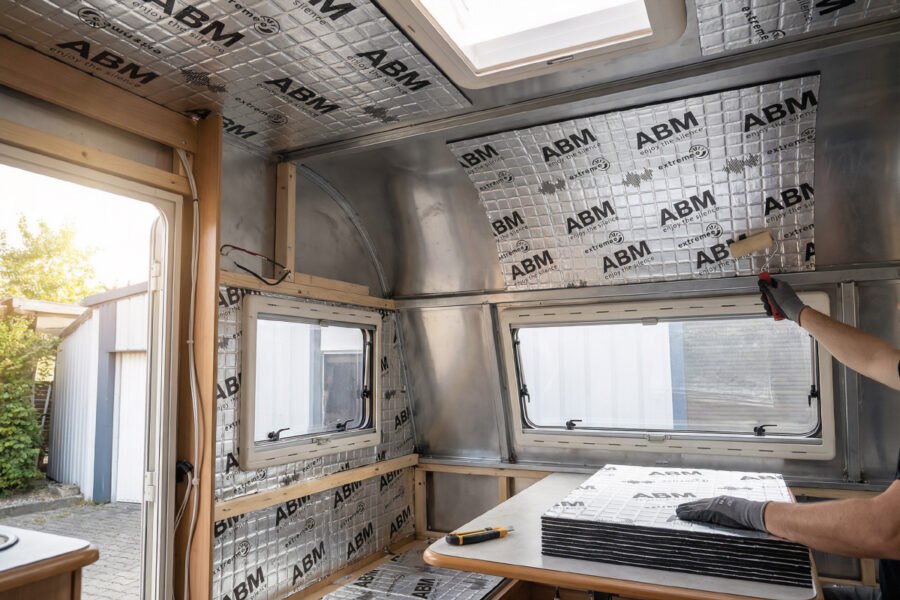
A caravan is a mobile home where peace and quiet are of utmost importance. Traveling with excessive road noise, rattling metal components, or wind noise can significantly spoil any trip. The question of the effectiveness of butyl mats is increasingly common among caravan owners seeking a proven acoustic solution.
Butyl materials have been used for years in soundproofing motor vehicles, campers, and industrial machinery. More and more people are checking if a butyl soundproofing mat will bring a similar effect to a caravan. The answer is not straightforward, and a full understanding requires knowledge of the construction of these materials and the specific nature of noise in caravans.
Well-planned caravan soundproofing translates into real comfort. Less noise while driving, quieter sleep at the campsite, and less noticeable chassis vibrations are effects achieved with the proper selection and installation of materials.
What are butyl mats and how do they work in soundproofing
Butyl materials are one of the most commonly used product groups in vehicle acoustic insulation. Their popularity stems from a combination of high specific mass, flexibility, and resistance to harsh conditions. Before deciding to use them in a caravan, it’s worth understanding the construction of these materials and their operating principle.
Construction and composition of a butyl soundproofing mat
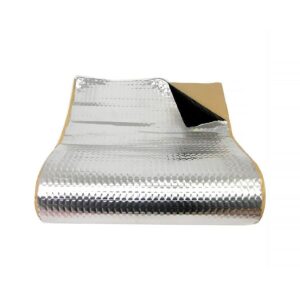
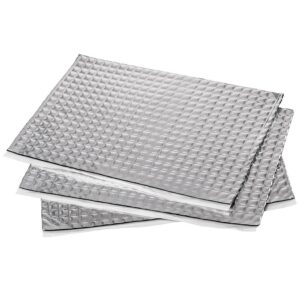
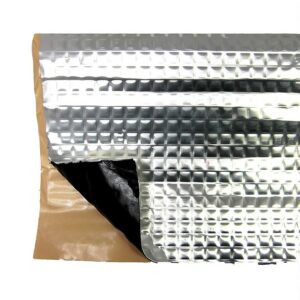
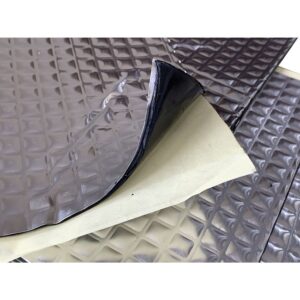
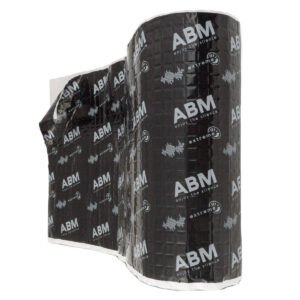
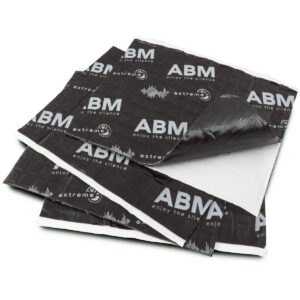
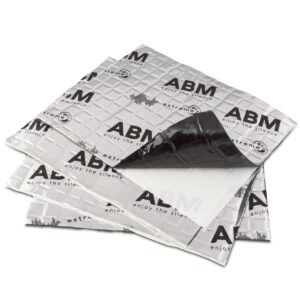
A butyl soundproofing mat is constructed from two main layers. The first is a layer of butyl, a high-density synthetic rubber. The second layer is aluminum foil, which stiffens the structure and facilitates installation. The entire assembly is held together by a self-adhesive bonding layer applied to the underside of the mat.
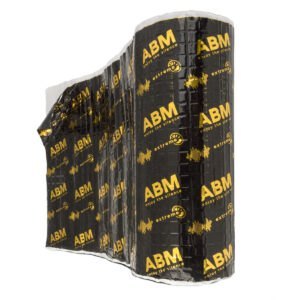
Butyl, as a material, is characterized by its high mass at a relatively small thickness. Mats are available in thicknesses from 1.3 to 4 mm, allowing for product selection tailored to specific applications. Products like the ABM Professional mat or the ABM Xtreme mat from ABM Insulation are made exclusively from natural raw materials, without the use of asphalt or toxic substances.
The absence of asphalt in the composition is an important feature. Asphalt becomes brittle and cracks at low temperatures, leading to the mat peeling off. Butyl mats do not have this drawback and maintain their flexibility in a temperature range from minus 40 to plus 170 degrees Celsius.
Vibration and noise damping mechanism
A butyl mat works by damping mechanical vibrations. When a metal sheet is set in motion by vibrations from the road or wind, the butyl mass attached to it absorbs the vibration energy and converts it into heat. The result is a significant reduction in sheet metal resonance.
The phenomenon of resonance is a major problem in vehicles with metal bodies. Large, flat sheet metal surfaces vibrate like diaphragms and amplify low tones. Butyl acoustic mat adhered to such surfaces stiffens the metal and reduces vibration amplitude. The effect is particularly noticeable at low frequencies, which are often perceived by the body as unpleasant vibrations.
Butyl mat does not absorb airborne noise, such as ambient sounds or human voices. To reduce such sounds, absorptive materials are needed, for example, acoustic foams or mineral wool. Butyl mats and absorptive materials complement each other’s action in a comprehensive insulation system.
Differences between butyl mat and other insulation materials
Several groups of materials are available on the market for soundproofing vehicles. Each works differently and is suitable for different applications. The table below shows the basic differences between the most popular solutions.
| Material | Main Action | Best Application | Moisture Resistance |
|---|---|---|---|
| Butyl Mat | Sheet Metal Vibration Damping | Floor, Walls, Roof | High |
| Sound Absorbing Acoustic Foam | Airborne Sound Absorption | Interior Walls, Ceiling | Medium |
| Insulating Rubber Foam | Thermal and Acoustic Insulation | Floors, Walls | Very High |
| Mineral Wool | Sound Absorption | Cavities Behind Cladding | Low |
Butyl mat will not replace acoustic foam, and foam will not replace butyl mat. Both materials serve different functions in an insulation system. Insulating rubber foam, used by ABM Insulation, works excellently as a complementary layer over butyl mat, combining thermal and acoustic properties.
Main Sources of Noise in a Camper Trailer
A camper trailer is a vehicle without its own engine, but the noise inside while driving can be very intense. Metal walls, floor, and roof react to every road imperfection and gust of wind. Identifying specific noise sources is the first step to effective soundproofing.
Road Noise and Chassis Vibrations While Driving
The trailer’s chassis transmits vibrations generated by the road surface to its entire structure. Every bump, crack in the asphalt, or stone hitting the floor creates a vibrational impulse that spreads through the metal construction. The trailer floor, especially its flat surfaces above the axles, resonates most strongly.
Vibrations transmitted through the chassis are structural noise, not airborne noise. This is precisely why butyl mat is the material of choice here. Applied directly to the metal floor, it absorbs vibration energy before it can set the entire trailer floor in motion.
Wind Noise and External Sheet Metal Resonance
While driving at high speeds, wind exerts variable pressure on the trailer’s walls and roof. The external metal sheet panels act like membranes and resonate at certain driving speeds or wind gusts. The result is a characteristic humming or droning sound audible inside.
Large, flat surfaces resonate particularly intensely. The side walls of camper trailers, often constructed from thin aluminum or steel sheets, are particularly susceptible to this phenomenon. Covering such surfaces with sound-deadening butyl mat reduces vibration amplitude and eliminates the membrane effect.
The extent of surface coverage with the mat directly impacts the effectiveness of soundproofing. There is no need to cover every square inch of sheet metal. Optimal coverage of large, flat panels at 40 to 50 percent of the surface area already provides a noticeable acoustic effect with minimal weight increase.
Vibrations Caused by Accessories and Interior Equipment
A camper trailer is equipped with components that can generate their own noise while driving. Cabinets, furniture fronts, loose equipment, and metal handles vibrate from the chassis-transmitted vibrations. This type of noise is often mistaken for external sheet metal resonance.
Vibrations caused by equipment are difficult to eliminate with butyl mat alone. An effective complement is sealing gaps between components with flexible foam and tightening all bolted connections thoroughly. However, butyl mat applied to the walls and floor reduces the amplitude of base vibrations, which translates to less vibration throughout the interior.
Ambient Noise While Camping in a Trailer
At a campsite, your trailer becomes both your bedroom and living room. Sounds from neighboring sites, the rustling of trees, and rain hitting the roof are airborne noises that penetrate walls and the roof. This type of noise is fundamentally different from road vibrations.
Butyl mats are less effective against this type of noise, as their primary strength lies in dampening structural vibrations. To reduce airborne noise, sound-absorbing materials with a high sound absorption coefficient are needed. Acoustic foam, used as a complementary layer above the butyl mat, significantly improves comfort while stationary.
Effectiveness of Acoustic Butyl Mats in a Camper Trailer
Understanding where and how an acoustic butyl mat works allows for a realistic assessment of its application results. A camper trailer differs from a passenger car in both its construction and usage. The effectiveness of the mats depends on the application area and the extent of surface coverage.
Areas in a Trailer Where Sound-Dampening Butyl Mats Perform Best
Sound-dampening butyl mats provide the greatest benefits where metal surfaces have a large area and direct contact with vibrations. The most important areas for soundproofing in a camper trailer are:
Highest Priority Areas:
- The floor above the axles and wheels, where vibrations are most intense
- Side walls with large, flat sheet metal panels
- The trailer roof, exposed to vibrations from wind and rain
- The front wall of the trailer, facing the towing vehicle
Applying the mat to the trailer floor above the wheel wells yields immediate results. This is the area where the vibrational energy generated by the wheels is greatest. Covering the floor with a 2 to 3 mm thick butyl mat reduces vibrations transmitted to the interior, significantly lowering the level of structural noise.
Side walls should be treated selectively. Focusing on the largest and flattest panels yields better results than uniformly applying the mat across the entire surface. Large, unobstructed sheet metal sections react most strongly to vibrations and require dampening first.
Expected Noise Reduction After Mat Application
Properly installed butyl mats, combined with other insulating materials, can reduce the noise level inside the vehicle by 5 to 15 decibels compared to the pre-insulation state. A reduction of 5 to 7 decibels is noticeable to the naked ear, signifying a clear decrease in noise and metallic rattling. A reduction of 10 to 15 decibels represents a significant improvement, making conversations and sleep comfortable even while driving.
A camper trailer with a complete insulation package, including butyl mats on the floor and walls, and sound-absorbing foam in the spaces between linings, can achieve a noise reduction of 20 to 30 percent compared to the baseline. The effects are particularly noticeable when driving on uneven surfaces and in strong crosswinds.
Butyl Mat Limitations and When They Aren’t Enough on Their Own
Butyl sound deadening mat has clearly defined effectiveness limits. The mat itself does not absorb airborne noise and will not replace a comprehensive insulation system. Understanding these limitations helps avoid disappointment and allows for proper planning of the entire soundproofing project.
Situations where butyl mat alone is insufficient.
Cases Requiring Supplementary Materials:
- Heavy rain noise on the roof requires additional sound-absorbing foam with a high NRC
- Ambient noise at a campsite needs airborne sound-absorbing materials
- Cold penetration through the floor requires insulating rubber foam as a second layer
- Noise from loose equipment requires mechanical sealing and tightening
Butyl mat is a starting point, not a complete solution. ABM Insulation recommends using butyl mats as the first layer directly on the metal sheeting, followed by rubber or acoustic foam as the absorption layer. This two-layer system ensures reduction of both structural and airborne noise.
Tip: Before purchasing materials, carefully measure the surface area of all metal panels on your trailer and plan to cover at least 40 percent of each. This approach helps avoid buying too little material and ensures effective soundproofing.
Products for Soundproofing a Camper Trailer at ABM Insulation Store
Effective camper trailer soundproofing requires practically tested materials. ABM Insulation is a manufacturer and supplier of insulation materials with many years of experience in the market, operating since 2010. The company specializes in acoustic insulation for vehicles, machinery, and buildings, and its products reach customers in Poland, European Union countries, and the United States.
ABM Insulation’s product range includes butyl mats, rubber foams, and sound-absorbing acoustic foams. Products are available in various thicknesses and formats, allowing you to match the material to the specific area of the trailer. The company guarantees shipment within 24 hours of purchase and a 5-year warranty on all its products.
ABM Professional and ABM Xtreme Butyl Mats
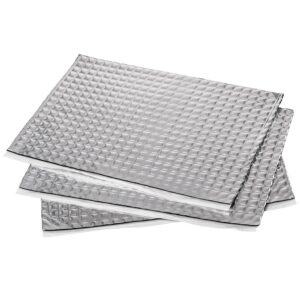
ABM Insulation offers two lines of sound deadening butyl mats. Each is designed for a slightly different range of applications and differs in parameters.
Comparison of ABM Insulation’s Butyl Mat Lines:
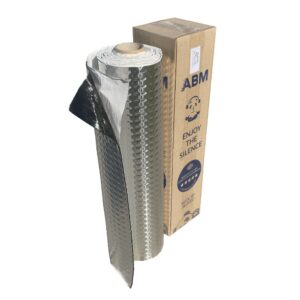
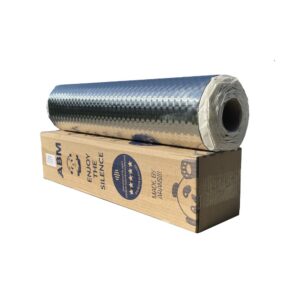
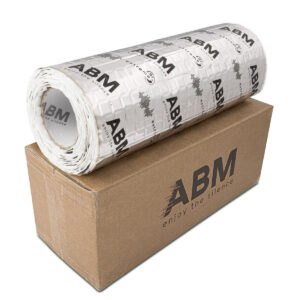
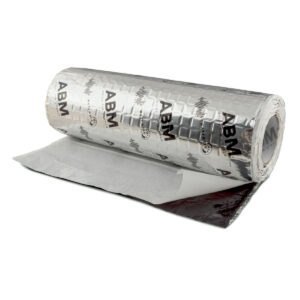
- ABM Professional Mats available in thicknesses from 1.3 to 4 mm, sold in sheets and rolls with an area of 0.5 to 2 m²
- ABM Xtreme Mats premium class, with higher material density, designed for more demanding acoustic applications
- Both lines do not contain asphalt or toxic substances
- Aluminum foils in the composition guarantee stability and facilitate installation
- Maintains flexibility in the temperature range from minus 40 to plus 170 degrees Celsius
The mats from both lines are self-adhesive and do not require additional glue or heating during installation. The product is perfectly suited for caravans, motorhomes, as well as for soundproofing industrial machinery and ventilation ducts. The high flexibility of the material allows it to be applied to curved surfaces and in hard-to-reach places.



Rubber and Acoustic Foams as a Complementary Layer
The acoustic butyl mat itself is the first layer of insulation, but full comfort is achieved with the use of airborne sound-absorbing materials. ABM Insulation provides two types of such materials.
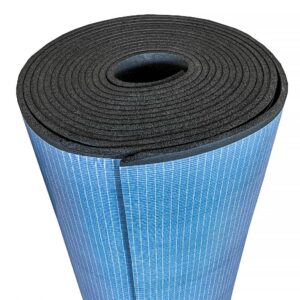
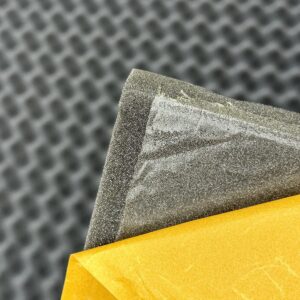
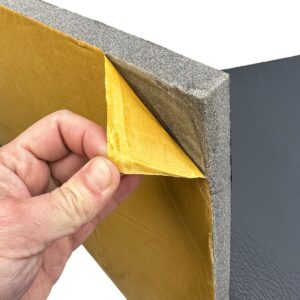
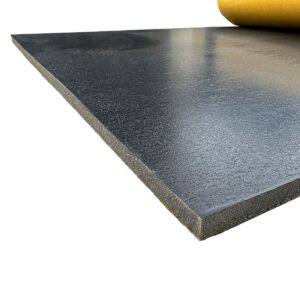
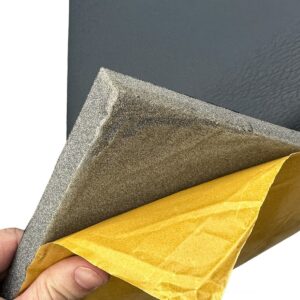
ABM Insulation Rubber Foams are materials with a closed-cell structure. Thanks to this construction, they are resistant to moisture, chemicals, and mold, while also providing thermal insulation. The foam is available in thicknesses from 3 to 19 mm, also in a variant with aluminum foil, which further enhances thermal insulation properties. It is a self-extinguishing material, which increases safety in enclosed spaces.
Application of rubber foam in a caravan:
- Applied as a second layer directly over the butyl mat on the floor
- Used in spaces between linings and external walls
- Used under the floor covering to improve walking comfort
- Laid on the caravan ceiling as a complement to roof soundproofing


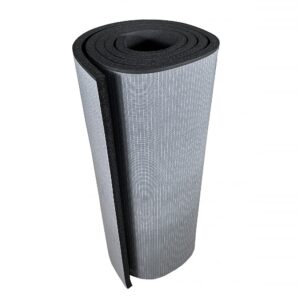
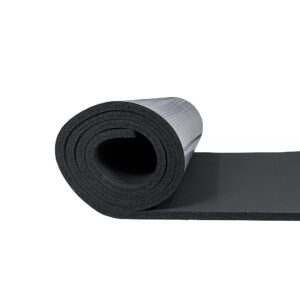
ABM Rubber Foam. Acoustic Insulation Self-adhesive, 32mm, 0.5m2
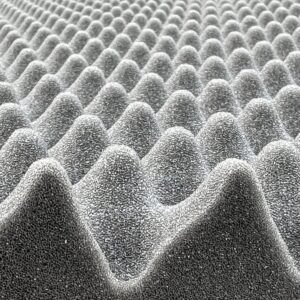
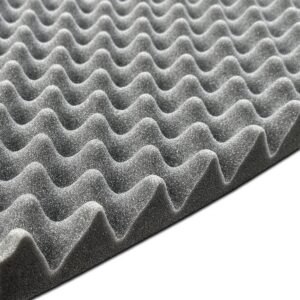
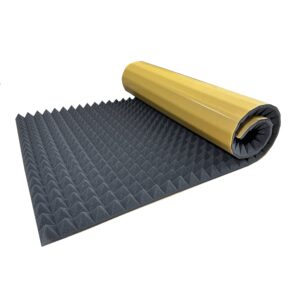
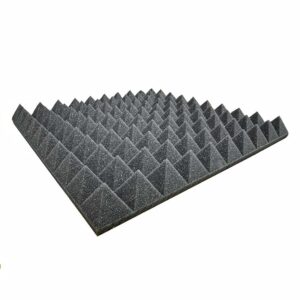
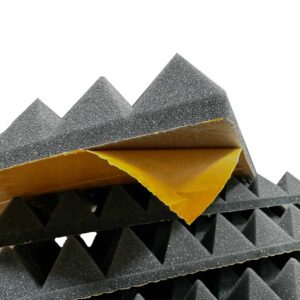
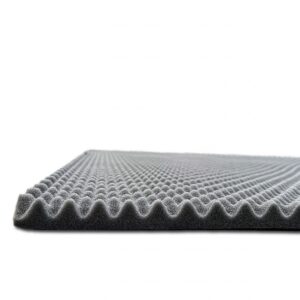
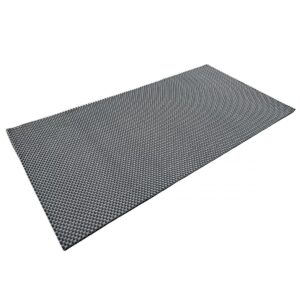
ABM Absorbing Acoustic Foams complement the insulation system by absorbing sound within the space. They reduce echoes, airborne resonance, and noise generated near the motorhome during stops. The combination of butyl mat with rubber foam and acoustic foam creates a complete, multi-layer insulation system that significantly enhances travel and relaxation comfort in a caravan.
ABM Insulation customers regularly provide positive reviews regarding both product quality, order fulfillment speed, and professional support in material selection. Expert advice is an important element of the service, as choosing the correct mat thickness and material combination directly impacts the final soundproofing result.
Orders for soundproofing butyl mats and insulation foams can be placed directly in the ABM Insulation online store. If you have any doubts regarding product selection for a specific trailer model or the scope of planned soundproofing, the ABM Insulation team provides consultations and helps you choose the appropriate set of materials.
Installing Butyl Soundproofing Mats in a Camper Trailer
The quality of installation significantly determines the effectiveness of the entire insulation. Even the best butyl soundproofing mat, if installed carelessly, will yield poor results. Proper surface preparation and mat application technique are the foundation for durable and effective insulation.
Surface Preparation Before Applying the Mat
The self-adhesive layer of butyl mats requires a properly prepared substrate. The metal sheet must be dry, clean, and free of grease, rust, and loose paint coatings. Insufficient surface preparation can lead to the mat peeling off after a few weeks of use, especially with significant temperature fluctuations.
Surface preparation procedure step-by-step:
Cleaning the metal sheet before installation:
- Remove dust and loose dirt with a dry cloth or brush
- Degrease the surface with acetone or isopropyl alcohol
- Check the paint condition and remove any peeling fragments
- Wait for the surface to dry completely before applying the mat
The ambient temperature during installation is important. Butyl mats adhere best at temperatures above 15 degrees Celsius. In low temperatures, the adhesive becomes less active, and adhesion decreases. It is best to perform the work in a warm garage or on warm days.
Application Technique and Pressing of Butyl Mats
After surface preparation, the butyl mat is applied immediately after removing the protective film from the adhesive layer. The mat should be warm and flexible, which facilitates its shaping on curved surfaces and in hard-to-reach areas. Cold mats can be heated with a hairdryer or heat gun, which significantly improves their flexibility.
Pressing the mat is a step that is often overlooked but has a huge impact on the durability of the bond. After applying each section, it must be carefully pressed with a rubber or plastic roller. Pressing begins from the center of the section and moves towards the edges to push out any air bubbles from under the mat.
When joining successive mat sections, it is recommended to maintain a slight overlap or ensure a tight seam between edges. Gaps between sections are areas where the sheet metal can continue to resonate. Thoroughly covering the entire planned surface without gaps ensures insulation continuity and maximum vibration damping effectiveness.
Tip: After applying the butyl mats, it is advisable to check each section by lightly tapping it with your hand. Areas with well-adhered mat will sound dull, while poorly attached sections will still produce a metallic sound.
FAQ: Frequently Asked Questions
Can butyl mat detach from the walls or ceiling of a trailer in the summer with high temperatures?
Original butyl mats without asphalt additive will not sag from walls or ceilings even under intense sunlight. The butyl material maintains stability in temperatures ranging from minus 40 to plus 170 degrees Celsius, and the strong adhesive layer permanently bonds the mat to the sheet metal for many years.
An important condition for durable installation is proper surface preparation before bonding. The sheet metal must be degreased, dry, and free of loose coatings. A carefully pressed mat will not peel off, even with rapid temperature changes typical for caravans parked in direct sunlight.
What percentage of the sheet metal surface in a trailer needs to be covered with butyl mat to achieve a noticeable effect?
Covering approximately 40 to 50 percent of each large, flat sheet metal panel already provides a significant reduction in resonance and vibrations. Focusing the mats on the largest, most vibration-prone sheet metal sections yields better results than evenly applying thin strips over the entire surface.
The floor above the wheel wells, large side wall panels, and the trailer roof are the highest priority areas. Full coverage of these zones with appropriately dense butyl mat maximizes structural noise reduction during driving.
What thickness of butyl mat is suitable for soundproofing the floor and walls of a caravan?
For the trailer floor, butyl mat with a thickness of 2 to 3 mm is best. A thicker layer means greater mass per square meter, which directly translates to better damping of low frequencies generated by the chassis. The optimal material density ranges from 2.1 to 4.8 kg per square meter.
For the side walls and roof of the trailer, a mat thickness of 1.3 to 2 mm is sufficient. The sheet metal in these areas is thinner and resonates at higher frequencies, and a lighter mat effectively dampens such vibrations without excessively loading the trailer’s structure.
Will butyl mats be enough to completely silence a caravan?
Butyl mat alone reduces structural noise and sheet metal resonance, but it does not absorb airborne sounds such as voices from neighboring sites, wind noise, or rain. Comprehensive caravan soundproofing requires a system of at least two layers.
The first layer consists of a butyl mat adhered directly to the sheet metal. The second layer is an acoustic foam or insulating rubber foam laid over the mat. The combination of both materials reduces both structural and airborne noise, significantly enhancing the comfort of being inside the trailer.
Are butyl mats safe for health in the enclosed space of a camper trailer?
Butyl mats produced without added asphalt or toxic substances are completely safe in enclosed living spaces. The material does not emit harmful fumes or the characteristic tar-like odor typical of cheaper asphalt mats.
Mats made exclusively from virgin components do not contain toxic chemical compounds. This is particularly important in camper trailers where space is limited and ventilation can be restricted. Choosing asphalt-free mats eliminates the risk of volatile organic compound emissions during both installation and subsequent use.
How to properly press a butyl mat to ensure its durable adhesion to the sheet metal?
After adhering each section of the mat, it is essential to carefully press it down with a special rubber or plastic roller. The roller’s movement should start from the center of the applied section and move towards the edges. This action removes air bubbles from under the mat and ensures full contact between the adhesive and the sheet metal.
Sections of the mat on rounded surfaces and in hard-to-reach areas are easiest to shape after slightly heating the material with a heat gun or hairdryer. Warm butyl becomes more flexible and adheres more closely to irregular shapes. After completing the work, tapping each section with your hand allows you to check the quality of the installation. A dull sound indicates proper mat adhesion, while a metallic tone points to areas needing correction.
Summary
Butyl mats are effective for soundproofing a camper trailer, but their effectiveness depends on proper application. They work best where sheet metal generates structural vibrations, such as on the floor, walls, and roof. They will not solve all the trailer’s acoustic problems on their own, but they form an essential foundation for an effective insulation system.
Comprehensive trailer soundproofing relies on combining butyl mats as a vibration-damping layer with sound-absorbing materials for airborne noise. A system designed this way ensures a real reduction in noise both while driving and when parked at a campsite, leading to a significant improvement in travel comfort.
Sources:
- https://en.wikipedia.org/wiki/Butyl_rubber
- https://pl.wikipedia.org/wiki/Guma_butylowa
- https://www.semanticscholar.org/paper/Study-on-the-Design-of-Butyl-Rubber-Compound-and-Kim-Chung/e438c7467b175e62008c78a848d1386
- https://www.sciencedirect.com/science/article/pii/S0142941821003330
- https://patents.google.com/patent/WO2023137868A1/en
- https://researchintelo.com/report/butyl-sound-deadening-mat-market
