
Every driver knows the feeling when, at higher RPMs, the engine starts to make itself heard more and more through the floor or the dashboard. This noise is not just a nuisance, but a real problem that affects concentration and fatigue while driving. Butyl mats are one of the most proven solutions for reducing engine noise penetrating the vehicle interior and have been recognized for years by both professionals and car soundproofing enthusiasts.
The mechanism of their operation is based on the phenomenon of dissipating vibrational energy. Instead of allowing vibrations to spread freely across the bodywork, the butyl layer absorbs this energy and converts it into minimal amounts of heat. The effect is noticeable even after applying the mat to a relatively small area of sheet metal. Importantly, car soundproofing with a butyl mat works on many levels simultaneously: it dampens vibrations, reflects acoustic waves, and eliminates resonances that, in an unprepared car, can literally multiply engine noise.
Properly performed cabin soundproofing requires knowledge of both the properties of the materials and the areas through which engine noise most easily penetrates. The choice of the right mat and the precision of the installation are of key importance here. Every skipped area is a gap through which sound will find its way into the car, which is why a comprehensive approach to the subject is essential.
How a butyl mat turns engine vibrations into heat, not noise
Vibration damping by a butyl mat is a process that differs fundamentally from simple sound blocking. Body sheet metal without any insulation layer acts like a membrane that vibrates and radiates noise into the cabin. A butyl mat sticks to this sheet metal, changing its dynamic properties and drastically limiting its ability to vibrate.
The mechanism of dissipating vibrational energy in the butyl layer
Butyl is a synthetic rubber with exceptional viscoelasticity. When the body sheet metal vibrates under the influence of the engine, the butyl layer deforms along with it, but it does not return that energy in the form of vibrations. Instead, it absorbs it and converts it into minimal amounts of heat, which physicists call viscous damping. This phenomenon is the basis for the effectiveness of mats used for acoustic insulation of vehicles.
Imagine the sheet metal as a spring that, without a load, would vibrate long and loudly. A damping mass (specifically butyl) glued to it causes the vibration to die out almost immediately. In practice, this translates into silence inside the car because the sheet metal stops being a source of secondary sound emission. ABM Insulation butyl mats, made of high-quality butyl, provide exactly this effect of viscous damping on the surface connected to the sheet metal.
It is crucial that the mat adheres to the sheet metal without any air gaps. Even small spaces between the mat and the substrate significantly reduce the effectiveness of vibration damping, because the sheet metal in those areas can still vibrate freely.
The role of aluminum foil in reflecting acoustic waves from the bulkhead
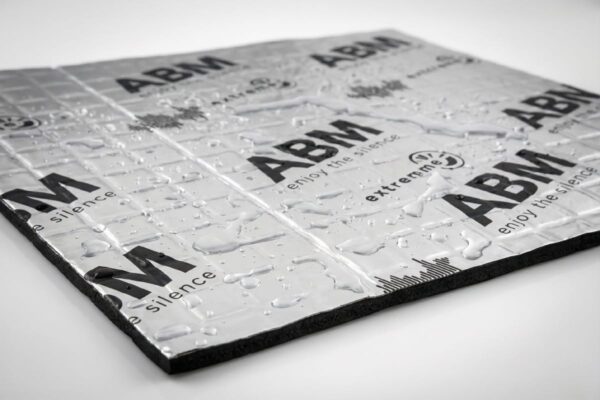
Every professional butyl mat has a layer of aluminum foil on one side. It performs several important functions simultaneously. First and foremost, the foil acts as a barrier that reflects acoustic waves that manage to reach the bulkhead from the engine compartment. Instead of passing through the sheet metal, these waves bounce off the aluminum and return to the source.
The aluminum foil also protects the butyl layer from high temperatures, which can be significant in the bulkhead area due to the proximity of the engine. ABM Insulation butyl mats in the ABM Xtreme class feature this exact composite structure, combining a butyl layer with aluminum foil, which ensures both effective engine noise damping and thermal resistance.
Why a car body without a mat acts like a membrane that amplifies engine noise
The thin steel sheet from which the car body is built has a natural resonant frequency. When engine vibrations hit this range, the sheet metal begins to vibrate with an amplitude significantly greater than the vibration source itself. This phenomenon acts as an amplifier, and the driver in the cabin hears louder noise than what the engine is actually generating.
Butyl mats interrupt this mechanism in a very simple way: they add mass and damping to the sheet metal. The mass shifts the resonant frequency outside the range of engine vibrations, and the butyl absorbs those that still appear in the car body structure. Without a soundproofing mat, even a relatively quiet car can seem loud precisely because of the resonance of the floor or bulkhead panels.
Which places in the cabin transmit engine noise most intensely
Soundproofing a car cabin begins with precisely identifying the paths through which engine noise enters the interior. It is not enough to stick a mat in one place and expect a full effect. Engine noise is insidious because it uses every leak, thin sheet metal, or uninsulated cable passage to get inside. Comprehensive vehicle soundproofing therefore requires action on several fronts simultaneously.
Main paths for engine noise to enter the cabin:
- The bulkhead separating the engine compartment from the cabin
- The floor around the center tunnel and under the seats
- Wheel arches and the upper part of the fenders inside the cabin
- Sills, pillars, and spaces between car body elements
- The hood as an additional sound reflector
Understanding that noise does not come from one place, but from many points simultaneously, changes the approach to soundproofing. Effective car acoustic insulation always covers several areas, and the order in which they are treated matters for the final result.
The bulkhead as the primary path for sound transmission from the engine compartment
The bulkhead, which is the body element between the engine and the cabin, is an absolutely priority area for soundproofing. Wiring harnesses, control cables, and other components pass through it, creating additional gaps for sound. The sheet metal of the bulkhead itself is often relatively thin and, without insulation, conducts both sound and vibrations very well.
Applying a butyl mat to the bulkhead from the cabin side brings the greatest and most immediately noticeable improvement in quietness in the car. It is recommended to cover at least 60 to 70 percent of the surface of this wall with the mat, with particular attention to the areas around cable grommets. It is a good idea to apply an additional layer of sound-absorbing acoustic foam over the butyl mat, which will absorb the remaining sound passing through the butyl layer.
Floor and center tunnel – hidden sources of resonance from the drivetrain
The car floor is constantly exposed to vibrations transmitted by the suspension, drivetrain, and exhaust system while driving. The center tunnel, under which the driveshaft or exhaust system runs, is particularly susceptible to resonance. These vibrations propagate through the floor sheet metal and reach the interior of the cabin as a dull thumping or low-frequency noise.
Floor areas requiring special attention:
- The floor pan under the front and rear seats
- The center tunnel along the entire length of the cabin
- The areas around seat and seatbelt mounts
- The space under the carpet near the door sills
Covering the floor with a butyl mat, followed by insulating rubber foam, creates a highly effective two-layer system. Thanks to its closed-cell structure, ABM Insulation rubber foam effectively blocks both sound and heat transfer, which improves the thermal comfort of the cabin simultaneously with the acoustic comfort.
Engine hood and wheel arches as points of secondary vibration emission into the interior
The engine hood is a surface often overlooked during soundproofing, although it is of great importance. It reflects acoustic waves generated by the engine back up and toward the side walls of the compartment, from where the noise penetrates into the cabin through leaks. Sticking a butyl mat to the inside of the hood limits this reflection effect and simultaneously dampens the vibrations of the hood sheet metal itself.
Wheel arches, in turn, are bombarded by pebbles, water, and other particles from the road, which generate characteristic tapping and rustling sounds. The inner surfaces of the wheel arches, accessible after removing the plastic covers, are an ideal place for applying a butyl mat. It dampens the vibrations of the wheel arch sheet metal and eliminates loud stone impacts, which are clearly audible in the cabin without insulation.
Covering sills and pillars to close off the final noise paths
The sills and body pillars form a kind of load-bearing skeleton for the body and, at the same time, channels through which noise can travel freely from one end of the car to the other. The interiors of the sills are often completely empty, which promotes the formation of resonances at low frequencies. Filling these spaces with a mat or specialized foam breaks this path of sound transmission.
The A, B, and C pillars, although smaller than the rocker panels, also conduct vibrations from the body structure to the door panels and side windows. Soundproofing them is relatively simple, as they only require thin sheets of butyl mat placed inside the pillar housing. The result is a reduction in the characteristic rattling of door components at certain driving speeds.
Technical parameters of butyl mats and the effectiveness of engine noise suppression
Not every butyl mat works with the same level of effectiveness. Differences in construction, thickness, and material density have a direct impact on how well a given product handles engine noise suppression. Before choosing a specific solution, it is worth learning about the technical parameters that determine the quality of acoustic insulation.
How the thickness and density of a mat affect the vibration damping coefficient
The thickness of a butyl mat is one of the key parameters affecting damping effectiveness. A thicker layer of butyl has more mass, which more strongly shifts the resonant frequency of the sheet metal and absorbs more vibrational energy. However, thickness alone without adequate density does not guarantee high effectiveness.
The density of the mat, expressed in kilograms per square meter, indicates how much mass the material adds to the treated sheet metal. The higher the density, the greater the damping effect. ABM Insulation butyl mats are available in various thicknesses, which allows for selecting the right material for a specific area of the vehicle body.
| Application area | Recommended mat thickness | Damping effect |
|---|---|---|
| Bulkhead | 3 to 4 mm | Very high |
| Floor and tunnel | 2 to 4 mm | High |
| Doors and side panels | 1.3 to 2 mm | Medium to high |
| Hood and wheel arches | 2 to 3 mm | High |
| Pillars and rocker panels | 1.3 to 2 mm | Medium |
The 0.1 mm thick aluminum foil found in ABM Professional mats provides complete reflective insulation and effectively reflects acoustic waves. This simultaneously results in higher thermal properties for the mat, which will be especially appreciated by a driver whose cabin heats up in the summer from a hot engine.
Minimum coverage of metal surfaces ensuring real noise reduction
Acoustic studies and the practice of installers indicate that covering at least 25 to 30 percent of a metal surface with a butyl mat already provides a noticeable noise reduction effect. With 50 percent coverage, the damping efficiency increases significantly. However, only coverage above 60 percent guarantees real cabin soundproofing that is noticeable to every passenger.
This means that you do not have to cover every centimeter of sheet metal to achieve a good result. What is key, however, is the strategic placement of mats in areas with the highest vibration amplitude. Areas near engine mounts, the center tunnel, and the bulkhead should always be treated as a priority and covered with the mat as much as possible.
Tip: Before purchasing a mat, it is worth measuring the surface area of the planned sections and adding 10 to 15 percent extra material for overlaps and fitting around irregularities. ABM Professional and ABM Xtreme mats are available in sheets and rolls of various sizes, which allows you to precisely select the amount of material without excessive waste.
Soundproofing materials at the ABM Insulation store
Effective car cabin soundproofing requires materials that have been proven in practice. ABM Insulation is a manufacturer of insulation materials with many years of experience, operating on the market since 2010. The assortment includes butyl mats and acoustic foams, which together create a complete soundproofing system tailored to various needs.
Every product has been verified in real automotive, industrial, and construction applications. Order fulfillment is efficient, and delivery is possible throughout the European Union.
Butyl mats and acoustic foams in the offer
The ABM Insulation store provides four main groups of materials used for vehicle soundproofing:
Butyl mats for soundproofing:
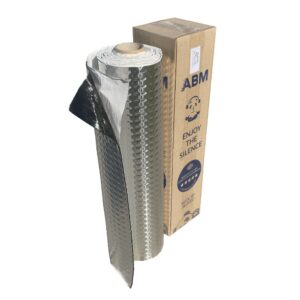
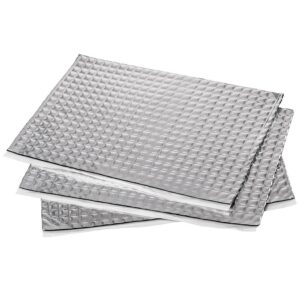
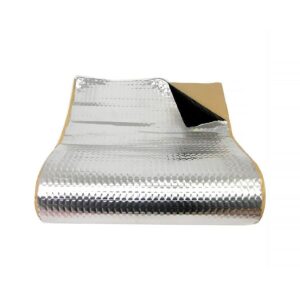
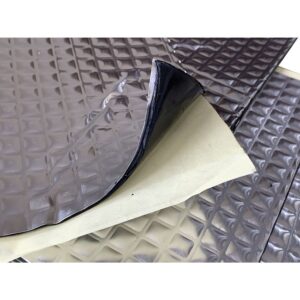
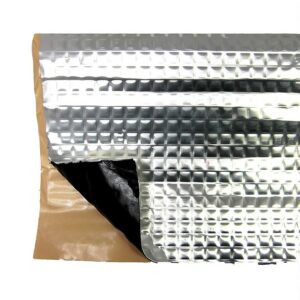
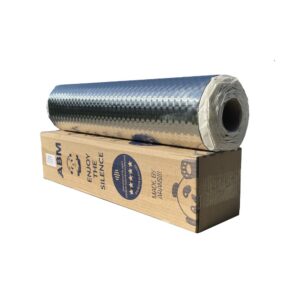
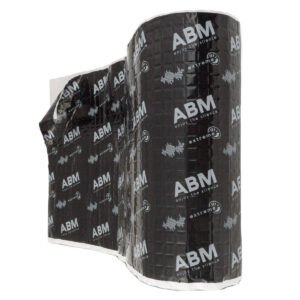
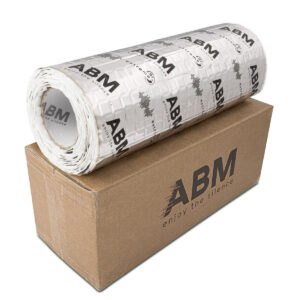
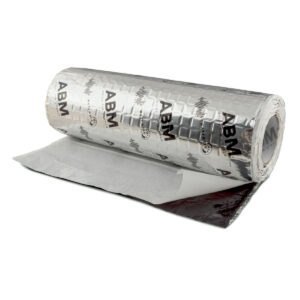
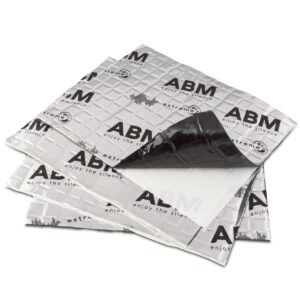
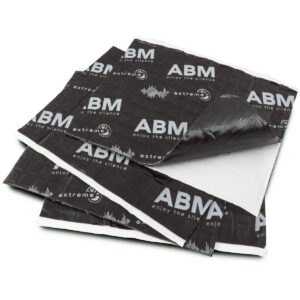
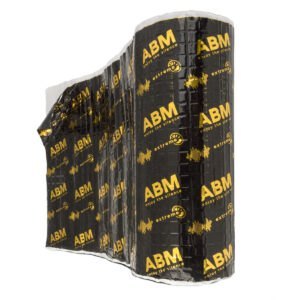
- ABM Professional butyl mats in sheets and rolls, available in thicknesses from 1.3 to 4 mm, with a 0.1 mm aluminum layer and a self-adhesive backing
- ABM Xtreme butyl mats intended for applications with increased acoustic requirements, characterized by higher density and surface mass
Both lines of mats contain butyl that is free of toxic substances and resistant to moisture and mold. The manufacturer provides a five-year warranty on all ABM brand products, which confirms the durability of the materials used and the reliability of the installation.



Foams complementing the insulation system
Foams that absorb higher sound frequencies are applied over the butyl layer. There are two types of complementary materials to choose from:
- Acoustic foams and panels with an open-cell structure absorb sound waves and eliminate echo inside the vehicle body space.
- Insulating rubber foams with a closed-cell structure block sound transmission and simultaneously provide thermal insulation for the cabin floor.
Combining a butyl mat with rubber foam creates a two-layer system with a wide range of effectiveness. The mat dampens structural vibrations of the sheet metal, while the foam insulates the cabin space from residual noise. The final effect is noticeable both at low engine speeds and at higher driving speeds.
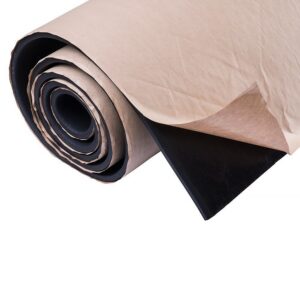
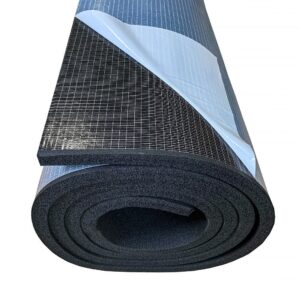
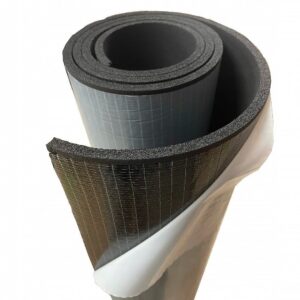
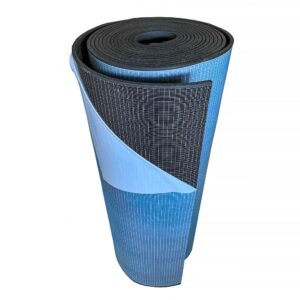
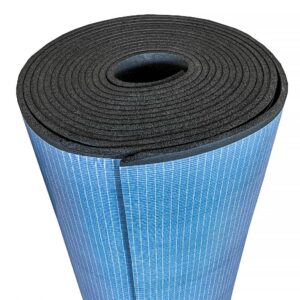
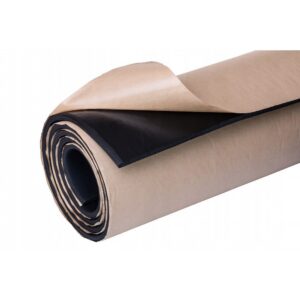
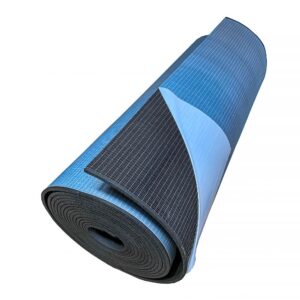
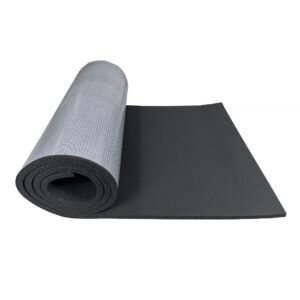
Rubber Foam. ABM Acoustic Insulation Self-adhesive, 25mm, 1m2
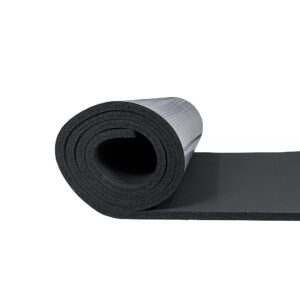
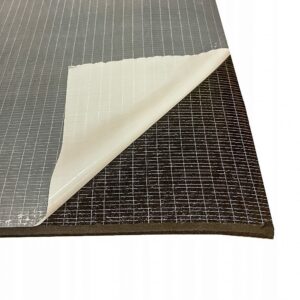
ABM Rubber Foam. Acoustic Insulation Self-adhesive, 32mm, 0.5m2
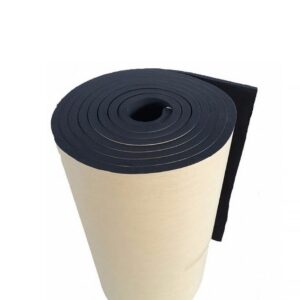
Rubber Foam. Acoustic Insulation Self-adhesive ABM, 32mm, 1m2
Before purchasing materials and selecting the appropriate thickness and quantity of products for a specific vehicle, you can take advantage of support and consultation from the ABM Insulation team. Customer opinions regarding product quality, service, and order fulfillment speed are available in ABM Insulation reviews.
How to properly install butyl mats to silence engine noise in the cabin
Even the best butyl mat will not fulfill its role if it is installed incorrectly. Installing soundproofing mats is a job that requires patience and precision, but it does not require any specialized tools or advanced technical knowledge. All you need is a well-prepared surface, the correct layer arrangement, and solid pressing of the material.
Preparing the sheet metal surface before sticking the butyl mat
Preparing the substrate is the stage that determines the durability of the entire insulation. The vehicle body sheet metal is almost always covered with a layer of factory anti-corrosion substance, bituminous primer, or simply dust and grease collected over years of operation. Each of these substances weakens the adhesion of the self-adhesive glue contained in the mat.
Sequence of surface preparation before mat installation:
- Remove old layers of bituminous insulation using a scraper or by carefully heating with a heat gun
- Degrease the sheet metal with an isopropanol-based preparation or acetone
- Wait a few minutes for the surface to dry completely
- Check by touch whether the sheet metal is dry and clean
The air temperature during installation matters. Butyl mats adhere best at temperatures above 15 degrees Celsius. At lower temperatures, the butyl becomes stiffer and harder to form, which can lead to the formation of voids under the mat. If the installation is taking place in a cold garage, it is worth gently heating the mat with a heat gun or a portable heating lamp before application.
Layering sequence – butyl as a base for acoustic foam
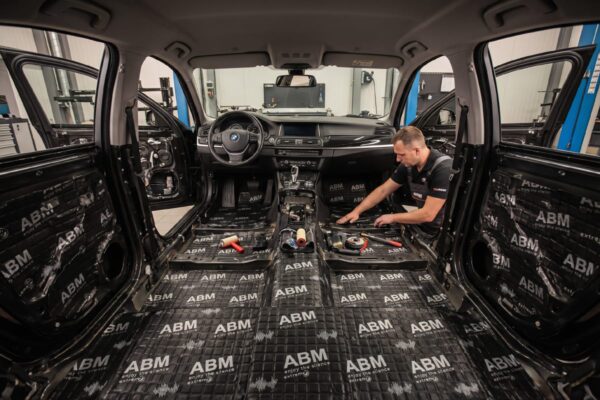
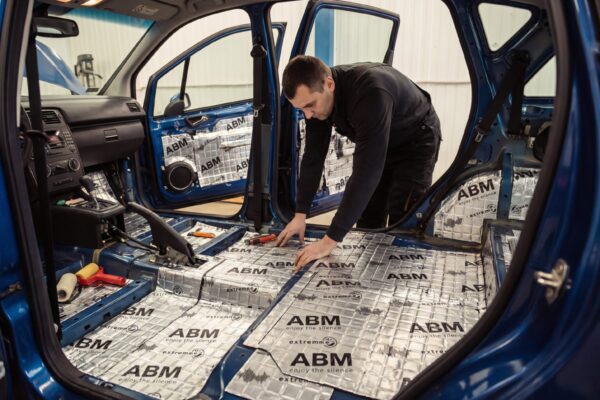
An effective acoustic insulation system in a car consists of several layers that perform different functions. The butyl mat always constitutes the first layer, glued directly to the bodywork sheet metal. Its task is to dampen vibrations and prevent resonance. Only then are subsequent materials laid on top of it.
The second layer consists of insulating rubber foam or sound-absorbing acoustic foam. ABM Insulation rubber foam with a closed-cell structure blocks sound transmission and additionally provides thermal insulation. Sound-absorbing acoustic foam, thanks to its open structure, absorbs residual sound waves and eliminates echo inside the bodywork space.
A well-chosen combination of a butyl mat and acoustic foam provides a synergistic effect, because each layer handles a slightly different frequency range. The mat better dampens low tones and structural vibrations, while the foam absorbs higher sound frequencies. The end result is a cabin that is quiet both when idling and at higher driving speeds.
Pressing and venting the mat with a roller to eliminate empty spaces
Simply applying the mat to the sheet metal is not enough to ensure a durable and effective bond. After placing the material on the surface, a special pressure roller must be used, which is moved over the entire surface of the mat from the center toward the edges. The movement of the roller squeezes out trapped air and presses the adhesive layer into every unevenness of the sheet metal.
Corners and areas with complex shapes require special attention. The mat should be cut along curves or folded so that it fits into recesses without wrinkling. Every wrinkle or air bubble represents a place where the sheet metal still has the ability to vibrate, and the insulation is ineffective at that point.
After completely installing the butyl mat and pressing it with a roller, it is worth checking the effect by tapping the sheet metal with your fist. A place without a mat makes a hollow, tinny sound. A surface covered with a mat should sound dull and muffled, without any resonance. This is a simple test that immediately shows where the insulation needs to be supplemented.
Tip: To press down the butyl mat in tight spaces, along door sills or pillars, a plastic roller with a handle or even a round pipe wrapped in a cloth works well. It is important that the tool allows you to exert even pressure without damaging the aluminum foil, which is sensitive to abrasion.
FAQ: Frequently Asked Questions
Does a butyl mat actually reduce engine noise, or does it only dampen body vibrations?
A butyl mat works in two ways simultaneously. First and foremost, it dampens the vibrations of the body sheet metal, converting vibrational energy into minimal amounts of heat. This phenomenon, known as viscous damping, causes the sheet metal to stop resonating and re-emitting noise into the cabin. As a result, engine noise is reduced because its vibrations no longer have a way to propagate through the body panels.
Acoustic studies confirm that butyl mats can lower the noise level in the cabin by up to 15 decibels with full coverage of key surfaces. With coverage of just the firewall and floor, the effect is on average between 3 and 7 decibels, which corresponds to a reduction in volume of over 50 percent as subjectively perceived by the driver.
What percentage of the sheet metal surface needs to be covered with a butyl mat for the engine noise reduction to be noticeable?
Covering just about 25 to 30 percent of the metal surface with a butyl mat produces a noticeable effect. At a coverage level of 60 percent, the damping efficiency increases significantly and is noticeable to every passenger. Therefore, you do not need to cover every centimeter of sheet metal to achieve a real result.
The key is the strategic placement of the mats in areas with the highest vibration amplitude. The firewall, the floor around the center tunnel, and the areas around the engine mounts are priority areas. It is there that the concentration of mats provides the best ratio of material used to the acoustic effect obtained. Other surfaces, such as wheel arches or doors, supplement the soundproofing and eliminate the remaining noise that still penetrates into the cabin through other paths.
Does installing a butyl mat on the hood make sense for reducing noise in the cabin?
The hood is often an overlooked element of soundproofing, although it has real significance for acoustic comfort. It reflects sound waves generated by the engine back toward the compartment, from where some of the noise penetrates through leaks and the firewall into the cabin. A butyl mat adhered to the inside of the hood dampens the vibrations of the sheet metal and limits this reflection effect.
To achieve full effectiveness on the hood, it is recommended to use butyl mats resistant to elevated temperatures, as there is significant heat in the engine compartment area. A combination of a butyl mat with aluminum foil works well here, as it simultaneously reflects thermal radiation and absorbs vibrations. Installation on the hood is relatively quick and does not require the disassembly of any interior elements, and the effect is noticeable after the very first drive.
Is a butyl mat alone enough to dampen engine noise, or is acoustic foam also needed?
A butyl mat alone is a solid foundation, but it does not exhaust the full potential of soundproofing. Butyl effectively handles low frequencies, such as the rumbling and resonance of sheet metal. However, higher sound frequencies, such as wind noise or higher engine tones, require an additional absorbing layer.
Absorbing acoustic foam applied over a layer of butyl creates a two-layer system with significantly higher effectiveness. Each layer is responsible for a different frequency range, which together makes the cabin quiet both at low engine speeds and at higher driving speeds. In turn, closed-cell insulating rubber foam additionally blocks sound transmission and provides thermal insulation, which increases cabin comfort throughout the year. Using both materials together is a solution used by professional installers as the standard for comprehensive vehicle soundproofing.
Summary
Butyl mats are the foundation of effective car cabin soundproofing. Acting on the principle of viscous damping, they absorb the vibrational energy of the bodywork sheet metal before it turns into noise audible to passengers. The key to success is a comprehensive approach covering all major paths of engine noise penetration, from the firewall, through the floor and center tunnel, to the wheel arches, hood, and body pillars.
Just as important as the choice of material is the precision of the installation. A properly prepared surface, a logical arrangement of layers with a butyl mat as a base and acoustic foam as a supplement, and careful pressing with a roller are the three pillars of successful insulation. ABM Insulation butyl mats, available in ABM Professional and ABM Xtreme variants, offer technical parameters adapted to the requirements of both standard installations and high-end setups, ensuring a lasting effect of engine noise reduction for many years of operation.
Sources:
- https://www.nature.com/articles/s41598-024-55823-x
- https://www.internationaljournalssrg.org/IJME/2025/Volume12-Issue2/IJME-V12I2P102.pdf
- https://pdfs.semanticscholar.org/1c36/deddee07c1267415aef1498daca065417ac0.pdf
- https://www.diva-portal.org/smash/get/diva2:317219/FULLTEXT01.pdf
- https://saemobilus.sae.org/papers/improvement-noise-transmission-across-firewall-a-passenger-car-2010-01-0751
- https://rjav.sra.ro/index.php/rjav/article/view/433
- https://www.acsu.buffalo.edu/~ddlchung/Materials%20for%20vibration%20damping.pdf
- https://automotive.sika.com/dam/dms/global-industry/r/damping-of-structure-bornenoiseinautomobiles.pdf
- https://pub.dega-akustik.de/DAGA_2017/data/articles/000009.pdf
- https://s3-prod.rubbernews.com/2021-05/RPN_20210517_tech_notebook.pdf
- https://ojs.acad-pub.com/index.php/SV/article/view/2649