Noise while driving can be truly annoying. Sheet metal vibrations, tire hum, floor rumbling, and wind pushing through every gap. Butyl mats for car soundproofing are materials that effectively reduce these problems. However, the market offers dozens of products that differ in composition, thickness, and build quality.
Before purchasing, it is worth carefully checking several key parameters. A bad choice means not only wasted money but also the need to disassemble the upholstery again. A good mat dampens vibrations for years without cracking, peeling, or losing flexibility.
How to choose butyl mats for car soundproofing
Choosing the right butyl mat starts with determining the installation location and the type of noise to be eliminated. Each body element generates a different type of sound, and effective car soundproofing requires matching the material to the specific application. A mat that is too thin will not handle low frequencies, while one that is too thick unnecessarily increases the vehicle’s weight.
What thickness of butyl mats to choose for doors and floors
The thickness of the mat is one of the first parameters to pay attention to. For doors, a mat with a thickness of 1.5 to 2 mm is sufficient. This value ensures effective vibration damping without overloading the window mechanism or the lock.
The floor and trunk require slightly thicker material, usually from 2.5 to 3 mm. More road noise appears on these surfaces, and a greater butyl mat thickness directly translates into soundproofing effectiveness. Mats that are too thin in these areas simply will not get the job done.
For the car roof, a mat with a thickness of 2 to 2.5 mm will work well. The roof is a flat, large surface that easily resonates at speed. A slightly greater thickness effectively limits this effect without unnecessary weight gain. For the hood and trunk lid, 1.5 mm is enough, as these elements do not require such intense insulation.
Does the density and weight of butyl mats matter
The density of the material has a direct impact on its sound-dampening ability. The optimal butyl mat density is in the range of 2.1 to 4.8 kg per square meter. The higher the density, the more effective the insulation, especially in the low-frequency range, which is most noticeable when driving on the highway.
The weight of the mat is directly linked to its thickness and density. For example, a 2 mm thick mat weighs about 3.4 kg/m², while a 3 mm mat reaches 4.8 kg/m². When soundproofing an entire vehicle, the total weight of the materials can be over a dozen kilograms, which is worth considering when planning the project.
How to recognize pure butyl without asphalt additives
This is one of the most important points when buying. Mats with asphalt additives are harder and more brittle. They can crack at low temperatures, and installing them without heating with a heat gun is practically impossible. Pure butyl retains its plasticity even at several dozen degrees below zero.
A simple test in the store or after receiving a shipment is to bend the mat without heating it. A good butyl mat remains flexible and does not break. A mat with asphalt will feel hard and brittle under your fingers, and a characteristic crunching or cracking sound may occur when bent.
Mats without asphalt additives are also safer for your health. They do not release harmful compounds when exposed to heat, which is especially important in the summer when the temperature inside a car can exceed 60 degrees Celsius. ABM Insulation butyl mats, both from the ABM Professional series and the ABM Xtreme series, are free from asphalt and toxic ingredients.
When an aluminum layer improves soundproofing effectiveness
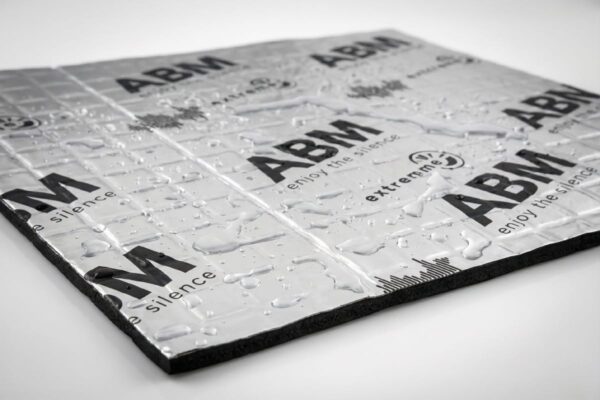
The aluminum foil layer on the surface of the mat serves several functions simultaneously. First, it stiffens the structure of the mat and increases its ability to dampen vibrations. Second, it reflects heat, which allows the mat to also act as a thermal insulator.
The thickness of the aluminum matters. The standard for a good mat is a foil thickness of 0.1 mm (100 micrometers). Thinner foil can lose its integrity over time and be subject to mechanical damage. Thicker foil, on the other hand, improves the surface stiffness of the mat, which is particularly beneficial for the floor and roof.
Aluminum foil also facilitates installation. The surface is smooth, easy to cut with a knife or scissors, and at the same time resistant to scratches when pressed with a roller. A mat with aluminum foil is easy to handle even for someone who is soundproofing a car for the first time.
Butyl mats for cars, what to pay attention to immediately
When buying a mat, many things can be evaluated immediately upon receiving the product. A few quick tests allow you to verify the quality of the material even before installation. This saves time and helps avoid problems in the future.
Features that are easy to check before installation:
- Flexibility of the mat when bent without heating
- Smell of the material (butyl has a delicate, rubbery aroma; asphalt emits a sharp, tarry smell)
- Uniformity of the aluminum coating without discoloration or defects
- Adhesive strength of the self-adhesive layer after removing the protective film
- Consistency of thickness across the entire surface of the sheet
A quick assessment of the material before starting work helps avoid disappointment. A mat of questionable quality will reveal its weaknesses only after a few months of use, when peeling or cracking forces a costly disassembly of the upholstery.
Does the mat hold well to the metal sheet during temperature changes
The adhesion of the mat to the metal sheet is a key performance parameter. A good adhesive layer of a butyl mat should maintain contact with the metal in both summer heat and winter frost. The operating temperature range of a good butyl mat reaches from minus 50 to plus 170 degrees Celsius.
A weak adhesive layer will peel off at the first sign of extreme temperatures. The mat will begin to shift, and air trapped underneath it will create vibrations and a characteristic tapping sound. When choosing, it is worth looking for products with information about the operating temperature range on the technical data sheet or packaging.
How to evaluate the flexibility of a mat on stampings and curves
Modern car bodies have many rounded shapes, stampings, and hard-to-reach areas. The flexibility of a butyl mat determines whether the material will precisely conform to every curve without wrinkling, bubbling, or peeling at the edges.
A mat with poor flexibility will only bend to a certain point before springing back. On sharply curved door stampings, such a mat will never adhere perfectly. Good butyl behaves like soft modeling clay, permanently taking on the shape of the surface.
Does a butyl mat dampen sheet metal vibrations and road noise
Dampening sheet metal vibrations is the primary function of a butyl mat. Bare body sheet metal acts like a membrane, amplifying and transmitting outside sounds directly into the cabin. A butyl mat adhered to the metal changes its resonant properties, making it significantly more deadened.
The vibration dampening effect can be verified with a simple test. Just tap on the bare door metal, and then on an area with the mat applied. The difference is immediately clear; the sound changes from a metallic ring to a dull, short thud. A good butyl mat eliminates this resonance almost completely.
Which butyl mat parameters are best to compare before purchasing
Online stores offer mats with similar-sounding descriptions but very different properties. Comparing a few key technical parameters allows you to quickly spot the differences and make an informed decision. It is worth focusing on the numbers rather than just marketing descriptions.
How to compare the thickness, weight, and coverage area of mats
When comparing mats, the simplest way is to look at three data points: thickness, weight per square meter, and total area in the set. The table below shows typical values for common thicknesses of butyl mats used in the automotive industry.
| Mat thickness | Weight [kg/m²] | Recommended installation location |
|---|---|---|
| 1.5 mm | 2.1 | Hood, trunk lid, roof |
| 2.0 mm | 3.0–3.4 | Doors, side panels |
| 2.5 mm | 3.4–3.9 | Floor, trunk, wheel arches |
| 3.0 mm | 4.8 | Cabin floor, engine bulkhead |
The weight of the mat is important information when planning to soundproof an entire vehicle. When soundproofing a floor with an area of 3.5 m² using a 3 mm mat, more than 16 kg is added to the vehicle. It is worth considering this value when calculating the total weight increase.
Does aluminum foil affect the stiffness and installation of the mat
Aluminum foil clearly affects how the mat behaves during installation. A mat with foil is stiffer on the surface, making it easier to cut into even pieces and fit to the shape of the panel. At the same time, the aluminum layer protects the butyl layer from mechanical damage during pressing.
When installing on highly curved surfaces, the foil may wrinkle slightly in places, but this does not affect the acoustic properties. Minor wrinkles in the aluminum on curves are a normal phenomenon and do not indicate poor product quality.
Stages of proper butyl mat installation:
- Cleaning the metal of dirt, rust, and grease
- Drying the surface and degreasing with isopropyl alcohol
- Cutting the mat into the appropriate shapes
- Peeling off the protective film and applying the mat to the metal
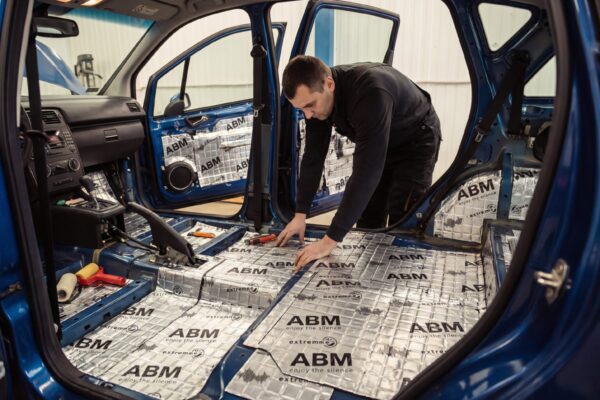
- Pressing thoroughly with a hard roller, starting from the center toward the edges
A properly applied mat should not have any air bubbles or protruding edges. Special attention should be paid to the edges of the sheets, as this is where peeling most often begins with inferior products.
How to check resistance to moisture, temperature, and aging
The interior of car doors is one of the more demanding environments. Water penetrates through the seals, the temperature fluctuates from freezing to summer heat, and the material must retain its properties for years. The resistance of a butyl mat to moisture is therefore a necessary condition, not an optional one.
A good butyl mat does not absorb water or moisture. Butyl is naturally hydrophobic, which means it does not swell or lose adhesion after contact with water. Mats with asphalt in their composition, on the other hand, can soften under the influence of moisture and lose the integrity of the adhesive layer.
Aging resistance is a parameter that is harder to assess without long-term tests. A clue can be the operating temperature range declared by the manufacturer. Mats that operate stably from minus 50 to plus 170 degrees Celsius have wide safety margins and are less susceptible to degradation over years of operation.
When a mat’s technical data sheet says more than user reviews
Buyer reviews are useful, but they have a significant limitation: most users evaluate a mat after a few months of use, not after years. The product’s technical data sheet contains hard data, such as temperature range, weight per square meter, aluminum thickness, and damping coefficient.
When choosing a mat, it is worth looking for products for which the manufacturer provides full technical data. The lack of a technical data sheet or vague descriptions without specific numbers should raise caution. A reliable manufacturer provides all parameters clearly and legibly.
Tip: Before purchasing, it is worth checking whether the manufacturer provides the mass law factor (MLF). The higher its value, the more effective the mat’s acoustic insulation. Values above 0.20 are considered a good achievement in the class of butyl mats for automotive use.
Car soundproofing materials from the ABM Insulation store
Effective vehicle soundproofing begins with the selection of proven materials. ABM Insulation is a manufacturer operating since 2010, specializing in acoustic insulation for vehicles, machinery, and buildings. The company supplies materials to markets throughout the European Union, and orders are shipped within 24 hours of purchase.
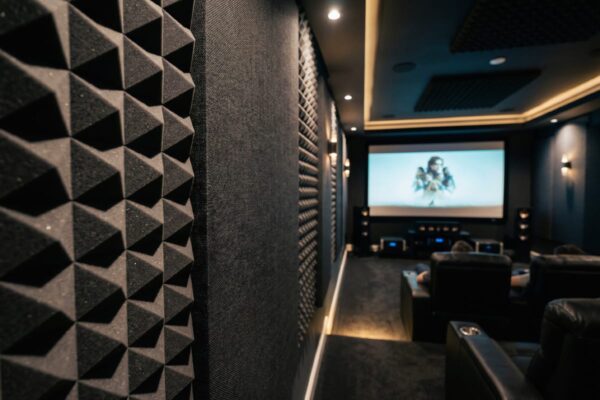
The assortment includes several product groups, each of which fulfills a different acoustic function. Butyl mat dampens sheet metal vibrations, rubber foam provides thermal insulation and absorbs structural sounds, while acoustic foams reduce airborne noise inside the cabin. Combining these materials provides a complete soundproofing effect.
Butyl mats for car soundproofing
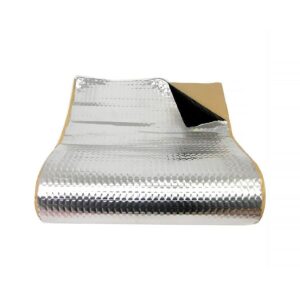
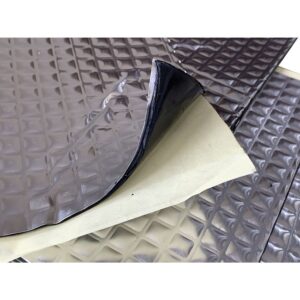
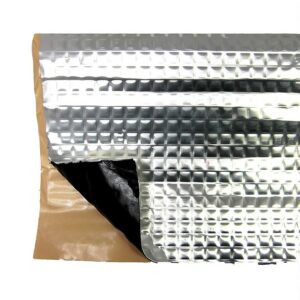
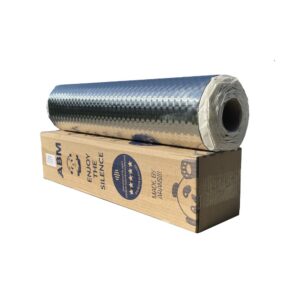
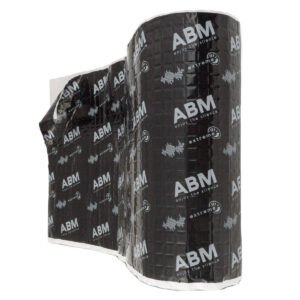
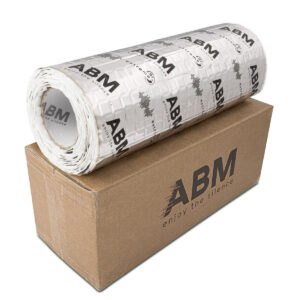
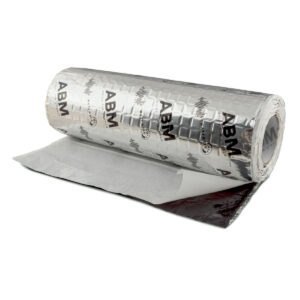
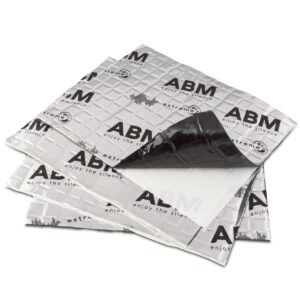
The foundation of any soundproofing is a butyl mat. In the ABM Insulation store, two product series are available, differentiated by their parameters and applications:
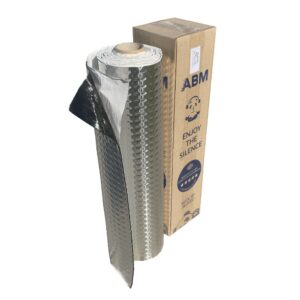
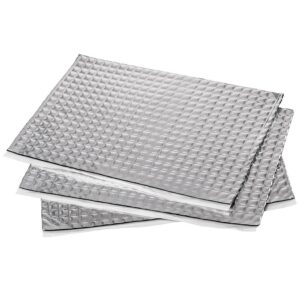
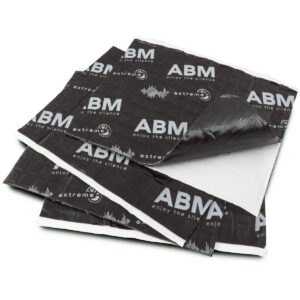
- ABM Professional butyl mats in sheets and rolls, available in thicknesses from 1.3 to 4 mm, intended for doors, floors, roofs, and trunks
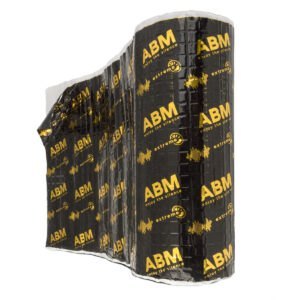
- ABM Xtreme butyl mats with enhanced damping parameters, intended for areas particularly exposed to vibrations and noise
Both series are free from asphalt and toxic components. An aluminum layer with a thickness of 0.1 mm ensures surface stability and reflects heat. The manufacturer provides a 5-year warranty on its products, which confirms their high durability. Mats from the ABM Professional and ABM Xtreme series have soundproofed over 40,000 vehicles worldwide to date.



Acoustic and rubber foams as a supplement to soundproofing
A butyl mat alone does not absorb all types of noise. To reduce airborne sounds and higher frequencies, an additional layer of absorbent material is necessary. ABM Insulation provides two types of foam for this purpose:
- Insulating rubber foams with excellent damping properties, resistant to moisture and temperature changes
- Acoustic foams and panels that absorb noise inside the cabin, used on walls, the roof, and the trunk
Rubber foams are installed as a second layer directly onto the butyl mat. This combination effectively reduces both road rumble and airborne sounds. ABM Insulation materials perform stably in temperature ranges from minus 50 to plus 170 degrees Celsius, which guarantees their reliability all year round.
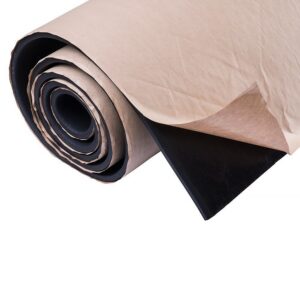
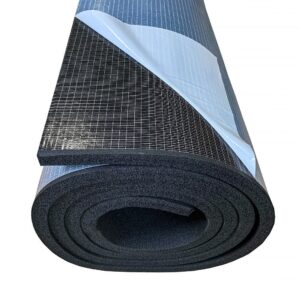
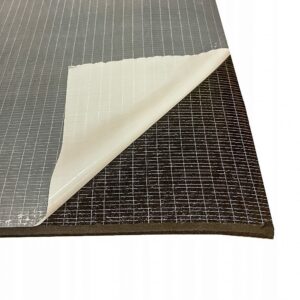
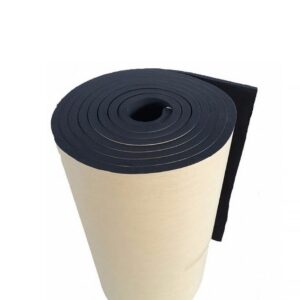
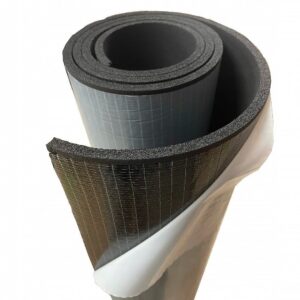
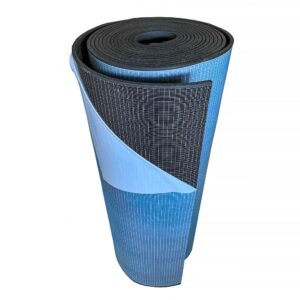
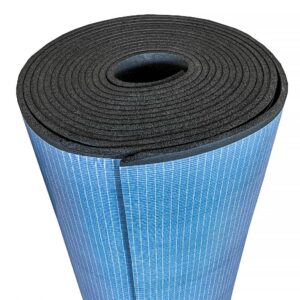
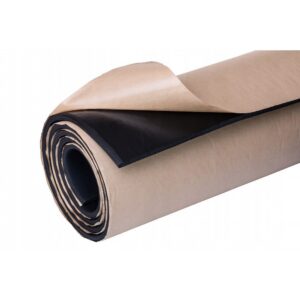
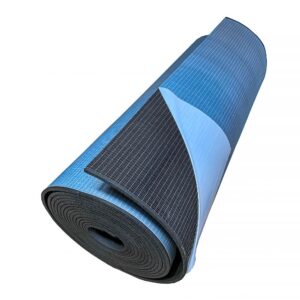
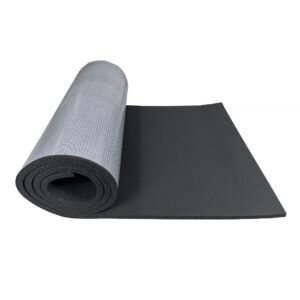
Rubber Foam. ABM Acoustic Insulation Self-adhesive, 25mm, 1m2
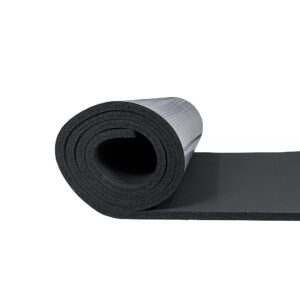
ABM Rubber Foam. Acoustic Insulation Self-adhesive, 32mm, 0.5m2
Rubber Foam. Acoustic Insulation Self-adhesive ABM, 32mm, 1m2
ABM Insulation customers regularly rate the products, service, and speed of order fulfillment. ABM Insulation customer reviews confirm the high quality of materials and efficient shipping within the European Union. For questions regarding the selection of materials or the quantity needed for a specific project, the ABM Insulation team is available via the contact form, providing technical advice.
Where to install butyl mats for effective car soundproofing
The placement of mats in a vehicle is just as important as their quality. Even the best mat installed in the wrong place will not produce the expected results. Car soundproofing is a well-thought-out process that covers several key areas of the bodywork.
Why doors require a different mat than the trunk and wheel arches
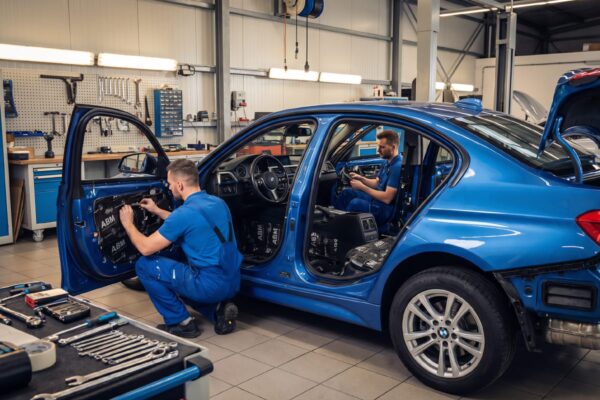
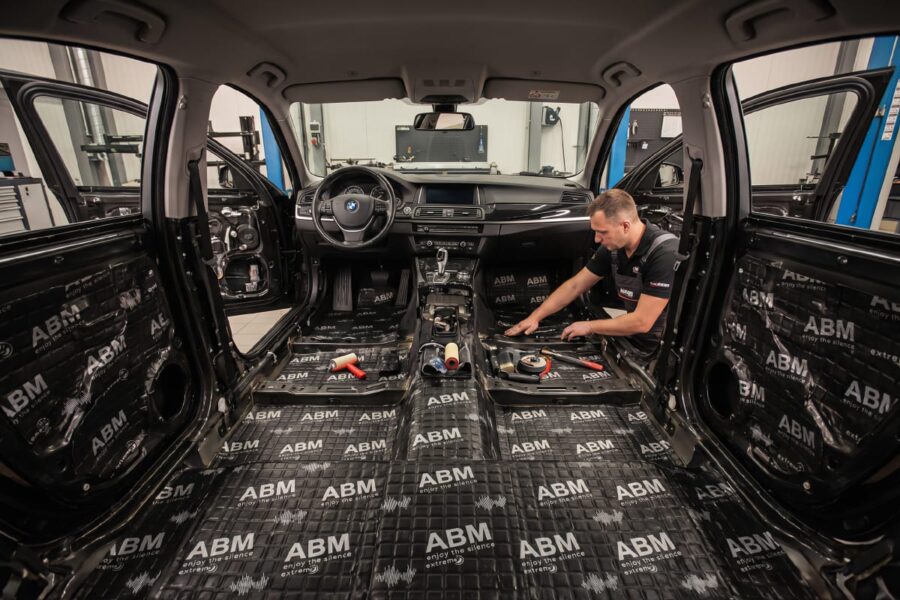
Car doors are built from two layers of sheet metal and have a cavity inside filled with window mechanisms and wiring. The mat installed on the inner door panel should be thin and very flexible because the surface is heavily embossed. A mat with a thickness of 1.5 to 2 mm with a strong adhesive layer works best here.
Wheel arches are a completely different challenge. Stone impacts, mud, and constant contact with water require a mechanically resistant and waterproof material. For wheel arches, thicker mats of 2.5 mm and up are used, often in combination with an additional layer of rubber foam, which absorbs impact noise.
The trunk mainly generates structural noise transmitted from the suspension. Here, mats with higher density and a thickness of 2.5 to 3 mm work well. The tightness of the coverage is also important, because uncovered fragments of sheet metal become acoustic bridges and reduce the effectiveness of the entire installation.
How to choose butyl mats for the floor, roof, and bulkhead
The floor is the area most responsible for road noise. The recommended mat thickness for the floor is 2.5 to 3 mm, and the total coverage area usually exceeds 3 m². For the best results, the butyl mat is supplemented with a layer of rubber foam, which absorbs higher-frequency sounds.
The roof is a large, flat surface that easily resonates when driving on the highway. A mat with a thickness of 2 to 2.5 mm clearly reduces this effect. When installing on the roof, it is crucial to cover at least 70 percent of the surface, because uncovered areas lose the entire damping effect.
The firewall, which is the wall separating the engine compartment from the cabin, is one of the most critical areas. The temperature here is higher than in other parts of the car, so the mat must be heat-resistant. Mats from the ABM Insulation series operate stably up to 170 degrees Celsius, which fully meets the requirements of this location.
Surfaces requiring coverage with a butyl mat:
- Inner sheet metal of the front and rear doors
- Cabin floor including the center tunnel
- Firewall from the cabin side
- Roof above the driver and passenger cabin
- Trunk sheet metal and spare wheel area
- Wheel arches from the inside
Thorough coverage of these areas provides real and noticeable soundproofing effects. Skipping even one zone clearly lowers acoustic comfort, because noise will still penetrate through the uncovered area.
Is one mat enough for the entire car and every noise
A butyl mat is an effective material for damping sheet metal vibrations, but it does not handle every type of noise. Airborne sounds, i.e., those transmitted through the air, require an additional layer of acoustic foam. Butyl alone does not absorb high frequencies as effectively as porous materials.
Professional car soundproofing always combines at least two layers of material. The first layer is a butyl mat glued directly to the sheet metal, damping structural vibrations. The second layer is acoustic or rubber foam, absorbing airborne noise and acting as a thermal barrier.
Tip: On the floor and in the wheel arches, it is worth using thicker butyl mats and supplementing them with rubber foam with a thickness of 6 to 10 mm. This combination of materials simultaneously reduces road noise, sheet metal vibrations, and the penetration of cold air in winter. This is a proven method used by experienced installers.
FAQ: Frequently Asked Questions
How many square meters of butyl mat are needed to soundproof an entire car?
The amount of material depends on the vehicle segment and the scope of work. To soundproof one pair of front doors, you usually need 2 m² of butyl mat. The front wheel arches require a similar amount, while the cabin floor requires 3 to 4 m². The trunk consumes the most material, sometimes even 4 m².
For comprehensive soundproofing of an entire car, the total demand for butyl mat ranges from 10 to even 18 m², depending on the vehicle class. For smaller city cars, the lower range is sufficient, while for delivery vans and minivans, a significantly larger amount of material is necessary. Before purchasing, it is worth measuring the surfaces or using a mat calculator available on specialized websites.
Is a butyl mat enough for effective car soundproofing, or are additional materials needed?
A butyl mat effectively dampens sheet metal vibrations and reduces low-frequency noise, such as rumbling and humming. However, on its own, it only provides part of the acoustic effect. Airborne noise, road noise, and higher-pitched sounds require an additional layer of sound-absorbing material.
The standard for professional soundproofing is a combination of a butyl mat and rubber foam. The butyl mat is applied directly to the metal, and the rubber foam is installed as a second layer. This combination of materials can reduce noise by as much as 12 to 15 decibels, whereas a butyl mat alone provides a reduction of about 7 to 9 decibels. Combining both materials protects against the full spectrum of sounds.
At what temperature should a butyl mat be installed to ensure it adheres well?
A butyl mat is flexible even at sub-zero temperatures, but the optimal installation temperature is around 20 degrees Celsius. Before starting work, it is worth keeping the mat in a warm place for at least 12 hours. A cold mat loses some of its flexibility and does not conform as well to the contours of the sheet metal.
The metal surface must be thoroughly cleaned and degreased before installation. Dust, grease, or traces of rust significantly weaken the adhesion of the adhesive layer. After application, the mat must be pressed down very carefully with a hard metal roller, starting from the center of the sheet and moving toward the edges. Only full pressure guarantees a durable bond with the metal.
How do you properly apply a butyl mat to highly curved surfaces, such as wheel arches or door contours?
Highly curved surfaces require a mat with good flexibility. The mat sheet should be cut into smaller pieces before installation. Small fragments are much easier to fit to curves and contours than large sheets. When applying, it is best to start from the center of the surface and gradually move toward the edges.
On very tight curves and in hard-to-reach places, cutting the mat into narrow strips is effective. Several strips laid with a slight overlap provide the same acoustic effect as one large sheet. It is important that every fragment is carefully pressed down with a roller. Slight wrinkling of the aluminum layer on curves is a normal phenomenon and does not affect the damping properties of the mat.
Summary
When buying butyl mats for car soundproofing, it is worth focusing on a few key parameters. Thickness, density, material composition, and the quality of the adhesive layer determine whether the installation will bring real results. A pure butyl mat, free of asphalt, with aluminum foil and good adhesion to metal, is the foundation of effective soundproofing. The product’s technical data sheet provides objective information that allows for an informed comparison of market offers.
Equally important is the thoughtful placement of materials throughout the vehicle body. Different areas of the vehicle require different thicknesses and types of mats, and the butyl mat itself works best in combination with acoustic foam. A comprehensive approach to soundproofing, based on proven products and precise installation, brings results that are noticeable during every trip.
Sources:
- https://en.wikipedia.org/wiki/Butyl_rubber
- https://www.sciencedirect.com/science/article/pii/S2352146523000881
- https://automotive.sika.com/dam/dms/global-industry/r/damping-of-structure-bornenoiseinautomobiles.pdf
- https://patents.google.com/patent/WO2014162244A1/en
- https://scholarhub.ui.ac.id/cgi/viewcontent.cgi?article=1691&context=mjt
- https://www.birlacarbon.com/the-evolution-of-anti-vibration-systems-in-automotive-applications-part-1/