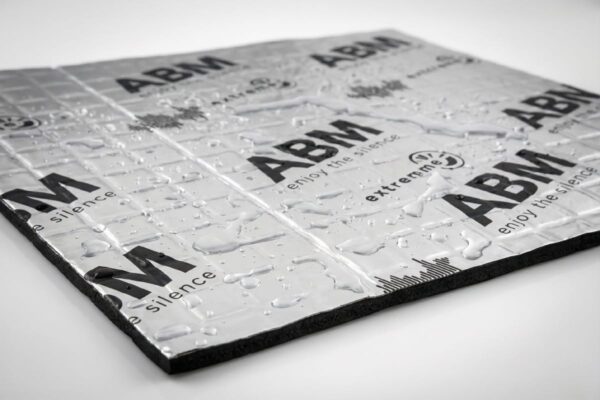
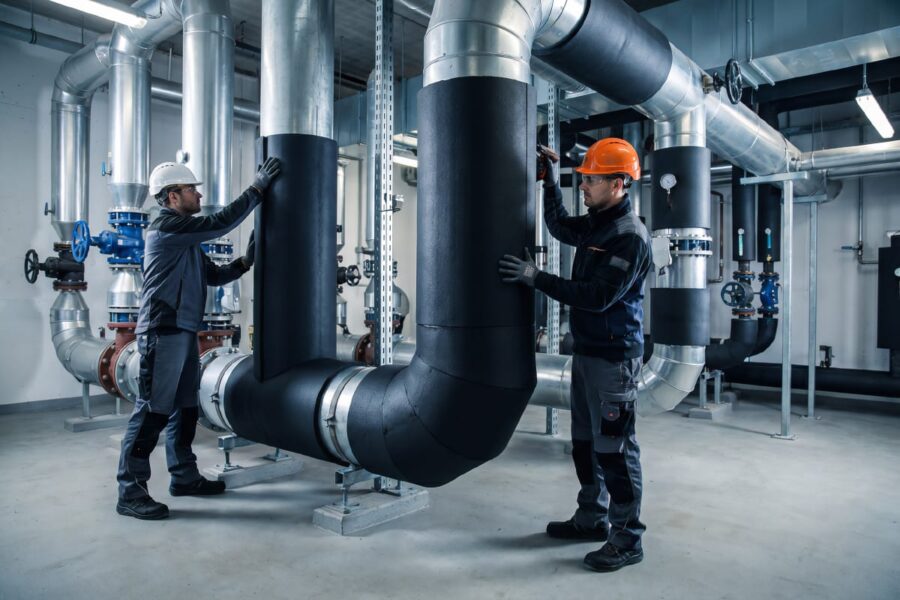
Rubber foams are among the most commonly used materials for acoustic insulation in the automotive, construction, and industrial sectors. They effectively reduce noise, but their performance is not uniform across the entire sound spectrum. They work best with high and medium-frequency sounds, while their effectiveness drops significantly with low-frequency tones.
Understanding why this happens allows for the selection of the right material for a specific acoustic problem. The physics of sound, the cellular structure of the rubber, and the thickness of the insulation layer are three key factors that together determine where rubber foam works best and where its capabilities are limited.
How the cellular structure of rubber foam absorbs sound energy
Rubber foam is not a homogeneous block of material. Inside, it consists of thousands of small air cells surrounded by flexible rubber walls. When an acoustic wave hits such a material, the sound energy must penetrate this network of cells, and each transition involves losses. The more the wave has to struggle with obstacles inside the foam, the more energy it loses along the way.
Closed-cell NBR and the dissipation of acoustic waves through air friction
Nitrile rubber (NBR) foam has a closed-cell structure. This means that each cell is tightly isolated from its neighbors. When an acoustic wave hits such a material, the air inside the cells cannot flow freely between them, forcing it to vibrate within the confined space.
It is precisely the friction of air against the cell walls that is one of the main mechanisms for absorbing sound energy. High-frequency waves have short vibration cycles, so they repeatedly stimulate the air in the cells to move within a given time, converting its kinetic energy into heat. At low frequencies, the vibration cycle is long, and the air in the cells does not have enough time to radiate sufficient heat, making the foam less effective at absorbing energy.
Properties of NBR rubber foam:
- closed-cell structure ensuring moisture resistance
- high density resulting in better sound absorption
- flexibility allowing for installation on irregular surfaces
- self-extinguishing properties increasing safety of use
- resistance to oils, chemicals, and temperature changes
However, the closed structure of NBR has its consequences. The material is less air-permeable than open-cell foams, which limits sound absorption in the medium-frequency range. On the other hand, for high tones, this same feature becomes an advantage, as the foam effectively reflects and absorbs wave energy without letting it pass through.
Why high foam density translates into better damping of high tones
Material density directly affects its sound absorption coefficient. The higher the density, the more mass each sound wave must set in motion. High-energy, short-wavelength waves, i.e., high frequencies, are capable of inducing vibrations in a thin and dense layer of foam. In contrast, bass waves have a frequency that is too low to interact effectively with a dense structure at typical insulation thicknesses.
Rubber insulation foams from ABM Insulation are characterized by high density, which makes them particularly effective in the medium and high-frequency range. Denser foam creates a stronger mechanical barrier for short-cycle vibrations. For low tones, this barrier is insufficient because the sound wave has too much energy and too long a wavelength to be effectively stopped by a several-millimeter layer of material.
The role of rubber viscoelasticity in converting vibrations into heat
Rubber is a viscoelastic material, which means it combines the properties of a liquid and a solid. When mechanical vibrations deform the structure of the rubber foam, the material does not immediately return to its original shape. Instead, it absorbs part of the deformation energy and converts it into heat. This mechanism is called internal damping or energy dissipation.
The phenomenon of viscoelasticity works most efficiently at higher vibration frequencies. With high-pitched sounds, the rubber foam is deformed multiple times in a short period, which generates a significant amount of heat and effectively reduces the amplitude of the vibrations. With low bass, the deformations are slower, and heat does not have time to be released in an amount sufficient for a significant reduction of acoustic energy.
The viscoelasticity of NBR rubber also depends on the ambient temperature. At lower temperatures, the material hardens, which changes its damping properties. Therefore, acoustic insulation with rubber foam should take into account the conditions in which it will operate, especially in automotive and industrial applications exposed to variable temperatures.
Why the acoustic wavelength determines the effectiveness of soundproofing
Every sound has a specific wavelength that depends on its frequency. The speed of sound in air is approximately 343 m/s, and the wavelength is calculated as the quotient of speed and frequency. The result shows how much space one vibration cycle of a given sound occupies.
It is precisely this relationship that makes thin rubber foam excellent at handling high tones while failing at bass. Effective acoustic absorption requires the material thickness to be at least one-quarter of the wavelength of the absorbed sound. This is the so-called quarter-wave rule, the basis for designing acoustic insulation.
Short high-frequency waves and the thickness of the rubber foam layer
A sound with a frequency of 4000 Hz has a wavelength of only about 8.6 cm. A quarter of this length is less than 2.2 cm. This means that even a several-millimeter rubber foam is capable of effectively absorbing the energy of such high tones, although it works optimally at thicknesses above 6 mm. In practice, rubber foams with a thickness of 3 to 6 mm effectively dampen sounds above 2000 Hz.
At a frequency of 1000 Hz, the wavelength is 34.3 cm, and the quarter-wave thickness of the absorber should be over 8.5 cm. This shows how quickly the required material thickness increases as the frequency decreases. Rubber foam with a thickness of less than 10 cm is unable to work effectively at such and lower tones.
Low bass frequency requires material thickness greater than 10 cm
Bass sound with a frequency of 100 Hz has a wavelength of 3.43 m. A quarter of this value is over 85 cm of absorbing material. No standard rubber foam reaches such thickness, which makes low-frequency damping using rubber alone practically impossible.
Even 19 mm thick foams, available in the ABM Insulation range, are too thin to effectively deal with bass below 200 Hz on their own. At such tones, completely different physical mechanisms, such as material mass and acoustic impedance, are of fundamental importance.
Therefore, in practical automotive and construction applications, rubber foams are used where the problem is high-frequency noise, such as engine noise, tire squeal, or ventilation noise. For bass, it is necessary to reach for heavier and thicker materials with a different mechanism of action.
Acoustic impedance of foam and mismatch to long-wavelength waves
Acoustic impedance is the resistance that a material offers to the propagation of sound waves. When a wave passes from air into rubber foam, it encounters a sudden change in impedance. Part of the wave energy is reflected back, and only the remainder penetrates the material and can be absorbed.
At high frequencies, this change in impedance is sufficient to trap a significant portion of the energy in the material. However, with very long bass waves, the impedance difference between air and foam is too small relative to the wave energy. The bass wave simply bypasses or passes through the thin layer of foam with little energy loss.
Resonant frequency of rubber foam and the range of effective insulation
Every elastic material has its own resonant frequency, which is the point at which it vibrates with the greatest amplitude. For rubber foam, this frequency depends on its density, thickness, and modulus of elasticity. At resonance, the material, instead of absorbing sound, becomes a source of vibration itself, which worsens insulation.
The resonance of rubber foam typically falls in the range of several dozen to several hundred Hz, which overlaps with the bass and lower mid-range. Above the resonant frequency, the foam works efficiently as an absorber. Below it, its effectiveness drops sharply, and at the resonance point itself, it can even amplify unwanted vibrations. Choosing the appropriate thickness and density of the foam allows this point to be shifted outside the range of frequencies critical for a given application.
How the thickness and hardness of rubber foam change the soundproofing range
The thickness and hardness of rubber foam are two parameters that directly control its acoustic behavior. Thinner foam works only at high tones, while thicker foam can reach slightly lower in the frequency band. Hardness, in turn, affects the energy dissipation mechanism and the resonant frequency of the material.
3–6 mm foams are effective at high airborne frequencies
Thin rubber foams with a thickness of 3 to 6 mm have found their permanent place in the soundproofing of cars, ventilation ducts, and device housings. In this thickness range, the foam effectively absorbs sounds with frequencies above 2000 Hz, such as aerodynamic noise, squeaks, and electrical tones. ABM Insulation provides rubber foams in these exact thicknesses for applications requiring surface noise suppression.
Applications for 3–6 mm foams:
- soundproofing of vehicle doors and roofs
- insulation of electronic device and appliance housings
- suppression of fan and pump noise
- sealing and thermal insulation of air ducts
Foams of such small thickness, however, have limitations. Below 500–800 Hz, their effectiveness drops significantly. Installing several layers of thin foam on top of each other is not equivalent to using one thicker layer, because each layer interface introduces additional reflection surfaces that can change the absorption characteristics.
10–19 mm foams and their limited effectiveness against bass vibrations
Thicker rubber foams, available in 10, 13, and 19 mm variants, more effectively absorb sounds in the 500 to 2000 Hz range. They can capture some of the energy of lower mid-tones, but at frequencies below 200 Hz, even a 19 mm layer is too thin to handle bass waves on its own.
Rubber foam with aluminum foil in thicknesses of 10 to 19 mm, as supplied by ABM Insulation, combines the absorbing properties of foam with the reflective properties of foil. This layer arrangement improves thermal insulation and partially increases effectiveness at lower mid-frequencies, but it does not solve the problem of low bass.
Vibration damping coefficient vs. Shore hardness of NBR rubber foam
The hardness of rubber foam is measured on the Shore A scale. The higher the Shore A value, the harder and less flexible the material. Hardness has a direct impact on the vibration damping coefficient, which is the material’s ability to absorb mechanical energy during deformation.
Soft foams with a low Shore A value better dampen mechanical vibrations at lower frequencies but provide poorer insulation against airborne sounds. Hard foams work the opposite way: better insulation against airborne noise, but worse absorption of mechanical vibrations. The optimal hardness of rubber foam for automotive applications is usually between 20 and 40 Shore A, which provides a compromise between vibration absorption and airborne noise insulation.
Tip: When choosing rubber foam for a specific application, it is worth checking both the thickness and the Shore A hardness. For airborne noise suppression, a thin, hard foam is sufficient, while for mechanical vibration reduction, a softer, thicker foam works better.
Where to buy materials for effective soundproofing of high and low frequencies
Effective acoustic insulation starts with the selection of proven materials. ABM Insulation is a manufacturer and supplier of soundproofing materials with many years of experience in the market, operating since 2010. The company specializes in acoustic insulation for vehicles, machinery, and buildings, and its products reach customers throughout the European Union with delivery within 24 hours of purchase.
The assortment includes materials for both high-frequency damping and the reduction of structural vibrations and low frequencies. A wide range of available thicknesses and product types allows for selecting the right solution for every application.
Butyl mats and rubber foams for comprehensive soundproofing
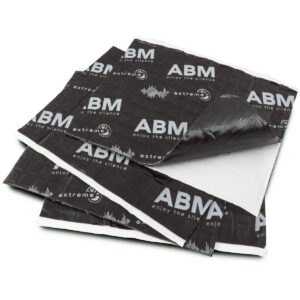
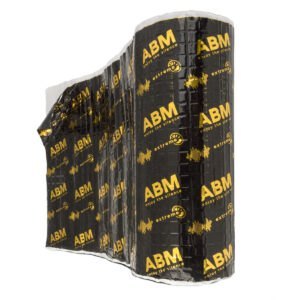
The basis for effective soundproofing across a wide frequency range is a set of two complementary materials. A heavy butyl mat dampens structural vibrations and low tones, while rubber foam absorbs higher airborne noise. ABM Insulation provides both products in various thickness and surface variants.
Types of butyl mats:
- ABM Professional butyl mats for effective damping of sheet metal resonance and chassis vibrations
- ABM Xtreme butyl mats for extreme acoustic conditions, providing the highest level of low-frequency vibration reduction
Both series of butyl mats are characterized by high surface mass, which directly translates into the effectiveness of absorbing low-frequency wave energy. They are installed directly onto sheet metal or other vibrating surfaces before applying the foam layer.
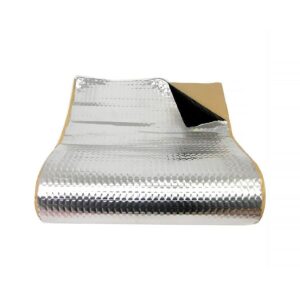
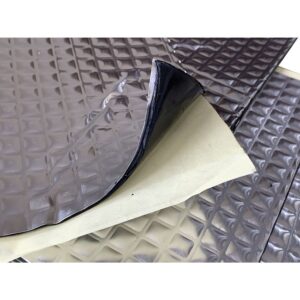
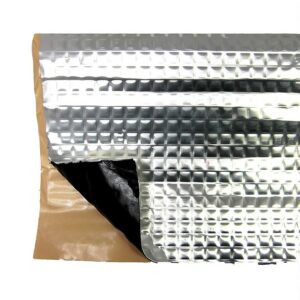
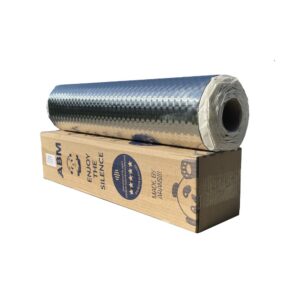
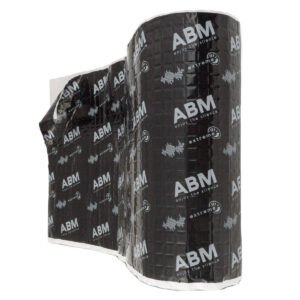
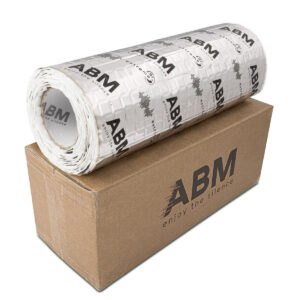

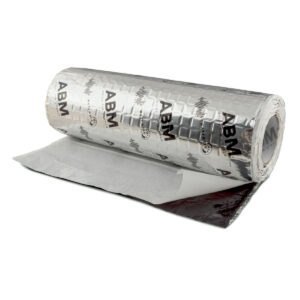
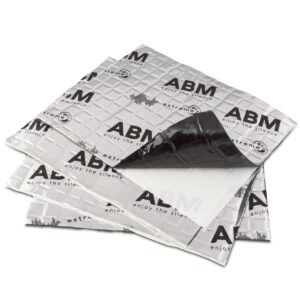


Rubber and acoustic foams in various variants
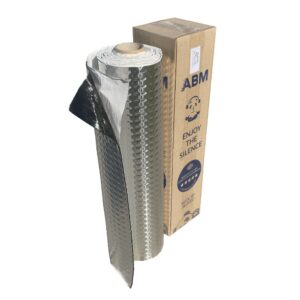
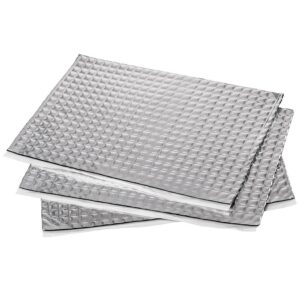
ABM Insulation provides foams in two complementary product groups. Insulating rubber foams are available in thicknesses from 3 to 19 mm, in self-adhesive versions and with aluminum foil to improve thermal insulation. Absorbing acoustic foams and panels are used to reduce reverberation and improve the acoustics of rooms and equipment enclosures.
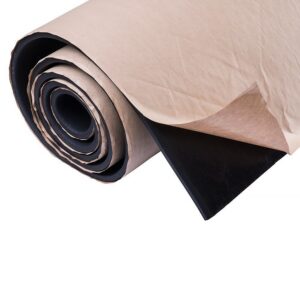
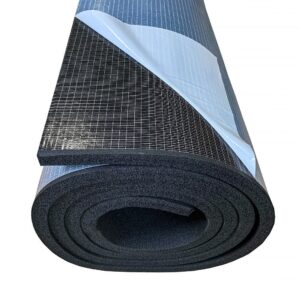
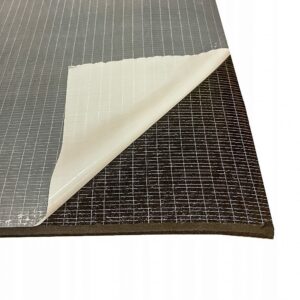
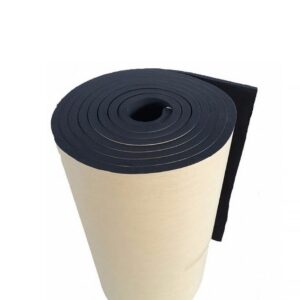
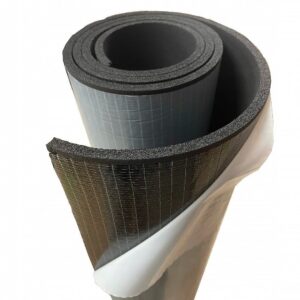
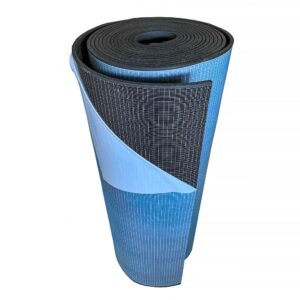
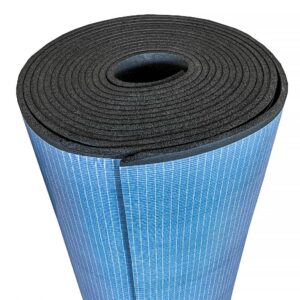
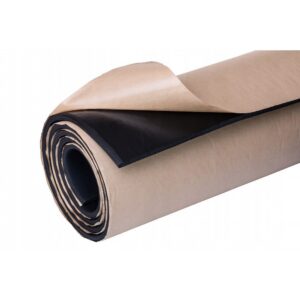
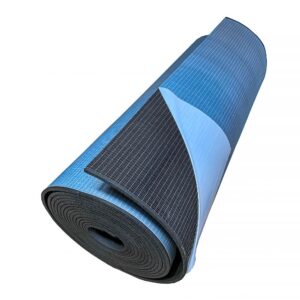
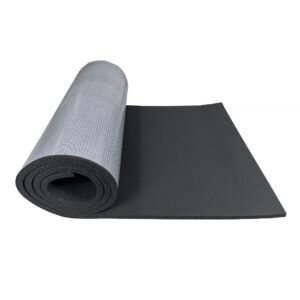
Rubber Foam. ABM Acoustic Insulation Self-adhesive, 25mm, 1m2
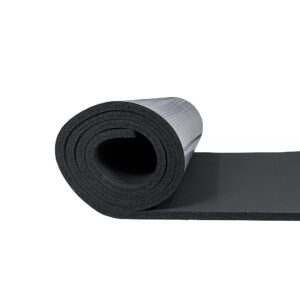
ABM Rubber Foam. Acoustic Insulation Self-adhesive, 32mm, 0.5m2
Rubber Foam. Acoustic Insulation Self-adhesive ABM, 32mm, 1m2
Deliveries are carried out express throughout the entire European Union. Customer reviews regarding the quality of products, service, and efficient shipping of ABM Insulation can be checked in the reviews on Google Maps. If you have questions regarding the selection of materials for a specific application, ABM Insulation specialists are available to help via the contact form.
Comparison of rubber foam effectiveness in different frequency bands
Not every sound is equally difficult to dampen. Rubber foams have their optimal operating range, beyond which they require the support of other insulation materials. Understanding this characteristic is the foundation of effective soundproofing design.
The 500–4000 Hz band as the optimal operating range for rubber foam
The range from 500 to 4000 Hz is the area where rubber foams demonstrate the highest effectiveness. This band includes engine noise, ventilation system noise, electrical tones from devices, as well as many sounds generated by tires while driving. It is precisely here that rubber foams absorb acoustic energy with the greatest efficiency.
| Frequency range | Wavelength | Rubber foam effectiveness | Required thickness |
|---|---|---|---|
| Below 200 Hz | above 1.7 m | very low | above 40 cm |
| 200–500 Hz | 0.7–1.7 m | low | 15–40 cm |
| 500–2000 Hz | 17–70 cm | medium to high | 6–19 mm |
| 2000–4000 Hz | 8.6–17 cm | high | 3–10 mm |
| Above 4000 Hz | below 8.6 cm | very high | 3 mm and more |
In this frequency range, rubber foam with a thickness of 6 to 19 mm is capable of reducing noise levels by several to over a dozen decibels. This is a difference that is heard very clearly. In a passenger car, such a reduction means a noticeable quieting of the cabin while driving on the highway or at higher engine speeds.
The range below 200 Hz and why rubber foam alone is not enough there
Below 200 Hz, the physics of acoustics works against thin absorbing materials. The wavelength at 100 Hz is over 3 meters, and at 50 Hz, it is over 6 meters. No reasonable thickness of rubber foam is able to absorb a wave of such dimensions, because it is itself many times thinner than a quarter of that wavelength.
In this range, only materials acting on the principle of mass and inertia are effective. A bass wave must encounter a heavy barrier that it is unable to set in motion. Rubber foam is too light and too flexible to fulfill this role. Therefore, for low tones, it is necessary to use heavy damping mats that act through inertia, not through absorption.
Butyl mat combined with rubber foam and broadband damping
Butyl mats and rubber foams complement each other in a way that is difficult to achieve with a single material. Butyl mat acts through mass and inertia, damping structural vibrations and lower tones. Rubber foam absorbs the energy of higher frequencies and reduces airborne noise. Combining both layers creates a broadband system, effective from low-mid to high frequencies.
Installation order for two-layer insulation:
- Cleaning and degreasing the surface before installation
- Sticking the butyl mat directly to the sheet metal or substrate
- Pressing the mat with a roller to remove air bubbles
- Installing the rubber foam as the top layer
- Checking the tightness of connections and edges
ABM Professional butyl mat and ABM Insulation rubber foams create a proven set for comprehensive soundproofing of vehicles and rooms. The butyl mat dampens sheet metal resonances and structural vibrations, while the rubber foam absorbs the rest of the airborne noise. The end result is a clearly quieter environment across all frequency bands that are perceptible to human hearing.
Tip: When installing the butyl plus rubber foam set, it is worth ensuring that the butyl mat covers at least 60 percent of the sheet metal surface. The rubber foam can be applied to the entire surface. Such a combination provides the best ratio of insulation effectiveness to material used.
FAQ: Frequently Asked Questions
Can rubber foam effectively silence bass and low tones in a car?
Rubber foam is not a material intended for damping low bass. Sounds below 200 Hz have a very long acoustic wave, reaching several meters. Effective wave absorption requires the material thickness to be at least one-quarter of its length, and no standard foam reaches such dimensions.
Rubber foam, on the other hand, works excellently with higher tones, from about 500 Hz and up. Engine noise, tire noise, and ventilation sounds are the range where rubber absorbs acoustic energy very effectively. To dampen bass, a heavy butyl mat is necessary, which works through mass and inertia, rather than absorption.
Why does thicker rubber foam dampen lower-pitched sounds better?
The quarter-wave principle governs the effectiveness of every acoustic absorber. The lower the sound frequency, the longer its wave, and the thicker the material needed to capture its energy. Foam with a thickness of 5 cm effectively absorbs sounds from about 970 Hz and up, while absorbing a 100 Hz tone requires material thicker than 48 cm.
Thicker rubber foam therefore lowers the threshold of effective operation, but it does not eliminate it entirely. Even a 19 mm layer will not handle bass below 200 Hz. For noise problems involving various frequencies, the best solution is to combine the foam with a butyl mat, which allows for covering a wide sound spectrum.
Such a set works in two stages. The butyl mat dampens structural vibrations and lower tones, while the rubber foam absorbs higher airborne noise. The end result is significantly better than when using only one material.
Which frequency range does rubber foam absorb most effectively?
The optimal operating range for rubber foam is between 500 and 4000 Hz. This band covers most annoying everyday sounds, such as engine noise, tire squeal, electrical tones from devices, or ventilation noise. In this range, the closed-cell structure of NBR foam allows for the repeated absorption and dissipation of acoustic energy in a short time.
Above 4000 Hz, rubber foam works just as efficiently because the wavelength is very short, and the material easily captures the energy of such tones. Below 500 Hz, effectiveness drops, and for bass below 200 Hz, the foam alone ceases to fulfill its role. This is precisely why several layers of materials with different properties are used for comprehensive soundproofing.
How does the closed-cell structure of NBR foam affect sound absorption?
NBR foam with a closed-cell structure absorbs acoustic energy through the friction of air against cell walls. When a sound wave hits the material, the air inside the sealed cells is forced to vibrate, and the resulting friction converts acoustic energy into heat. At high frequencies, this process occurs many times per second, which makes it very effective.
However, a closed cell has different characteristics than an open one. Materials with an open structure allow air to pass through more freely, which improves absorption at medium frequencies but performs worse at reflecting high tones. NBR foam with a closed cell works better where simultaneous resistance to moisture, oils, and mechanical damage is required, while maintaining good insulation against airborne noise.
Summary
Rubber foams dampen high frequencies more effectively because the physics of sound leaves no room for any other result. The short wavelength of high tones, the mechanism of air friction in closed NBR cells, and the viscoelasticity of rubber together create conditions in which a thin material absorbs a great deal of acoustic energy. With low bass, these same mechanisms cease to function because the waves are too long, too energetic, and cannot be stopped by a thin layer of flexible material.
Effective acoustic insulation requires an understanding of these limitations and the selection of materials for a specific frequency range. Combining a heavy butyl mat with rubber foam is a solution that covers a wide range of frequencies, from structural vibrations to high-pitched airborne noise. ABM Insulation provides both types of materials, whose properties complement each other, which translates into real and noticeable noise reduction in every application.
Sources:
- https://pmc.ncbi.nlm.nih.gov/articles/PMC7795880/
- https://pmc.ncbi.nlm.nih.gov/articles/PMC6403634/
- https://pmc.ncbi.nlm.nih.gov/articles/PMC9919418/
- https://pmc.ncbi.nlm.nih.gov/articles/PMC10181158/
- https://www.academia.edu/63392535/Correlation_between_the_acoustic_and_dynamic_mechanical_properties_of_natural_rubber_foam_Effect
- https://www.acousticfields.com/quarter-wavelength-rule/
- https://www.ijtra.com/special-issue-view/acoustic-absorption-and-physicomechanical-properties-of-sbrrr-foam.pdf
- https://etheses.whiterose.ac.uk/id/eprint/23694/1/Epoxidized%20Natural%20Rubber%20in%20Vibration%20and%20Noise%20Control%20Applications.pdf
- https://pdfs.semanticscholar.org/d83c/bfb0c26a871ac2cedc7ba1ef70eea7591f40.pdf